





☝🏻 Quick start: Toxic relationship - How to recognize it and what to do?
Humiliations! Misunderstandings! Passion!
Is your relationship toxic? Or is your partner toxic?
Is separation the only way out of a toxic relationship? Or can you still somehow make it work together ?
You certainly didn't stumble across this article by chance...
Here you will learn everything important about toxic relationships and the ways out of the crisis.
🚀 Already 65,511 people have gained clarity through the test.
What is a toxic relationship?
A toxic relationship causes lasting harm to one or both partners, as love is systematically "poisoned." This can lead to serious health problems.
Recognizing a toxic relationship - The signs
You probably fear that your partnership could be a 'toxic relationship' - a relationship that is not good for you at all.
Which of the following signs of toxicity apply to you?
(1) You feel extremely stressed
They are constantly on high alert, have great difficulty switching off (and may even no longer be able to eat, sleep and work properly) and find it almost impossible to replenish their energy reserves in between.
(2) Their self-esteem is at rock bottom
You feel like you're no longer 'yourself'. Your self-confidence has already suffered massive damage as a result of your relationship.
(3) They ignore their own needs
They hardly perceive their own needs anymore, but only focus on the needs of their partner.
(4) You neglect everything that was previously important to you
They drift further and further away from what 'defined' them (family, friends, hobbies...) because they lack the necessary energy, feel burned out, or their partner is possessive and jealous.
(5) Your social circle is worried about you
People close to you are alarmed to notice that you have changed drastically (e.g., seeming 'driven', 'looking unwell', no longer 'reachable'). Some may withdraw, feeling helpless.
(6) They feel incapable, manipulated, threatened, guilty
You have become trapped in a dangerous situation involving emotional and/or physical violence, pressure, control, dependency, insults, disrespect, blame, and other signs of an unhealthy entanglement from which you cannot escape.

"What's wrong with us?!" "How can we go on?" - The agonizing questions
You've probably asked yourself the same questions countless times – and still haven't found clear answers:
What's wrong here?
Is there something wrong with me (anymore)?
Is something wrong with my partner (anymore)?
Is there something wrong with our relationship (because the combination between us is so explosive)?
Can there be a shared future for us?
- Is it possible for a 'toxic relationship' to develop into a respectful partnership on equal terms (and if so, how) ?
- Ultimately, there is no way around ending the relationship with the partner in which unhealthy patterns have become entrenched, in order not to lose oneself completely (and if so: how)?
We want to help you gain more clarity about your relationship situation and take the right path for you so that you and your health are no longer harmed.

Is my relationship toxic? - Take the PaarBalance relationship test! (free)
The scientifically based test from PaarBalance (duration approx. 10 minutes) was developed by the renowned relationship expert Prof. Dr. Ludwig Schindler & colleagues.
Analyzing the quality of your relationships can help you find an answer to the question:
Does it make sense to continue fighting for this relationship - or should I use all my energy to free myself from it?
The test focuses on your very personal perception of relationships:
- How do you experience your partnership?
- How do you shape your relationship?
Immediately afterwards you will receive a detailed overview of the danger areas and strengths of your cooperation (free of charge).
Take your relationship test now! (free)
How is your relationship?
What are your strengths and weaknesses?
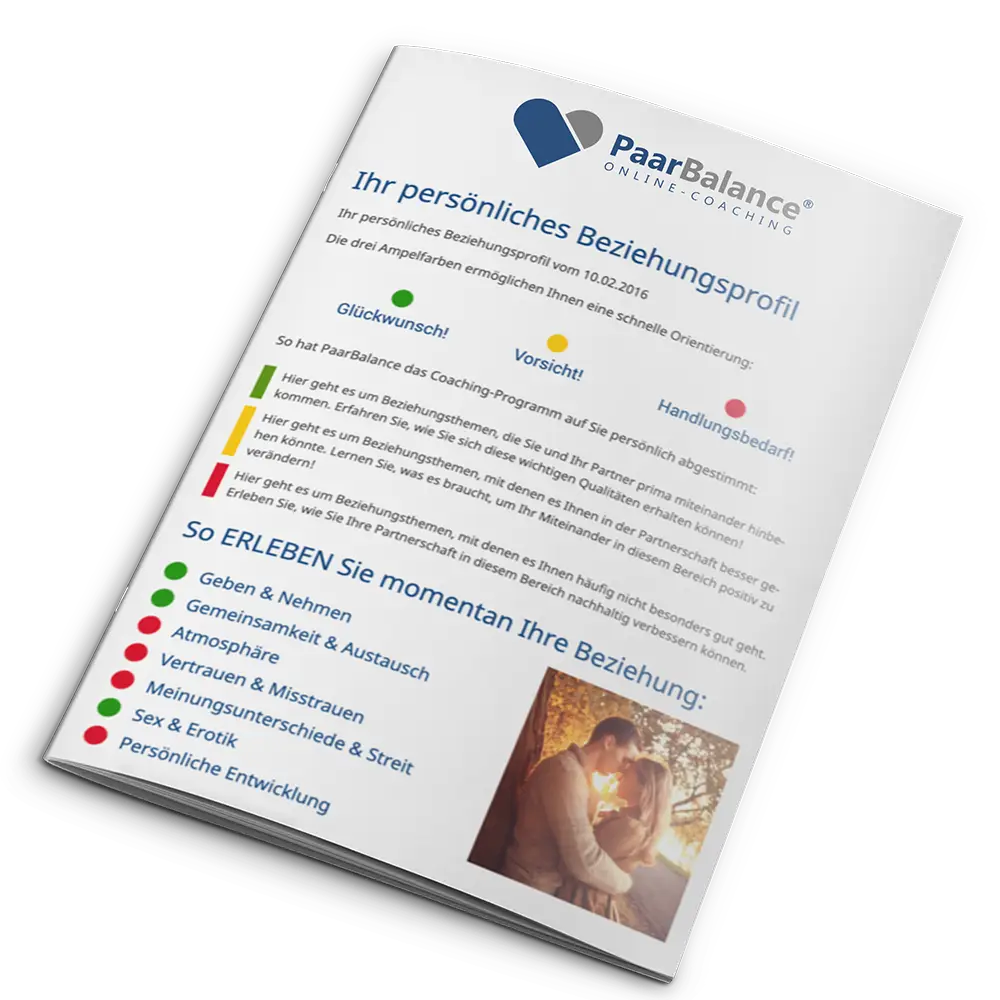
You will find out immediately afterwards in your personal PaarBalance relationship profile (free).
Start your relationship test now!
✓ Scientifically sound
✓ Includes detailed analysis
✓ Your data will not be shared
✓ 100% free & non-binding
100% secure. We comply with data protection regulations. Registration for the relationship test is free .
Please read this important information beforehand:
Data Protection ᐧ Terms and Conditions ᐧ General Information Agreement Terms and Conditions . Transparency Statement
Your relationship profile uses 3 traffic light colors to show you at a glance:
- Red : In this area, things are really heating up!
- Yellow : We have room for improvement in this area!
- Green : We're doing well in this area!
Look as honestly as possible:
- Is it truly within your own power (see test section: 'How do you shape your relationship?') to change problematic patterns - or have you already tried (more than) everything?
- In your opinion, are both sides willing and able to 'sweep in front of their own door' - in order to then tackle the 'hot topics' together ?
What exactly is 'toxic': the relationship or the partner ?
Every partnership with a toxic partner is also toxic - but not every toxic partnership has a toxic partner.
The term 'toxic relationship'
First of all: “Toxic relationship” is not a term commonly used in science and does not represent an 'official' diagnostic category.
Rather, it is a popular scientific term that has become increasingly widespread in the media - but also among psychotherapists.
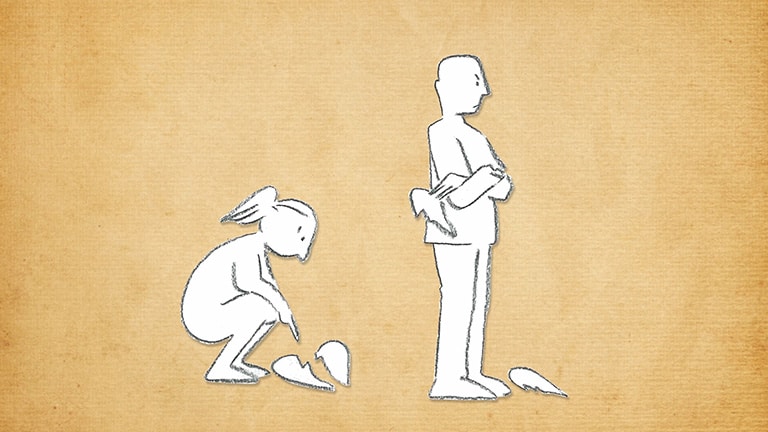
Toxic literally means: "poisonous", "caused by poison", "based on poisoning".
Applied to relationship dynamics, this means that the atmosphere in so-called toxic relationships is poisoned - and there are significantly more painful than relaxed and positive moments.
How can I tell if my relationship is toxic?
"It always takes two!" - Does that also apply to toxic relationships?
In principle, yes. The word 'relationship' makes it clear:
It is about the reciprocal relationship , i.e., the combination of people and the type of connection between them :
- Who treats whom, and in what way?
- Who is being treated by whom, and in what way ?
Depending on how the partners deal with each other and with personal boundaries (do I respect them? do I break them down? do I let them break down?), a caring or a destructive dynamic can develop.
There are numerous relationship constellations that are experienced as extremely stressful by those affected, even though each person would describe themselves as 'capable of relationships' and has already had fulfilling partnership experiences.
In a formerly loving partnership that has become toxic, two essentially 'good people' with good intentions have gotten caught in a negative cycle due to personal differences or severe stress.
"We are very different!"
The combination of the two partners can be 'the problem' - i.e., it is not due to one "toxic partner" or one "difficult partner".
'Opposites attract' may be true at the beginning of a relationship - but the couple then has to learn to deal with personal differences in a permanently benevolent way.
When both partners have very different characters and their interests and needs are far apart, a great deal of global acceptance and tolerance is needed (after the initial infatuation phase, when the rose-colored glasses have long since disappeared into the nightstand).
Unfortunately, this is often lacking, and the (always doomed to failure) attempt at the great 're-education program' begins: The other person should finally become more like oneself.

However, if both partners equally desire to stay with this particular partner and maintain a loving, respectful relationship in the long term, the challenge can be met with the right support – see our article on "couples therapy" .
Take action as soon as possible!
The following articles may help you:
📄 Saving your relationship: Here's how! The best tips from couples therapists
📄 The '5 Love Languages' - to better understand your partner and yourself and improve communication
"We are under an incredible amount of stress!"
Even if two people start their relationship with the very best intentions, love can suffer in the hamster wheel of everyday life ( see our blog article "No More Mental Load! How to Achieve a Fair Division of Labor in a Partnership" ).
Patience, respect, and empathy are increasingly lost, friction and arguments escalate. The relationship spirals downward and becomes increasingly strained – because the formerly loving couple makes life harder for each other instead of supporting one another.
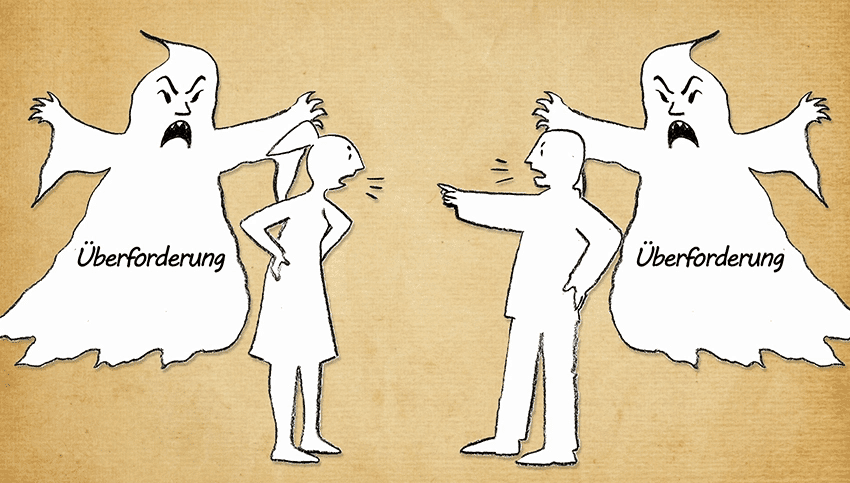
The more porcelain has already been broken, the more difficult it becomes to start over together.
And yet: Even a relationship that is in a very precarious state can be saved if both partners genuinely desire it (and are truly willing to make their respective contributions) to turn things around.
However, this usually requires effective external support ( e.g., in the form of couples therapy ) before it is too late!
Be careful with labels that won't come off!
In connection with unhappy relationships, one often hears terms like "an extremely toxic woman", "what a toxic guy", "a total toxic partner", "that poison-filled woman", etc.
It is understandable that people themselves are perceived as 'toxic', 'evil' or 'dangerous' when you, as their partner, are feeling desperate and stressed.
However, if you want to give your relationship another real chance, we strongly recommend distinguishing between the person and their behavior.
Almost never is a person completely toxic – even if many of their behavioral patterns, signs, or statements may (have become) so.
If both sides want to do everything they can to become happier together again, all problematic attitudes and behavioral patterns must be addressed – and no one should receive a permanent 'label' as a person.

How can I tell if my partner is toxic (characteristics & behavior)?
[Warning: Narcissism!]
Maintaining a consistently equal, respectful, and relaxed relationship is virtually impossible when one partner has a so-called ' narcissistic personality disorder ', also known as narcissism . This is precisely what is often the case in severely toxic relationships.
The term 'toxic relationship' is usually equated with 'relationship with a toxic (and by that usually means: narcissistic) partner ', i.e.
- There is a partner who acts (to a degree or strongly) egocentrically, dominantly, aggressively, and manipulatively, and
- a partner who feels increasingly dependent and insecure and allows themselves to be devalued, humiliated and controlled by the other.
All your alarm bells should be ringing ("Help! Narcissism!") if your partner:
- has constant mood swings
- sends double messages
- lies regularly
- She punished them with withdrawal of love
- She constantly misunderstands
- She controls
- It makes them feel like they can't do anything right.
- Destroying their self-esteem
- They were separated from trusted people.
- She makes others feel bad about herself
- speaking about his ex-partners in a ruthlessly derogatory manner
- She insults and belittles
- They threaten to harm themselves
- She intimidates
It is impossible for family and friends to miss the fact that the 'entangled' person is subjected to toxic manipulation and psychological abuse, and that the relationship is massively damaging him.
Despite the suffering, the affected person is unable to break free from the 'ill-making' partner.

In a relationship with a toxic partner, a bad person (or one who has become bad due to their own biography) tries to manipulate their partner in order to fulfill their own needs.
Narcissistic partners are unable to recognize their own weaknesses, accept criticism, feel empathy, and change destructive behavior patterns.
In this case, we believe it is justified to describe the partner as 'toxic'.
Then it's
every man for himself!

+++ When we refer to a 'toxic relationship' below, we mean a 'poisoned' relationship with a 'toxic partner' who is unable (or unwilling) to permanently change their own destructive behavior patterns. +++
Typical patterns in toxic relationships
Big emotions - big drama
A key characteristic of toxic relationships is that life is suddenly experienced as extremely intense, and feelings as exceptionally strong – even if they resemble a permanent roller coaster ride.
Something is constantly 'happening', everything revolves around weighty themes such as 'guilt', 'betrayal', 'passion', 'forgiveness', 'failure', 'power' and 'powerlessness'.
Overwhelming emotions hit you with full force:
intensity, excitement and feelings of love like never before - despair, anger and powerlessness like never before.
In a toxic relationship, there are usually only short periods of harmony and peace. Therefore, there is little time to catch one's breath, recharge, and take stock – even when thoughts like these increasingly arise:
- "What kind of sick relationship are you in?!"
- "You can't do anything right, you're constantly criticized and feel like you've failed and are guilty."
- "Is this really love - even though you often feel bad and are even afraid of your partner?"

Psychologist Christian Hemschemeier, an expert in the field of 'toxic relationships' for many years, summarizes the most important signs of a toxic relationship as follows:
- It hurts constantly.
- There is an obsessive focus on the relationship.
- The 'toxic partner' displays extreme anger when the other does not keep their 'part of the deal'.
- The self-esteem of the dependent partner is increasingly lost.
- The manipulative partner blames the other for everything.
- The feeling of insecurity is a constant companion.
- Those affected often have a 'bad feeling' from the beginning (which they often don't listen to, or only listen to much too late).
The start of a relationship: "Love Bombing"
Even though the longing for the object of desire and the mutual attraction are strong in all those newly in love, when it comes to the beginning of a 'healthy' relationship, partners generally take enough time to gradually get to know each other better. Most of the time, the new connection is not yet further 'defined' (in the sense of: "From now on we are a couple," "You are my boyfriend," "We belong together forever").
The situation is different in the first days and weeks of 'toxic' relationships:
The dominant partner bombards the other with compliments and declarations of love from the very first moment - and does everything to push the intensification of the relationship.
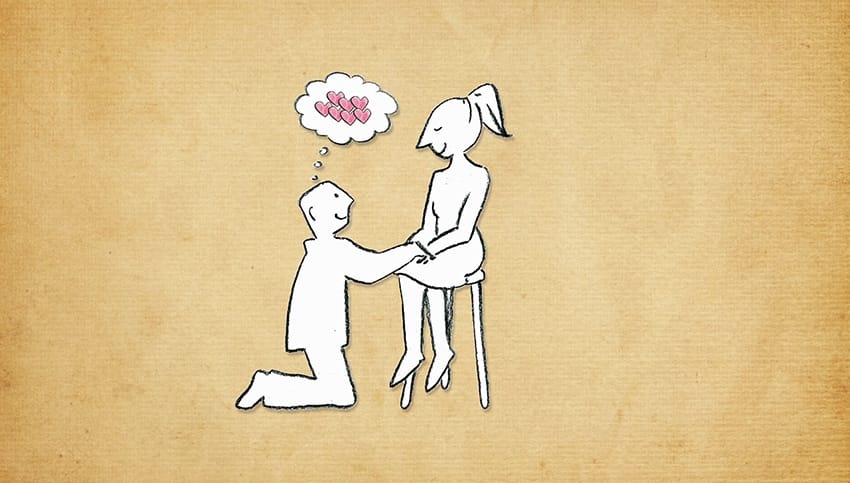
Why is that? The answer is: He wants to bind the other person to him by any means necessary.
In this context, couples therapist Christian Hemschemeier says:
"In relationships that truly deserve the label [Note: 'toxic relationships'], there is first a 'love bombing phase.' During this phase, you're on cloud nine and believe with every fiber of your being that you've found 'the one.'" (Interview from April 12, 2022 - Stuttgarter Nachrichten)
Always in the fast lane: "Fast Forwarding"
According to Christian Hemschemeier, another characteristic sign of a toxic start to a relationship is 'fast forwarding'.
Step C comes before step B or step A.
This can look something like this: perhaps as early as day three, talk of 'love,' a token of affection is given, or even a marriage proposal is made—before the couple has really had a chance to get to know each other properly. The object of their affection is initially overwhelmed by this intensity and flattered by all the declarations of love—and is swept into a kind of obsessive whirlwind of love.

But experience shows that this phase doesn't last long. With the same rapid pace and the same obsession with which the relationship was initially pushed, the new partner reveals a completely different side only a short time later.
What happens then? Goodbye, respect, goodbye...
"Typically, after about three months, there is a breakdown (infidelity, boundary violations, lies are uncovered). From then on, the relationship oscillates between increasingly shorter 'highs' and more and more 'lows'," says Christian Hemschemeier.
While every long-term relationship will inevitably have its share of difficult episodes alongside its positive aspects, the crucial point is that appreciation and respect remain largely unaffected.
In disagreements and disagreements, neither partner humiliates the other or belittles them as a whole person. Neither partner puts the other under constant pressure. When things don't go smoothly, the focus eventually shifts from who was at fault to working together to find solutions.

The situation is different in a relationship with a toxic partner:
- Empathy is replaced by constant blame and justification of one's own behavior.
- Rejection, hurt feelings, and insults are on the rise.
- Instead of cooperation, selfishness and disregard for agreements emerge.
- Instead of requests, rules are imposed.
- The toxic partner no longer takes personal needs into account .
- Manipulation and dependency control behavior.
- Suspicion and jealousy take over and lead to extreme controlling behavior .
- Conflicts and escalation are becoming increasingly dramatic (possibly even leading to physical violence).
- Friends and family often turn away because they can no longer bear to witness the suffering – the couple becomes isolated .
- The addict increasingly loses their self-worth (feeling of not being "good enough") and control over their entire life.
Occasional good moments rekindle the hope for change and make people hesitate before breaking up – until the next scandal.
Why are we 'vulnerable' to toxic relationships?
Humans are relational beings.
Humans are social beings and need stable social connections. Whether man or woman, city dweller or country dweller, 20, 40 or 60 years old:
We long for closeness, reliability and connection - and usually also for intensity and passion.

Therefore, we embark on a search for our "better half" - and enter into a relationship in the hope that this partner is the one "for eternity", that living together will be an enrichment in the long run compared to living alone.
Universal are the desires for love and appreciation, security and support, romance, and sexuality.
Why do people get caught in toxic entanglements?
It is not surprising that a person who longs for a life with true love will feel particularly attracted to a person whom they experience as exceptionally passionate .
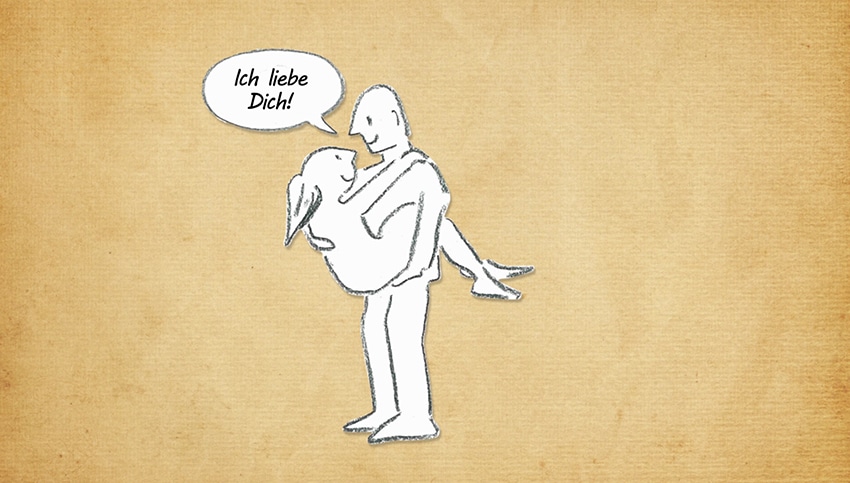
The person who enters into the relationship often describes how their new partner showered them with declarations of love like they had never experienced before, and how difficult it is to describe how strong the connection already felt after only a few encounters.
Is it possible to save a toxic relationship?
The short answer is:
- If the
problem is
the relationship dynamics itself :
-> Yes! (but only if both want it)
- If the
problem is
the (narcissistic) partner :
-> No! (at least with the highest probability)

Requirements for saving a toxic relationship
Even though it's not easy to turn things around, it is possible to transform a toxic relationship into a (re)developing enriching partnership – but only if both partners ...
- want to stay together.
- to find a consensus on what 'happy relationship' means.
- are in principle capable of accepting criticism.
- are motivated to change their respective problematic behavior patterns and attitudes.
- are open to sound professional support.
Tip: Check if you are in an emotionally dependent relationship!
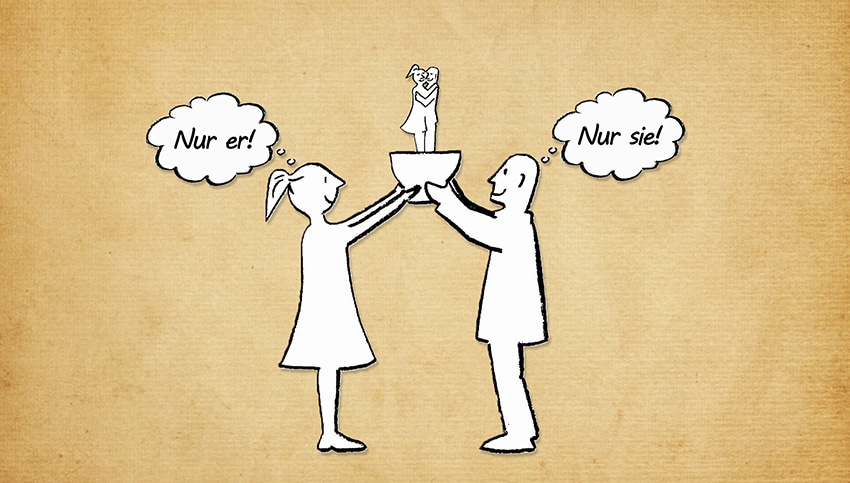
The right support to save a toxic relationship
In an emotionally charged situation, we often lose our ability to think clearly. Our thoughts race. We're mentally stuck.
Anyone who wants to get their relationship, which has fallen into crisis, back on track should seek professional help as soon as possible - before even more damage is done.
Here you can find information about various support services ↗

Our tip:
Use your current motivation and start today with the scientifically based online relationship coaching from PaarBalance.
Effective immediate help for individuals - regardless of time and place.
When to end a toxic relationship?
A breakup is one of the most profound and painful experiences imaginable - and therefore should be carefully considered.
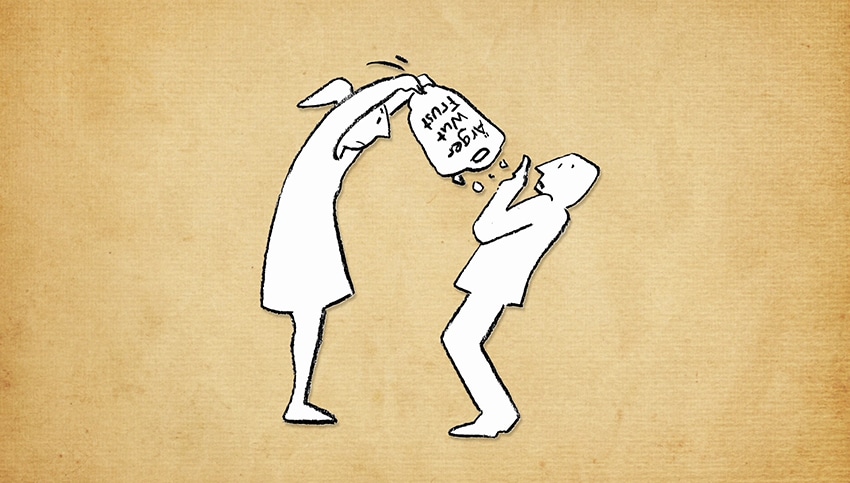
However, many sufferers experience the relationship with a toxic partner as similarly stressful - with the difference that the pain does not decrease and the wounds do not heal, but the state of suffering is permanently maintained and new, deep injuries are constantly added.
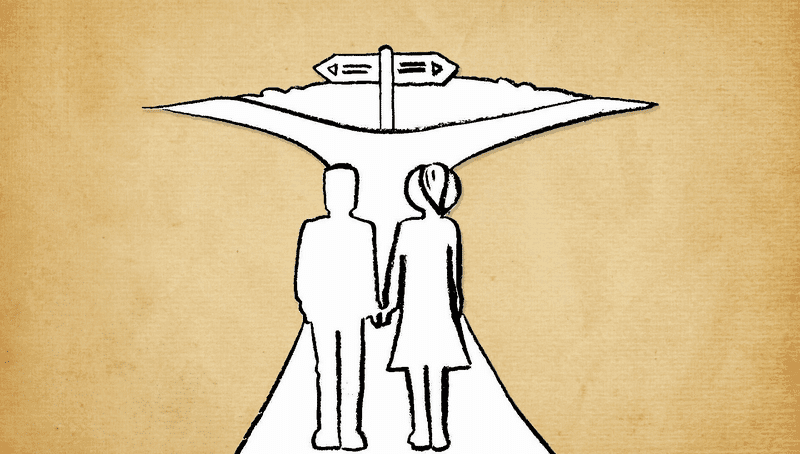
A relationship should enrich your life - not burden it.
Our partner should support us - not (emotionally) break our neck and destroy our self-esteem.
Reasons that speak in favor of a separation
You probably know the answer very well yourself:
- Has your relationship only (temporarily) taken on toxic characteristics due to unfavorable circumstances?
- Or does your partner have an (unchangeable) toxic personality structure?
If you have brought a toxic partner into your life, please be aware of the following:
- Your partner will not change.
- Their relationship will not change.
- They will not be able to have a respectful partnership in this constellation.
- You will never feel permanently safe and secure with this partner.
Therefore, we strongly recommend:
- Make the decision to break free from what is making you sick.
- Free yourself from the harassment of a toxic partner.
- Start afresh as soon as possible with a liberated feeling about life.
- Give yourself the chance to find someone who loves you just the way you are.
- Trust that you can experience a new, 'healthy' partnership.
The right support to end a toxic relationship
A separation is not an act, but a process, and a lengthy and extremely painful one at that – even if all parties involved are mentally healthy and try to part ways 'amicably' ( more on this topic in our article "Should I separate? All the important aspects surrounding the topic: Stay or Go" ).
Breaking free from the clutches of a toxic partner is, by contrast, far more difficult.
A toxic partner desperately wants to maintain control. A final breakup would mean an absolute loss of control – and is therefore unacceptable to them.
Especially if the existing relationship has involved not only emotional abuse but also physical assault, expressing concrete intentions to separate can be quite dangerous.
Therefore, a separation should never be announced impulsively, but rather be very well prepared using concrete steps.
Involve some trusted people in your plan and ensure you have reliable support (now & later).
Seek professional advice in good time, ideally from a local advice center.
Here you will find links to relevant facilities as well as emergency telephone numbers ↗ .
What do happy couples do right? - Become your own relationship expert!
Don't suffer any longer!
Finally be happy again!
Do something for your quality of life!
The best time to start with CoupleBalance coaching is today. This is the best foundation for a lasting, happy, and respectful relationship.
Das PaarBalance Coaching-Programm wurde von Prof. Dr. Ludwig Schindler, Dr. Judith Gastner & Team entwickelt, um alle "Zutaten für glückliche Beziehungen" aus 50 Jahren Paartherapie- und Beziehungsforschung auf den Punkt zu bringen.
Das Besondere: Es kann vom einzelnen Partner durchgeführt werden.
In 18 Online-Sitzungen, die Sie komplett in Eigenregie und unabhängig von Zeit und Ort machen können, erhalten Sie alles an Beziehungswissen, das es braucht, um eine von Lebensfreude, Vertrauen und Leichtigkeit geprägte Partnerschaft gestalten zu können.
Vor Beginn des Coachings können Sie (kostenfrei) den PaarBalance Beziehungstest durchführen, um eine fundierte Rückmeldung über den Stand Ihrer jetzigen Beziehungssituation zu erhalten.
Vertrauen Sie Ihrem Bauchgefühl: Sie wissen selbst am besten, welche Art der Unterstützung am besten zu Ihnen passt.
Wir wünschen Ihnen alles Gute!
Ihre Dr. Judith Gastner & Ihr Prof. Dr. Ludwig Schindler
☝🏻 Passende Artikel zum Thema Toxische Beziehung
Jemals darüber nachgedacht, ob Sie in einer Beziehung mit einem Narzissten sind? Entdecken Sie in diesem Artikel die Anzeichen und Warnsignale, anhand derer Sie einen Narzissten erkennen können. Wir enthüllen die Geheimnisse von Narzissmus in Beziehungen und geben Ihnen wertvolle Einblicke, was Sie in dieser Situation tun können.
Frequently asked questions about "Toxic Relationships"
What is meant by a toxic relationship?
A toxic relationship is a destructive relationship in which one partner's needs are ignored by the other. In such asymmetrical constellations, manipulation, a need for control, abuse of power, devaluation, and constant conflict dominate. A toxic relationship is not a loving, equal partnership.
Why do people get into toxic relationships?
There are many possible reasons why people end up in toxic relationships, such as a lack of relationship experience, low self-esteem, past trauma, or the hope that their partner will change. Toxic behavior patterns are often difficult to recognize at the beginning of a relationship and only become apparent over time.
How can you tell if a person is toxic?
Signs that a person is "toxic" include: constant (usually destructive) criticism, excessive controlling behavior, insults, belittling remarks, or even violent behavior. Toxic (or pronouncedly narcissistic) people generally have little regard for the needs and boundaries of others and act in a highly manipulative manner.
Should you end a toxic relationship?
It is almost always advisable to end a persistently toxic relationship that is not based on mutual respect and equality in order to protect one's own health. However, not every relationship problem should be hastily labeled "toxic." A professional, external perspective from a couples therapist can help gain clarity.
How can you end a toxic relationship?
The first crucial step is recognizing the situation as toxic. Only then can one effectively seek the best possible support to break free from the toxic relationship. Often, professional therapeutic guidance is necessary to successfully navigate the separation process, which is usually emotionally taxing.