





5 Love Languages - Test: Which one do you speak?

☝🏻 Quick Start: 5 Love Languages - Which one do you speak?
Have you ever wondered when you feel most loved by your partner?
Then, when your loved one…
Does he (she) tell you how much he (she) likes you or what he (she) particularly appreciates about you?
would you give a lovingly chosen gift ?
Does he (she) take something annoying off your hands after a tiring day , or ask what he (she) can do for you?
gives you his (her) undivided attention or does something nice with you ?
Does she take her in her arms or kiss her tenderly ?
Of course: In each of these moments, one's heart can warm, and we are all capable of understanding various signs of affection and togetherness.
But: Love takes slightly different paths in everyone's life. Do I, and my loved one, truly feel the same thing at the same moment ? Do we do, say, or convey something similar when we feel the same ?
Each of us has a certain tendency to 'send' and 'receive' affection, meaning that we are very likely to use (and experience) a very specific 'love language' in a similarly intuitive way as our familiar 'mother tongue'.
🚀 Already 19,383 people have discovered their love language through the test.
Why should you know your 'love language'?

This concept in couple therapy (that every person - especially in couple relationships - prefers to convey affection and feelings of love in a very specific way) became known from the book "The 5 Love Languages" by the American relationship counselor and author Gary Chapman.
Those who are aware of their intuitive 'love language' can communicate their personal preferences and desires much more effectively. They know how to express their love and what their most important needs are in a relationship.
Instead of being "somehow dissatisfied" in his relationship, he recognizes when something is missing and what it is - and can clearly communicate this to his partner.
Different love languages in a relationship

Perhaps you are now wondering:
What if my partner and I speak different love languages?
Are we even a good match?
Can our relationship work in the long run?
I can reassure you: There are no love languages that are essentially "incompatible" with each other. Because: We can all, in principle, communicate in any of the five languages (just as we are generally able to learn foreign languages, especially if we live abroad for an extended period or live with a native speaker).
It's simply about understanding which of the "Love Languages" (as Gary Chapman calls them) is/are most important to you or your partner (because there can be several in parallel).
If you also know your partner's 'love language(s)' well and learn to 'speak' them as fluently as possible (if they are not among your 'native languages'), it will be much faster and better to understand the other person's feelings and to reconcile different needs.
What are Gary Chapman's 5 Love Languages?
The concept of the '5 Love Languages' is meant to illustrate the different ways in which different people prefer to express their love.
In the following, we would like to discuss each of Chapman's '5 Love Languages' in detail. We will not only explain how you can 'recognize' each language, but also what typical challenges the individual "Love Languages" can present when 'misused' (and, of course, how you can solve them... :-)).
Language 1: Loving Words
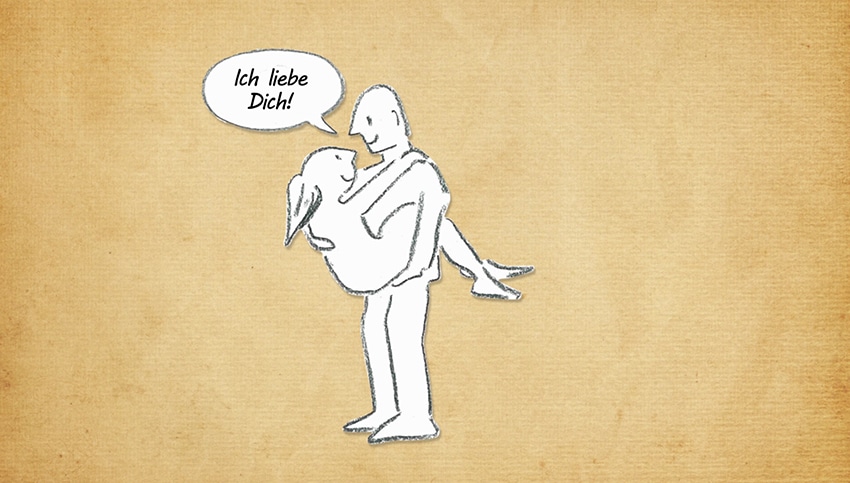
"When do I feel most deeply loved?"
You probably have an immediate answer to this question: when your partner showers you with compliments or declarations of love.
You don't need any gifts or material things - words of appreciation or whispered love are experienced as the greatest and most heartfelt form of recognition.
You yourself also regularly express your love and affection by generously showering (or even overwhelming) your partner with compliments, praise, and declarations of love.
Typical problems of the love language "love words"
When it comes to love, we humans are generally easily unsettled. People with this love language, in particular, tend to equate a lack of compliments and expressions of love with a lack of appreciation and affection, and to keep an internal tally of these comparisons.
"Why do I say 'I love you' so much more often than he does?"
"Why am I always the one complimenting her, but she almost never compliments me?"
"No wonder I don't feel loved. I never get to hear it."
Don't fall into the trap you've set for yourself. While you naturally express your love through praise or words of appreciation and affection, your partner might react very differently – and yet, they still love you wholeheartedly.
This applies to each of the five love languages: Don't project your own love language onto your partner. He/she may express their love in a completely different way.
Don't hesitate to talk to your loved one about this topic from time to time. If he/she understands how important it is to you to show (and receive) recognition, appreciation, affection, and love with words, he/she will be much better able to respond to you (see also our article " How Relationships Work - The Biggest Myths Debunked ").
Here you can find more information about the love language 'Love Words / Praise & Recognition (Words of Affirmation)' .
Language 2: Togetherness
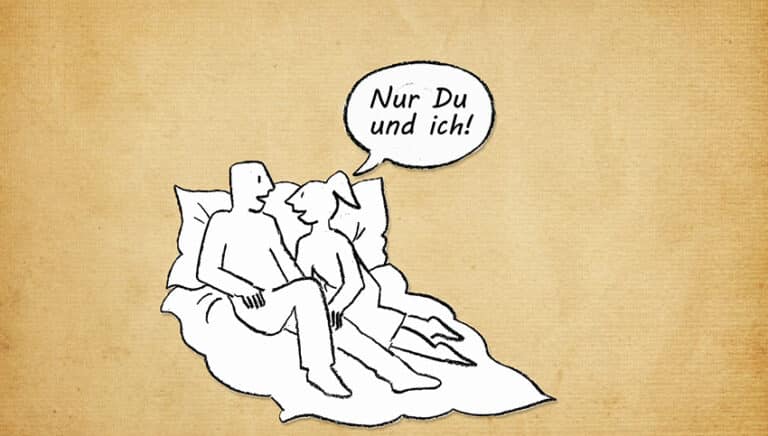
For you, nothing beats shared time of undivided attention. You feel loved when your partner takes time for you (and only for you!) and consciously spends it with you.
Typical problems of the love language "togetherness"
This is probably the one of the five love languages that can most easily lead to conflict. Especially if your partner works a lot or needs a lot of time for themselves, it can quickly happen that your need to spend quality time together is not met.
The solution to this problem: communication. Talk to your partner. Avoid misinterpreting your partner's lower need for closeness as "less love".
Keep figuring out when and how much time each of you needs for togetherness and time for your own needs – and find solutions together that you can both live with in that moment. There's no one-size-fits-all solution that can be settled 'once and for all'; you have to continually renegotiate with each other.
Remember: A compromise is only 'good' if it hurts both sides (a little). 😉
Here you can find more information about the love language 'quality time'.
Language 3: Gifts
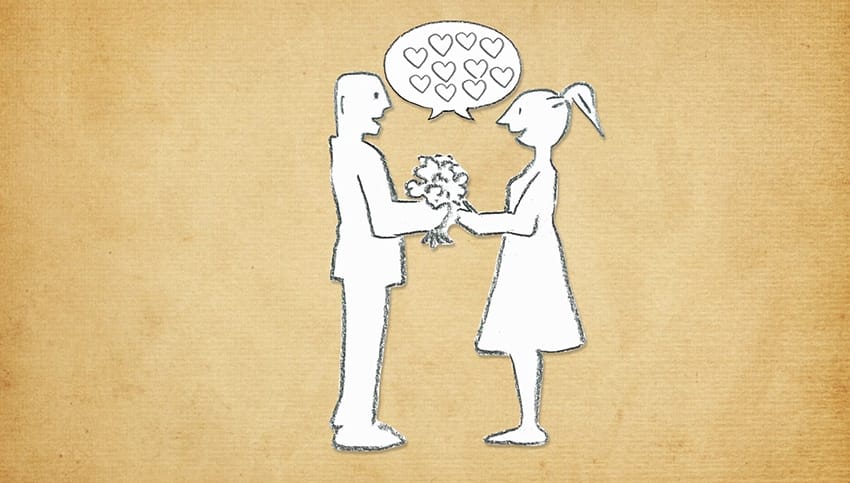
The doorbell rings. You open the door – and there stands your partner. Behind their back, they suddenly produce a large bouquet of fragrant flowers (or one of your favorite sweets, magazines, or...).
Admittedly, almost everyone is happy to receive gifts! They remind many of us of our childhood and awaken a corresponding 'childlike joy' in us.
How important gifts and small tokens of appreciation from your partner are to you is very individual.
For some, a lovingly chosen gift is worth more than a thousand words - others experience a few hours of shared time and passion as far more meaningful.
To learn which of the '5 love languages' might be your "native language," always look at your own behavior. Regarding the language of gifts, this means:
Do you enjoy giving gifts to others? Do you often give your partner small tokens of affection? Do you feel that this is a particularly good way to express your love?
Typical problems of the love language "gifts"
The act of giving a gift is inherently beautiful – especially when you have a good sense of what the other person would appreciate. Both giver and recipient usually experience equal joy when receiving a present. However, don't be disappointed if your partner shows their love in other ways and "only" gives you gifts at Christmas or on your birthday (if at all, and even then perhaps not very imaginatively) – while you hardly miss an opportunity to surprise your loved one with small, thoughtful tokens.
Nevertheless, you can of course mention (please in a relaxed moment!) that you also love receiving gifts and would feel especially seen and loved if people who are important to you occasionally think of something nice for you.
Here you can find more information about the love language 'receiving gifts' .
Language 4: Helpfulness

Your day is incredibly stressful. You're still working hard at the computer until late in the evening. Then your partner brings you a plate of delicious food, pours you your favorite drink, and offers to take over a bothersome appointment for you the next morning.
As someone whose love language is "helpfulness," support is the foundation of a relationship. You want to help those you love.
It doesn't even have to be anything big: small 'deeds' and gestures of support will warm your heart and make you feel loved.
Regardless of which of the five love languages your partner speaks, almost everyone—man or woman—feels good when they are supported. Mutual support is especially valuable in a relationship (or marriage, and particularly within a family with children— see our article "No More Mental Load" ). Your natural inclination to lend a hand to your loved one with practical actions and helpful gestures can prevent many arguments and maintain harmony. You appreciate your partner's offers of help like almost nothing else.
Typical problems of the love language "helpfulness"
Be careful to keep things in perspective and not end up completely overwhelmed and stressed out by being too helpful: that won't help your partner either.
Here you can find more information about the love language 'Acts of Service' .
Language 5: Physical Intimacy

A passionate kiss, a long hug, gentle touches... For you, physical closeness and intimacy are the most important elements of a relationship.
Of course, you appreciate good communication, recognition, appreciation, attention, and the various other love languages. But for you, nothing evokes such strong feelings as conscious touch. Only when your partner regularly touches and hugs you do you experience truly deep feelings of connection: only then do you feel genuinely loved.
Typical problems of the love language "physical intimacy"
A common challenge for those who practice this 'love language' is that relationships often begin with a great deal of tenderness and passion, but physical intimacy diminishes significantly over time. To a certain extent, this is perfectly 'normal' and expected.
Many people then make the mistake of equating less physical touch with less love or a lack of affection.
This decline in displays of affection usually has other reasons: Those newly in love can't keep their hands off each other. At the beginning of a relationship, our hormones practically compel us to touch our partner as often as possible. However, this hormonal cocktail diminishes over time. Touching and a flurry of kisses no longer happen automatically whenever the other person is near.
You can easily counteract this trend: consciously initiate tenderness, touch, and closeness with your partner. Don't wait for them to start hugging you. Your partner may express their love differently than through touch, caressing, and cuddling—so don't hesitate to take the first step when it comes to physical intimacy.
Important: Don't take it personally if you don't manage to automatically put the other person in a cuddly mood. It simply means it's not the right time for them.
Perhaps this metaphor will help you: If you have absolutely no appetite, you would probably also refuse your favorite food - and that doesn't mean that you generally don't like it anymore.
Should the situation worsen, read our article "No More Sex in Marriage" about the 7 biggest sex myths .
Here you can find more information about the love language 'Physical Touch' .
The 5 Love Languages - Listen to your inner voice again and again...
Even more revealing than any test on the internet is to regularly check in with yourself or to remember the moments when you were or are happiest with your partner.
Or, if you don't currently have a partner: What do you imagine in your imagination when you dream of your ideal relationship?
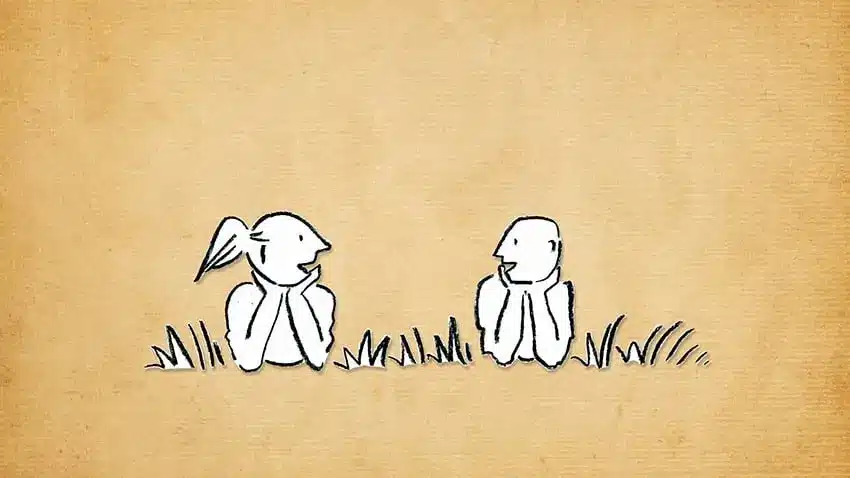
We humans also change over the years. It can happen that through various experiences with 'different language' partners, we ourselves become multilingual over time, and learn to speak and understand a language we didn't speak (well) before so well that one day it might even be just as dear (and fluent) to us as our mother tongue.
What kind of communication evokes strong feelings in you? How do you show your love and affection in everyday life? What (and how) does your partner love? What kind of affection do they value most? What do you both enjoy?
- Is it a tender kiss and a warm hug with which you greet each other at the door?
- Are these words of recognition that provide support and security?
- Are they moments of togetherness and the feeling that everything else around you is no longer so important?
- Is it an exciting book that one person brings to the other as a surprise?
- Is it the cup of coffee that one partner brings to the other in bed in the morning after a strenuous night shift?

Learn foreign languages! 🙂
Perhaps you like all these ideas of a loving and attentive way of interacting. And presumably, there are or have been many different signs of affection in your relationship: warm words , mutual support , time together , tender gestures , and small surprises. Some more often, some less often.
Because, as I've already said: Nobody speaks only one love language. Nobody understands only one love language. We are all, in principle, multilingual. And that's wonderful.
But there are languages that are more difficult for us to learn than others – much like it might have been in school. In those cases, it's especially important to have a patient and warm-hearted language teacher.
Tip:
Rank the 5 love languages according to their importance to you, then show your partner your ranking. Have them do the same.
Talk about which of the important people in your family of origin (parents, grandparents, siblings, close friends, etc.) expressed love and affection in what way. You will probably know each other much better after this conversation.
Agree to patiently give each other language lessons if you happen to be experts in different languages. This can work particularly well if you regularly ask each other: "Can I do anything for you?"
It is highly likely that each of you will then seize the opportunity to express a wish in your own native language, e.g.
- "Yes, gladly. It would be great if you could quickly call XY for me" or
- "Thank you, yes. It would be lovely if you could make me a cup of tea."
- "Give me a hug - I'm totally exhausted right now" or
- "Please tell me something uplifting - I'm feeling pretty frustrated after the phone call with my boss" or
- "I would be absolutely delighted if you could take some time for just the two of us this evening," etc.
In this way, one partner is naturally encouraged to put their needs into words and communicate them to the other, while the other is given the opportunity to learn their partner's love language better and better - and vice versa.
The 5 Love Languages - explained by Dr. Judith Gastner using many tangible examples in the WDR podcast: "Lisa's Relationship Cut: The Relationship Podcast with Lisa Ortgies": 🎙️ Why declarations of love sometimes don't get through
Start your self-test now!
Have fun and all the best for your love!
Yours sincerely, Dr. Judith Gastner
☝🏻 Related articles on the topic of the 5 love languages
Source used:
- Gary Chapman: "Five Love Languages Revised Edition: The Secret to Love That Lasts" – 1. Januar 2015 - ISBN: 978-0802412706
Frequently Asked Questions
What are the five love languages?
The concept developed by American relationship counselor Gary Chapman has gained worldwide popularity. In German, the so-called "Love Languages" are translated as:
- Praise and recognition (words of affirmation)
- Quality time together
- Gifts (receiving gifts)
- Acts of service
- Physical intimacy (physical touch)
What love language does my partner speak?
Pay conscious attention to how your partner shows you affection and which signs of love they enjoy most. Is it loving words, a meal together, a small gift, an offer of support, or a warm hug? Talk to each other about it. This way, you can learn a lot about each other and give each other exactly what you need.
Is it bad if my partner speaks a different love language?
This doesn't have to be a problem at all, because we are capable of learning foreign languages, including those related to love. Open communication, goodwill, and respect for personal differences are crucial. When does each of you feel most loved? Make an effort to get to know each other's love languages better and better.
Can a love language change over the course of a relationship?
Yes, the preferred love language can change. People evolve, and this includes our needs and preferences. It's important to maintain open communication to find out if and how things have changed over time and how you can continue to nurture each other.
Is it possible for someone to speak only one love language?
Yes, it's possible for someone to primarily speak and initially understand only one love language. However, this doesn't mean that other love languages can't be understood or learned at all. It's important to acknowledge the other four love languages and to be mindful of the partner's individual needs.