





Breakup? - The most important recommendations from a couples therapy perspective

What is the right option in your personal situation: to take the path of a final separation or to try for a fresh start with your partner? Here you will find answers from research on couples therapy and separation, as well as our many years of practical experience, which can help you take the right next steps for yourself.
In the current exceptional situation of separation, it is crucial to avoid fatal mistakes.
Therefore, get advice from our couples therapists so you can act correctly in such a situation. There are various starting points when it comes to separation – which is why you should take a closer look at your current situation:
- Are you on the verge of a breakup? Then read our article " Should I break up? ".
- Are you considering a break in your relationship? Here you'll find key decision-making tools for taking a break – and in this article, you'll learn under what conditions a temporary separation makes sense .
- Are you feeling really down and wondering, "Why is this happening to me (again)?!"? Click here to jump directly to the relevant section.
- Have you already broken up and feel it was a mistake? Then click here for our article " Winning back your ex ".
- Do you want to understand what's going wrong in your relationship and what's leading to or has led to a breakup? Then start with the free relationship analysis .
- Are you married and considering divorce? Read our article below. Are there children involved? Click here to jump directly to the relevant section.


The "separation of table and bed" - what does that mean for us as attachment beings?

Separating from a once-beloved partner is one of the most emotionally painful experiences imaginable. We humans are social beings and yearn for belonging and connection. We are not made for being alone.
Even if relationship frustrations have increased recently, after a breakup, one of the most important people, with whom you may have spent years or even decades sharing a fundamentally important part of your life, is no longer there in the same way, or has completely disappeared. The shared future you had planned together over years or decades will no longer be possible. It's time to close an important chapter of your shared journey and your shared life story, and to realign your own future plans within a relatively short period of time. The former shared (or new) home may become unusually quiet.
Being separated doesn't just mean being separated from the table and sleeping place, but also being separated from familiar conversations, shared rituals, plans, division of labor, the joint upkeep of house and farm, and countless things that have become widely established since the beginning of the relationship.
In the context of separation and divorce, in addition to all the pain and loss, there are usually also protracted negotiations (regarding alimony, other financial matters, etc.). If the partners are married, have one or more children together, and questions arise concerning child support and visitation rights, the process of separating becomes truly complicated. Without legal counsel, such challenges are difficult for the spouses, who are often still at odds at this stage, to resolve amicably. Once the separation year has ended and both (ex-)partners are still emotionally turmoil, the unpleasant court appearances become increasingly frequent.
Formal separation is not the same as emotional separation .
It can take months, even years, until we have fully processed the emotional end of a marriage or partnership and are truly 'separated' in our feelings.
Some people dwell on lost love for the rest of their lives. Or they struggle with the question of whether they should have stayed or fought harder for their life together. Should they have insisted more forcefully on themselves and their ex-partner to give it their all and try for a fresh start? Closing the chapter of a broken relationship without regret and in peace is then extremely difficult.
Breakups are never easy. That makes it all the more important to deal with this complex issue as honestly and openly as possible – whether the goal is to prevent a breakup or to handle and process it.
There are well-researched and proven measures that help to prevent the difficult situation from worsening and to avoid additional turbulence.
Use good tips - and ignore bad ones !

You have surely heard the saying: " The clever person learns from their own mistakes, the wise person from the mistakes of others."
Especially when it comes to separating from a partner or divorcing a spouse, the consequences of mistakes can be painful and far-reaching. Therefore, numerous guides exist that aim to help avoid preventable pitfalls. However, not all of these guides or websites are equally reliable.
Given the abundance of available support services, it is therefore necessary to first gain a good overview, and then to focus more intensively on qualified recommendations or websites.
We have tried to take this step off your hands and have compiled some important guidance on the topic of "Separation and Divorce: Yes or No?" below.
"Why does this happen to me of all people ?!"

When separation is imminent or the spouse has recently moved out of the shared apartment, most people affected experience this as an absolutely exceptional situation.
Anyone who finds themselves in this emotional chaos has the impression that their fate is unique (because it is uniquely terrible, sad, burdensome, frightening, challenging, etc.).
Thinking that way is perfectly understandable and normal – but ultimately quite irrational. A brief look at the statistics shows why.
Separation in numbers

According to a 2019 study by ElitePartner, Germans have an average of 3.4 relationships over the course of their lives. This inevitably also means that they have to cope with several breakups.
The divorce rate in Germany has fluctuated between 30 and 50 percent over the last 10 years. In other words, every third to second person will have to go through a divorce at some point.
And that includes everything that almost always goes with it: separation period, legal fees, divorce petition, formal separation year from the spouse, spousal support, dissolution of an apartment or house, hurt feelings, shattered dreams, guilt, etc. And not just once, but potentially several times in the course of a lifetime.
If you also experience a breakup, the comforting news is: you are not alone. However, this certainly doesn't mean that a breakup and its consequences are trivial and something you can simply "get over."
"Screw you! I'm filing for divorce right now!" - Warning! Strong emotions are not good advisors...

Few questions are more difficult to answer than this: When is it truly no longer possible? When have I tried more than enough ? When should I separate for the sake of my own well-being ? What impact will a separation have on me, on us, and on the important people in our lives (children in their current developmental stage, parents, friends, neighbors, colleagues, etc.) at this time?
The answer always depends on your individual situation. Nothing and no one—not even your best friend, the bestselling self-help book, or your closest family member—can ultimately make this decision for you. However, as couples therapists, we can offer the following clear advice:
Never end a marriage or relationship in a highly emotional moment (such as acute anger or escalated jealousy, or sexual desire rejected by the other person, etc.).
As long as you are unsure whether separation or divorce is the right path, there is still hope for your relationship. In that case, the answer to the big question "Separation?" should initially (and until further notice) be "No!"
Insecurity is a common indication that one still desires a functioning relationship with their current partner .
For the sake of consistency with one's own biography, it has been proven that the best thing is to be able to say in retrospect: We sought fair compromises, made a genuine effort to achieve successful communication, and tested new ways to improve the quality of the relationship and find a way out of frustration and conflict. And this applies even if everyone around you has already advised separation.
Understanding what happened (free test, 10 min) - The most important thing in your current situation!
In which areas was (or am) I dissatisfied? What were (or are) our strengths as a couple?
Why has our relationship become trapped in a vicious cycle? This is often difficult to answer amidst the emotional turmoil.
With the scientific relationship test by Prof. Dr. Ludwig Schindler & colleagues, you can gain a helpful overview of the strengths and weaknesses and the dynamics in your relationship (10 min).
Take your relationship test now! (free)
How is your relationship?
What are your strengths and weaknesses?
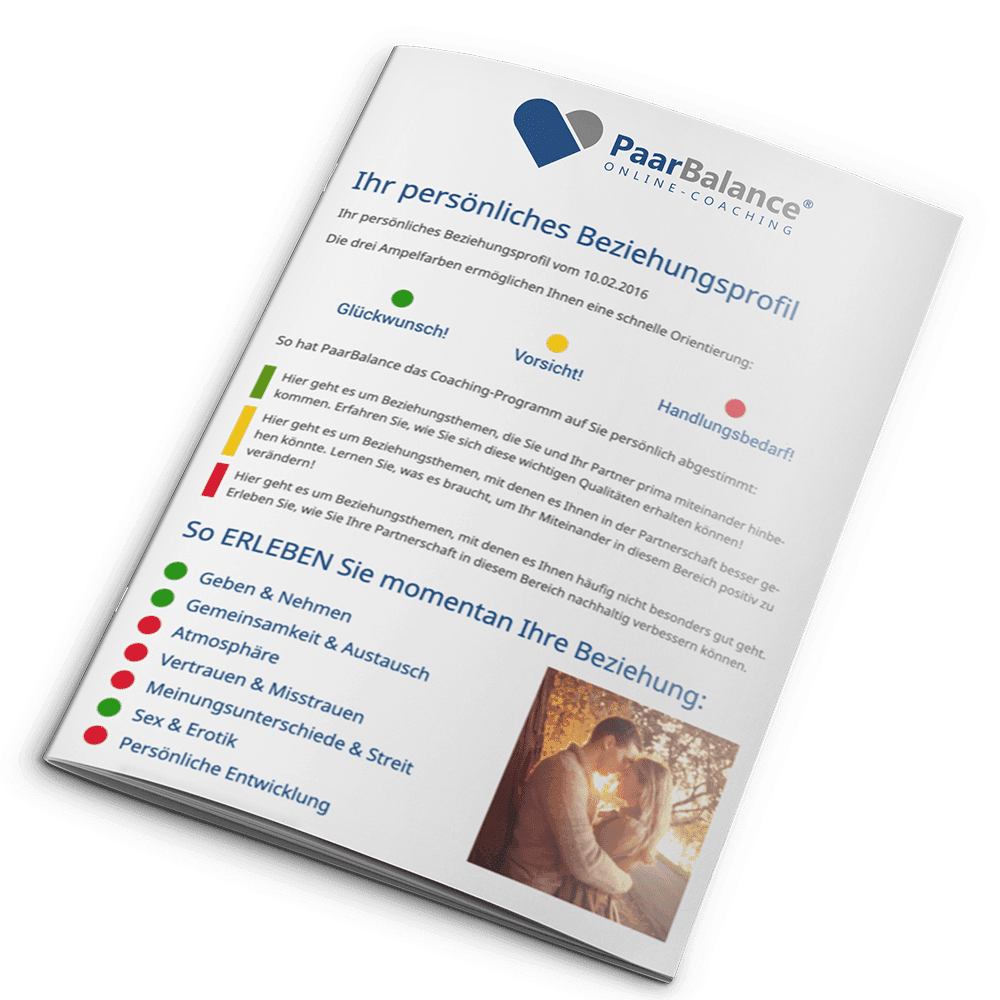
You will find out immediately afterwards in your personal PaarBalance relationship profile (free).
Start your relationship test now!
✓ Scientifically sound
✓ Includes detailed analysis
✓ Your data will not be shared
✓ 100% free & non-binding
100% secure. We comply with data protection regulations. Registration for the relationship test is free .
Please read this important information beforehand:
Data Protection ᐧ Terms and Conditions ᐧ General Information Agreement Terms and Conditions . Transparency Statement
Marriage and divorce: Which areas of life are affected by a divorce?
Almost all areas of life are affected by a separation. Therefore, the decision to "stay or go" should never be made impulsively.
A divorce consumes those involved for a long period of time. Ultimately, a divorce is not only an immense bureaucratic undertaking (divorce petition, lawyer, negotiations, court, custody, etc.), but usually has serious financial consequences (separation maintenance, child support, property maintenance, division of income and assets, etc.). A shared apartment or house, work, or other intertwined life arrangements generally complicate matters even further.
The emotional consequences that such a step entails for the spouses deeply affect their previous identity.
The person with whom you previously shared your home and every day is not just leaving your apartment, but your life together. The separated partners must redefine themselves in many ways.

If only I had known beforehand...
We often hear the sentence: "If I had known beforehand what a divorce really meant, I would have tried everything again to save our relationship."
Therefore, allow yourself plenty of time before taking such a final step. Very often, it proves to be far better to make every effort to bridge the differences and to reflect on all the reasons why you entered into marriage in the first place.
Professional advice (from a couples counselor or sound online coaching ) can help couples who are doubting.
If you are currently experiencing an acute marital crisis, the article "Overcoming a marital crisis" may also be helpful.
When children are involved

The challenges of a separation process mentioned above are very painful, costly (especially in the case of divorce), and emotionally taxing for most of those affected, and often also physically demanding (e.g., due to sleep disorders, etc.), but can ultimately be overcome: After various struggles, the intertwined lives are eventually disentangled, and a kind of 'new normal' gradually returns for the separated spouses.
Things only get truly 'serious' when children are involved in the separation. Then it's no longer 'just' about the hurt feelings of the adults, but about the physical and mental health of the children, for whom both parents bear responsibility.
When a parent moves out and no longer lives with the children, it brings about significant changes for many of them. And it's not uncommon for children to witness the many conflicts that precede most divorces: a year of constant arguments and shouting. Or tension and icy silence between the parents – perhaps for two, three, or even more years... And after all that suffering, still no reconciliation and no experience of family unity. All of this can leave deep scars on children with long-term consequences.
During a divorce, most adults are so preoccupied with formal and logistical matters (is there an entitlement to alimony? Who gets custody? How do we arrange visitation rights? Which parent stays in the shared home? etc., etc.) that the emotional distress of the children is often underestimated.
Consequences of separation for the children
Numerous studies have shown that children from intact families have significantly more positive prospects than children of separated parents: On average, they have better academic performance, higher incomes later on, and a significantly lower crime rate – to name just a few examples.
Whether we like it or not: As parents, we must also consider these facts and keep them in mind when deciding for or against a separation.
Preventing a divorce at all costs is, of course, not always advisable: for example, when one partner is violent or when frequent, destructive arguments cannot be resolved. In such cases, the children may be significantly better off if their parents live separately. But even then, the parents' aim should be to make the separation year and the subsequent period as gentle as possible for the children's sake.
How are the most important areas of your partnership currently doing?

Separation or divorce is often so distressing precisely because – despite all the frustration – positive feelings for one another still exist, even if the problems have currently become overwhelming. Then, the mere thought of being permanently separated from one's spouse is painful.
If your head says "yes" and your heart says "maybe" or "no" to the breakup, you're in a bind.
We, as 'personified relationship advisors' and psychotherapists with decades of experience, are convinced:
It is almost always worth fighting for your relationship or marriage if both partners still have feelings for each other.
If you are grappling with the question "Should I break up even though I still love her/him?", it will probably help to read the articles "Separation despite love" or "Should I break up?" in more detail .
Reasons for separation

If it's so painful and has such serious consequences, why do people break up at all?
There are countless individual reasons and justifications that we could never list. However, certain reasons for separation are ones we hear frequently in our practice.
Therefore, in our article "Separation despite love" under the heading "10 typical reasons for a separation despite love", we dealt with the most common reasons for separation.
Temporary separation?
Perhaps you've already considered the concept of a "relationship break" or "temporary separation." Some see it as a good strategy for focusing on their own and their shared needs – others suspect the suggestion is a "gradual separation."

Can a "temporary separation" work?
Whether such a step can personally help you develop new perspectives for your marriage and prevent a divorce cannot be answered in general terms. It depends entirely on how each couple shapes this phase and what steps they plan to take.
Living apart from your boyfriend or spouse for a while can be very helpful for decision-making – with good preparation.
The person suggesting a trial separation must clearly explain to the other person what they hope to achieve with this step. And both must understand equally that this is not a permanent separation.
Temporary separation – avoid serious mistakes!
To prevent ambiguities from unintentionally leading to a final separation, you should thoroughly consider what needs to be clarified in advance of a "temporary separation".
In our special guide article on the topic of "temporary separation" , we describe which agreements should be made in advance and how dangerous pitfalls can be avoided.
The most important basic rule: First things first

Providing support to countless people before, during, and after a separation has shown that every situation is different. However, there is a basic rule that applies to almost everyone affected:
For one's own sake, one should – according to one's own subjective feelings – have tried everything to save one's partnership or marriage.
"What if..."
Even if all efforts fail and ultimately a separation or divorce occurs, you can look in the mirror in the future and know: "I tried everything. I didn't give up on our love lightly."
This is the best possible answer to the questions that often plague separated or divorced partners even years later: "What if...? Did we really do everything we could to prevent the divorce? Shouldn't we have tried to make it work for another year? Would the right professional advice have helped us save our marriage?"
Not knowing whether the relationship could have been saved, whether one gave up prematurely, and whether shared happiness was squandered, can disturb one's peace of mind and keep the pain alive far beyond the year of separation.
"...it might still work out?"
And here's the thing: If at least one partner – ideally both partners simultaneously – decides to save the relationship if at all possible, and – very importantly! – applies the appropriate strategy, a separation or divorce can very often be prevented. And not only that:
Harmony and relationship satisfaction can return from a 'problem relationship' in 'permanent crisis mode' within a very short time (not, as many think, after perhaps a year or even many years).
What is needed for that?
The willingness to invest jointly in the partnership, as well as the right strategy and approach. You must bring the former yourself; we are happy to support you with the latter.
Separation? No - First of all: Change of course!

As I said: It takes active commitment and a good strategy to avert a separation or divorce and to steer the partnership back onto a positive path.
Does this mean you have to work through all your problems before you can enjoy your relationship again ? Does it require a year or two of hard work before you can feel comfortable again? No! In fact, quite the opposite is true:
First, all sails should be set again towards a benevolent interaction, moments of lightness and shared enjoyment, before one can gradually face the challenges in the partnership or marriage constructively (and with real chances of success!).
The good news: Relationship work ? Probably not necessary at all!
In this sense, dealing with your relationship absolutely does not have to feel like "work".
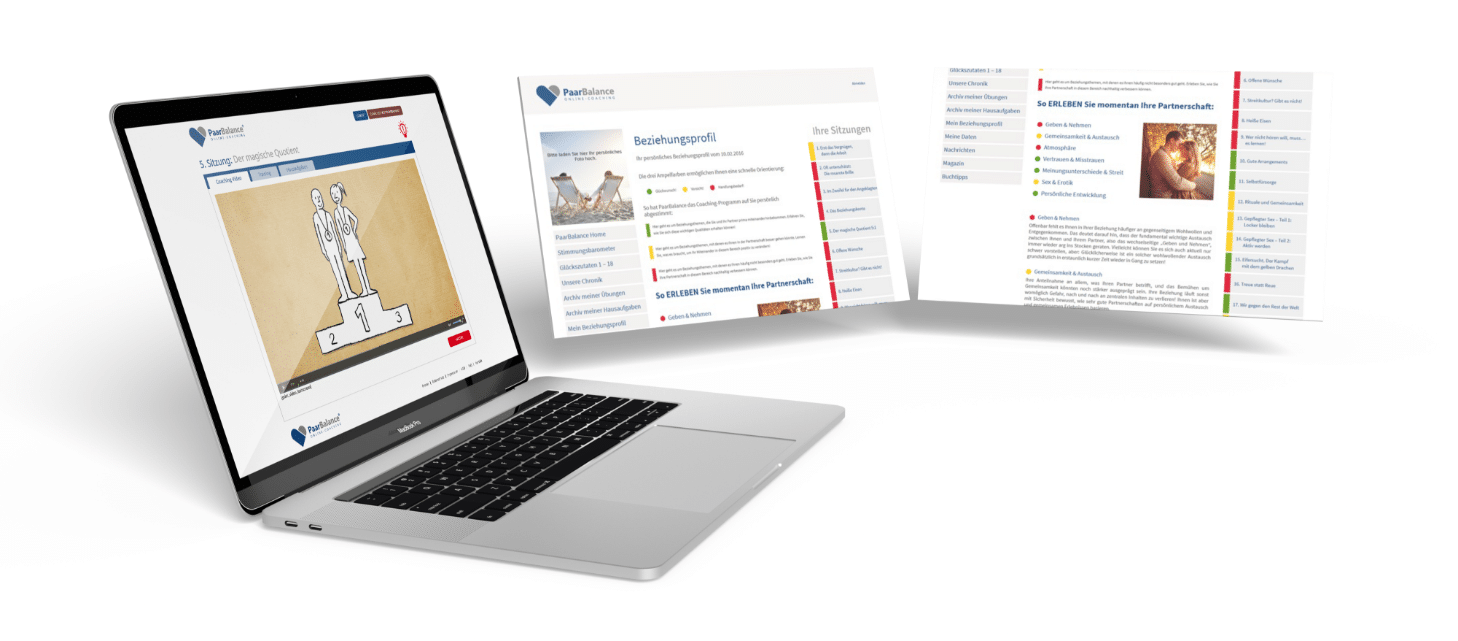
The innovative online coaching program from PaarBalance ↗ , developed by my colleague Dr. Judith Gastner and myself (Prof. Dr. Ludwig Schindler ), provides you with a proven and scientifically validated step-by-step plan that allows you to (re)establish a stable and harmonious foundation for your relationship in an often surprisingly short time .
The CoupleBalance program helps couples to balance their relationships through entertaining videos and exciting exercises.
The content and structure of the coaching are scientifically based . The program can be used both as a pure self-help program and as a supplement to couples therapy or counseling .
Take action as soon as possible – before the “point of no return” is crossed for you or your partner and a separation or divorce can no longer be prevented.

Make sure your partnership becomes an enrichment to your life again!
We wish you all the best and send you our warmest regards.
Yours sincerely, Dr. Judith Gastner, Prof. Dr. Ludwig Schindler & the PaarBalance team
Frequently Asked Questions
How can one cope well with a breakup?
Processing a breakup takes time. The emotional rollercoaster needs to settle, and the emotional wounds need to heal. During the breakup process, it's important to figure out what helps you most: Talking to trusted people? Working out? Trying something new? Journaling? Meditating? Starting therapy? Or all of the above?
Is a breakup without conflict possible?
A breakup is almost always a difficult process. However, it can be made as amicable and respectful as possible. Always remember: your inner peace is at stake. Therefore, postpone conversations if you are too upset. Avoid accusations. Let go of thoughts of revenge. Strive for fair compromises.
How can you help children during a separation?
The most important thing is to provide a safe environment where children can express their feelings and concerns. Explain the situation honestly and in an age-appropriate way. Listen carefully. Provide answers. Ensure that the children can have a good relationship with both parents. Avoid speaking negatively about your ex-partner whenever possible.
How can you deal with feelings of guilt after a breakup?
Breakups are almost always accompanied by feelings of guilt and blame. It's important to forgive yourself and your partner and to recognize that relationships are complex and don't automatically last. People and life plans change. In such cases, it can be better to let go peacefully and say goodbye – and with that, let go of the blame game.
What is important after a breakup before starting a new relationship?
Use the time after the breakup to regain your footing and refine your own identity. Cultivate your interests. Try new things. Deepen acquaintances and friendships. Honestly examine the reasons for the breakup: What was your role? What would you like to do differently in a new relationship?
Take the relationship test now and gain clarity!