





☝🏻 Quick start: Couples therapy - when is it appropriate? Process, methods & effects
Every relationship has its good and bad phases. Almost every couple struggles with occasional relationship problems.
But what if...
- Have the difficulties been going on for (too) long?
- Are problems, anger, and arguments overshadowing your entire daily life?
- Are beautiful moments increasingly fading into the background?
- Are your own needs (for understanding, trust, tenderness, sexuality...) hardly or no longer being met?
- You no longer know what you yourself could do to improve the stressful situation?
Then you should seek appropriate help as soon as possible - before one day the word 'separation' or 'divorce' is in the air and can no longer be banished.
The good news:
Often, even a long-standing or severely strained relationship situation can change surprisingly quickly and positively with the right support – and this change can be sustainable.
However, this requires the following attitude:
What's on your agenda?
- Is it necessary to overcome a serious relationship crisis (in the sense of a ' rehabilitation measure')?
- Are you looking for an answer to the question: " Should I separate or make a fresh start?"
- Do you have the desire to strengthen your love (and all it takes is some 'relationship wellness' or 'partnership fitness') ?
Which measures might be most helpful for you personally right now?
- Couple therapy, counseling or coaching on site?
- A self-directed online program?
- Video consultations?
- Open conversations with trusted friends?
- Self-help literature?
The following article provides comprehensive information on the most important questions – so that you can make the right decision for yourself as soon as possible:
- In your specific relationship situation, what makes the most sense for you right now: to seek help for yourself
first or to start together as a couple ? - What type of intervention can be most easily integrated into your daily or weekly routine ?
- What are you personally ' ready ' to do?
🚀 Already 65,511 people have gained clarity through the test.
The most important question first: How are we doing as a couple?

Before any good intervention, there needs to be an idea of 'which direction the journey could take' (desired state) as well as meaningful diagnostics (collection & analysis of the current state).
Before delving into the topic of 'counseling options' in more detail, you should therefore gain as much clarity as possible about what is currently going well in your relationship and what is not (anymore):
- What resources are available?
- What challenges ?
Use the scientifically based PaarBalance partnership test (by Prof. Dr. Ludwig Schindler & colleagues) to immediately gain a sound overview of the strengths and problems of your relationship (free of charge):
Take your relationship test now! (free)
How is your relationship?
What are your strengths and weaknesses?
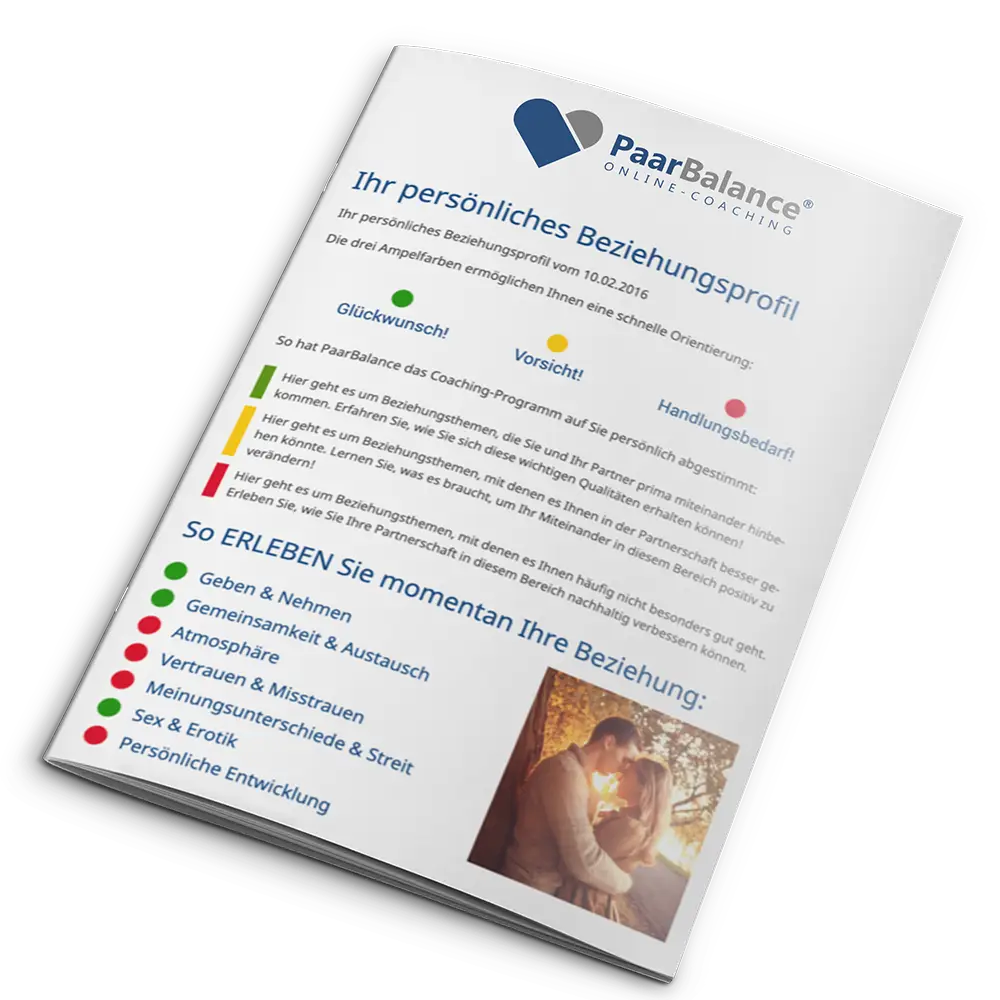
You will find out immediately afterwards in your personal PaarBalance relationship profile (free).
Start your relationship test now!
✓ Scientifically sound
✓ Includes detailed analysis
✓ Your data will not be shared
✓ 100% free & non-binding
100% secure. We comply with data protection regulations. Registration for the relationship test is free .
Please read this important information beforehand:
Data Protection ᐧ Terms and Conditions ᐧ General Information Agreement Terms and Conditions . Transparency Statement
What forms of couples therapy are there? Which one suits me best?
Couple therapy is now offered in various forms.
Alternatives to traditional couples therapy have existed for some time, and these differ significantly in terms of setting and costs.
In the following section, we have compiled questions that may be helpful in choosing the right support.
Our recommendation:
- Pay attention to which criteria are important to you (e.g., the personality of the practitioner, costs) and which are not (e.g., the gender of the practitioner).
- Don't get bogged down in too many "ifs and buts". Focus only on the questions that are personally relevant to you.
- Then make a decision as quickly as possible about which direction you want to go in (or research).
- Take action promptly and concretely , because remember: "There is nothing good unless you do it." (Erich Kästner) 🙂
What appeals to you intuitively? What have you already tried? What did you find helpful, and what didn't? Answer as spontaneously as possible:
- Do I wish we could address our relationship together – or should we each do it on our own first ?
- Could a neutral location with a personal contact person and a clearly defined timeframe be best for both of us?
- Would a male therapist be a better fit for me/us or a female therapist ?
- Would I/we prefer a therapist couple as our counterparts?
- Can I/we open up better to a trusted person or to an outsider ?
- Would it be advantageous for us if we could use personal consultation sessions online , regardless of location – without the need for time-consuming travel ?
- Would we prefer to decide when to address our challenges independently of specific timeframes ?
- Could an online self-help program that we can complete independently be the simplest option for me/us?
Traditional couples therapy on site
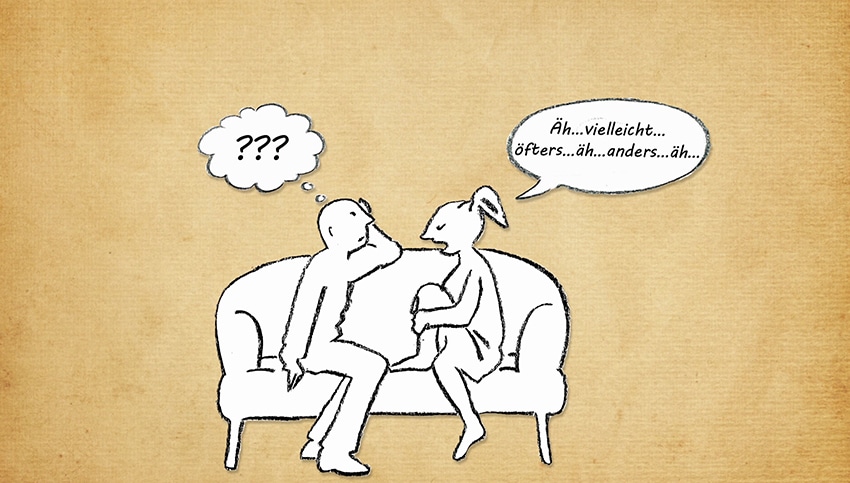
If you would like a 'classic setting' - i.e., couple therapy sessions in on-site treatment rooms - the following constellations are possible :
1. as ' classic' couples counselling with both partners on site & a couples therapist
Cost: approximately €100-200 per hour
2. as ' extended' couples counselling with both partners on site & two couples therapists
-> often a male couples therapist and a female couples therapist
Cost: approx. €120-250 per hour
3. as partnership counseling or relationship coaching for the individual partner on site & a therapist
Cost: approx. €90-120 per hour
Note:
If, in addition to relationship problems, there are psychological complaints with clinical significance, individual psychotherapy can be requested, which will be reimbursed by the health insurance company if appropriate justification is provided.
Research on the internet which colleagues offer which type of treatment in which constellations, using search terms that are personally interesting to you (such as 'couples counseling with two therapists', ' couples therapy online ', etc.).
Here you will find our overview of selected therapists for couples therapy in Munich .
Relationship counseling online & by phone
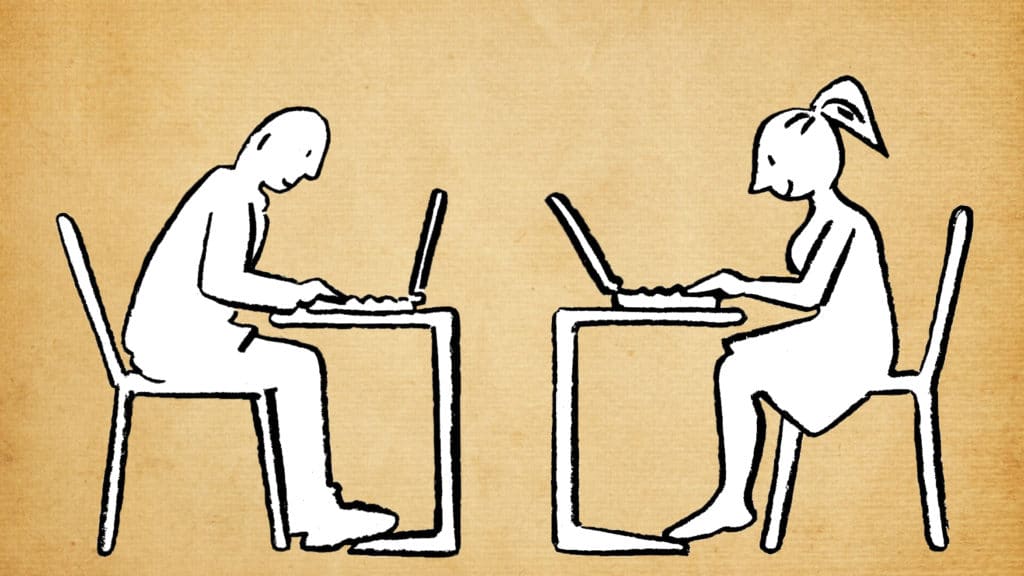
What was hardly conceivable a few years ago is now almost commonplace: therapeutic conversations via telephone, chat or video call.
More and more therapists are offering this type of consultation - more and more clients are finding this option (for logistical reasons) to be relieving and helpful.
Many colleagues now also offer the following 'settings' online or by phone (however, you will probably have to do a little more research to find them):
1. Couples therapy sessions for three people via video call
( both partners & a couples therapist)
Cost : approx. €120-150 per session (between 60 and 90 minutes)
2. Couples therapy sessions for four people via video call
( Both partners & two therapists -> often a male and a female couples therapist)
Cost : approx. €150-180 per session (between 60 and 90 minutes)
3. Individual sessions (focusing on partnership) via telephone or video call
( one partner & one couples therapist)
Cost: approx. €90-120 per session (50-60 min)
Self-administered couples therapy (online tool & bibliotherapy)

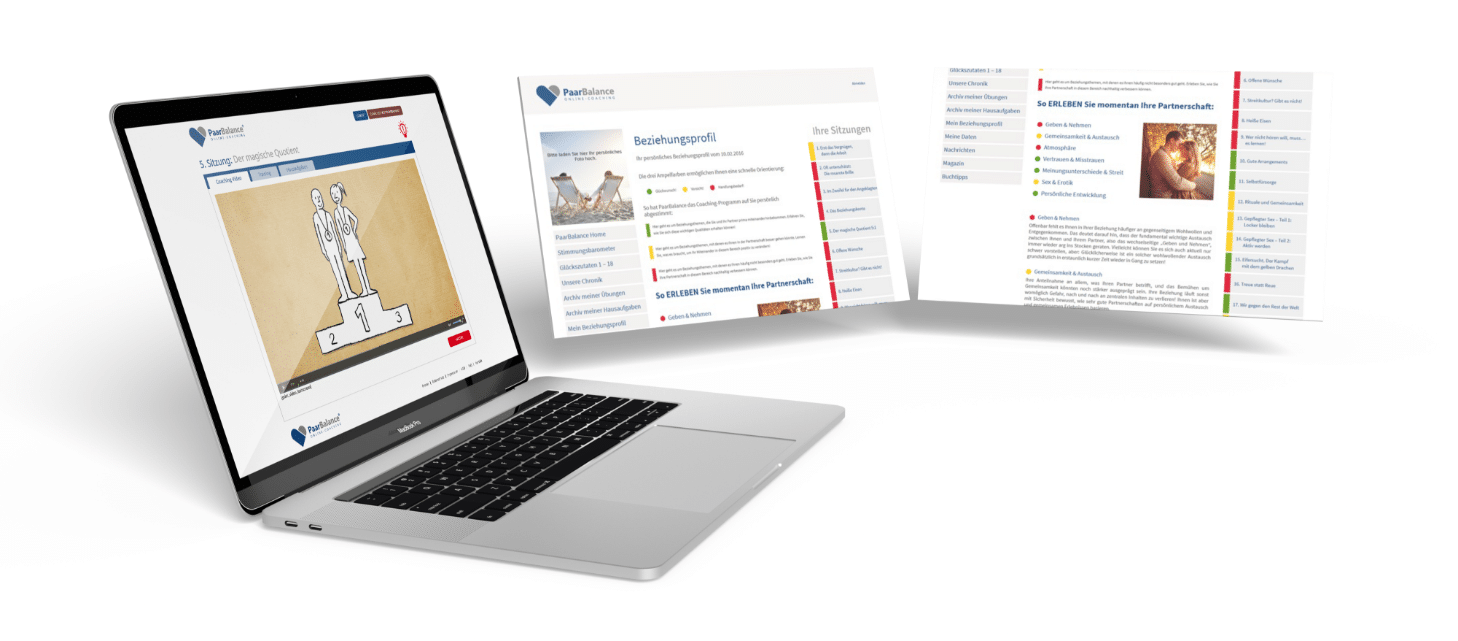
The online self-help program for couples therapy, PaarBalance
For those who prefer to pursue their personal goals independently, PaarBalance might be the right choice:
The tool is scientifically validated and allows each partner to work flexibly (i.e., regardless of time and place, at a self-chosen pace and in freely selectable units) on improving the quality of their relationship.
The core findings from 50 years of couples therapy research and practice are humorously summarized in this partnership program. Anyone interested can conveniently learn the "most important ingredients for a happy long-term relationship" from their computer or smartphone and integrate them into their everyday relationship life.
Recommended implementation :
One to a maximum of two (out of a total of 18) online units per week over a period of approximately 3-4 months.
Cost:
approx. €10 per session (duration approx. 25-30 min; divisible into approximately 10-minute units)
You are welcome to start directly with the PaarBalance relationship test, which precedes the coaching lessons (no obligation & free of charge):
Take your relationship test now! (free)
How is your relationship?
What are your strengths and weaknesses?
You will find out immediately afterwards in your personal PaarBalance relationship profile (free).
Start your relationship test now!
✓ Scientifically sound
✓ Includes detailed analysis
✓ Your data will not be shared
✓ 100% free & non-binding
100% secure. We comply with data protection regulations. Registration for the relationship test is free .
Please read this important information beforehand:
Data Protection ᐧ Terms and Conditions ᐧ General Information Agreement Terms and Conditions . Transparency Statement
Counseling at (church) counseling centers
Competent and effective support for couples and individuals suffering from relationship problems is also offered in church institutions and state counselling centers, which can be found in all major cities (but also in many small towns).
Links to important umbrella organizations can be found here:
- ProFamilia | www.profamilia.de
A non-profit organization with 180 counseling centers throughout Germany, offering advice on contraception, fertility, pregnancy, sexuality, and relationships. Focuses primarily on legal aspects. - German Association for Youth and Marriage Counseling | www.dajeb.de
Non-profit association with a register of 10,000+ local counseling centers. - KBKEFL | www.katholische-beratung.de
Catholic counseling centers throughout Germany. - Caritas | www.caritas.de
Marriage, family and life counselling.
Contact person for acute emergencies

In the event of massive and acute personal or relationship crises (especially if they involve violence or threats in the relationship, suicidality or severe psychological impairments - such as depression, anxiety, substance abuse, etc.), you should contact a crisis center, a specialist doctor or a psychotherapist in your area as soon as possible.
Even if it may feel that way in the acute crisis: You are not alone in your situation!
There are numerous competent supporters who want to be there for you as soon as possible.
The most important criteria for finding the right couples therapy offer for me
Which therapist is the right one for me?

Ultimately, only your gut feeling can 'decide' which advisor you feel most comfortable with.
If your family doctor, relatives or friends who know you well give you a specific recommendation, you can assume that the recommended consultant is very likely to be a good fit for you personally.
However, this requires allowing someone to 'look behind the scenes', i.e., being open about the fact that and why you need couples therapy support.
However, most people find it difficult to communicate in their personal environment when urgent changes are needed in very private or intimate areas (such as sex, communication within a partnership, division of labor, etc.).
Many people with relationship problems therefore prefer to first search for suitable help 'anonymously' on the internet.
Which of the following criteria are important or less important to you ?
- Training of the consultant (e.g., physician, psychologist, alternative practitioner)
- Therapy method (e.g. systemic couple therapy - behavioral therapy - analytical counseling)
- Therapist person (e.g., male/female; younger/older; lively/thoughtful...)
Ideally, arrange an initial introductory meeting as soon as possible and then decide 'from your gut':
- Are we feeling comfortable ?
- Do we feel understood ?
- Do we feel we are being treated fairly ?
Sometimes it takes several attempts until it 'works' equally well for both partners.
What waiting times and treatment duration should I expect?

Unfortunately, average values aren't really helpful here. Waiting times for the first consultation vary considerably among most outpatient counselors.
Sometimes a spontaneous window of opportunity arises on the same day (e.g., due to a cancellation caused by illness), sometimes it can take several months until an initial meeting takes place.
Before the first personal contacts, it is usually not possible to give a definitive answer to the question about the expected scope of couple therapy interventions.
Therefore, it is necessary to inquire individually and, if necessary, to repeatedly check with several institutions/colleagues in parallel to find out about waiting times.
It's often worthwhile to emphasize during the initial phone call (or if you leave a message on an answering machine) that you'll try to schedule an initial consultation even at short notice (for example, if an appointment becomes available at short notice). This can help you arrange the initial consultation relatively quickly, giving you a foot in the door and a sense of whether there's a good fit.
Einzig bei der Inanspruchnahme von Angeboten, die komplett in Eigenregie genutzt werden können (Online-Programme ↑; Selbsthilfeliteratur; Audio-Tools), liegt es in Ihrer Hand zu entscheiden, wann, in welchem Tempo und in welchem zeitlichen Umfang Sie sich mit den Herausforderungen in Ihrer Beziehung beschäftigen möchten.
Hier gibt es keinerlei Wartezeiten oder Vorgaben, wie viele Lektionen / Kapitel in welchem Zeitrahmen, zu welcher Uhrzeit oder in welchem Setting durchlaufen werden 'müssen' - sondern das bestimmen allein Sie selbst.
Die folgenden Fragen können Ihnen dabei helfen, Ihren inneren Kompass bzgl. Wartezeiten & Behandlungsdauer auszurichten und nach persönlicher Relevanz einzelner Faktoren für sich zu entscheiden:
- Können wir noch eine Weile warten oder sollten wir / sollte ich möglichst sofort aktiv werden - ohne Wartezeit?
- Was wäre mir (uns) lieber: Flexible Behandlungseinheiten nach Bedarf? Ein fester Therapie-Platz mit verbindlicher (finanzieller) Vereinbarung?
- Wie lange wäre ich (wären wir) bereit, eine Therapie zu machen? Wochen? Monate? Jahre?
- Bevorzuge ich Beratungseinheiten in kleiner Dosierung oder 'kompakt' (evtl. als Intensiv-Workshop)?
- Würden wir generell ein umfangreiches + intensives Angebot bevorzugen oder möchte ich (möchten wir) lieber so wenig professionelle Unterstützung wie möglich?
Wie kann ich Wartezeiten sinnvoll überbrücken?
Man könnte denken, dass ein Paar, das sich bereits für einen Paartherapieplatz hat vormerken und auf eine Warteliste hat setzen lassen, gewillt ist, etwas Grundsätzliches zu verbessern - und bereits selbst alles dafür tut, damit sich die Dinge positiv verändern.
Aus der Paartherapieforschung wissen wir jedoch, dass 'Wartezeit' als solche bei Paaren, die sehr verstrickt miteinander sind, fast nie automatisch mit einer Verbesserung der Beziehungsqualität einhergeht.
Das bedeutet: Auch wenn ein Paar weiß, dass der Beginn einer Paartherapie näher rückt, führt das leider noch nicht dazu, dass sich Frequenz oder Heftigkeit von Streitigkeiten bereits reduzieren oder es den Betroffenen gelingt, freundlicher miteinander umzugehen.
Eingeschliffene negative Muster lösen sich in der Regel erst dann auf, wenn gezielt und aktiv - und mit innerem Commitment und idealerweise einer verlässlichen Orientierungshilfe - das Thema "Beziehung verbessern" in den Fokus gerückt wird.
Wer also wirklich den Wunsch nach einer tiefgreifenden Veränderung hat, sollte am besten sofort damit starten, etwas für die Verbesserung des Miteinanders zu tun - bis die Paartherapie offiziell beginnt.
Two proven ways to tackle the topic of "More partnership quality" immediately on your own (yet with guidance) are, for example, the use of a structured online self-help program ↑ or therapeutic self-help manuals with integrated exercises ↓ .
Can I do couples therapy on my own?

It is a misconception to think that relationship counseling is only effective when a couple 'goes in together'. Rather, it is often experienced as a great relief simply to be able to put one's own wishes, needs, and moments of disappointment into words and sort them out.
Especially when problems have existed for a long time or when heated arguments repeatedly arise over the same topics (children, sex, balance between private and professional life, male-female stereotypes, etc.), it can make sense for each partner to first discuss the matter calmly with a couples therapist on their own – without the other person listening.
When you change yourself, for example with the help of therapy or coaching, your partner and the relationship automatically change as well.
Therefore, do not forgo couples counseling or therapy even if your partner does not want to actively participate at the beginning (or even permanently).
If you consistently strive for positive change, your partner will (sooner or later) follow suit (have to). 😉 This happens quite naturally – according to the principles of so-called 'reciprocity'.
Against this background , the interactive online couples therapy from PaarBalance is deliberately tailored to the individual and designed so that the program can theoretically also be carried out "secretly" - i.e. without the knowledge of the other person.
Accordingly, the focus of the inventory before the actual program start (see PaarBalance relationship test & relationship profile) is also on the individual perceptions, attitudes and behavioral patterns of the person answering the questions.
Couples therapy costs: What can we expect?
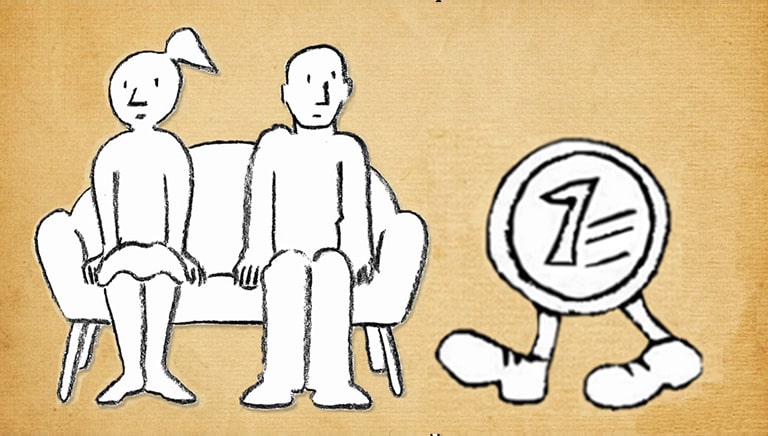
Couples therapy is (unfortunately) not covered by health insurance, meaning the associated (potentially not insignificant) costs must be borne by the individual.
However, there are also relatively inexpensive alternatives to traditional couples therapy.
In our article on couples therapy costs, you will find a detailed description of the different couples therapy options, the expected (usage) fees, and answers to the following questions:
- Will therapy always incur costs that I have to pay privately ?
- Does it make sense to ask my health insurance company if they might support me?
- Are there also professional support services for couples that do not incur any (private) costs ?
When and for whom is couples therapy & relationship coaching beneficial?
The most common reasons why couples seek help
There are many reasons why someone might consider couples counseling or relationship coaching one day: failed communication, escalating conflicts, too little sex, arguments about raising children, problems with overbearing parents, a perceived unfair division of household chores, and much more.

It is usually not one argument that 'makes the cup run over', or a specific trigger that ultimately makes couples unhappy, but rather a persistent, diffuse dissatisfaction hangs in the air at some point - and there is no solution in sight for how to end the unpleasant atmosphere.
Perhaps you too will find yourself reflected in one of the following statements (from clients at the beginning of a consultation):
- "We get irritated incredibly easily and argue a lot."
- "My wife and I often talk past each other."
- "My husband and I often have completely different ideas on almost all important topics (raising our children, our role as parents, division of labor in the family, leisure activities, finances...)."
- "Tenderness? Intimacy? Sexuality? They no longer exist between us."
- "We somehow 'lost' each other as a couple."
- "I have the feeling that we are becoming increasingly estranged."
- "I'm just not happy in our relationship anymore."
Negative external events can sometimes bring couples even closer together.
However, relationships can also be thrown into crisis when shaken by challenges such as the following:
- unemployment
- a professional conflict situation
- the illness of a relative
- a traumatic experience (e.g. the loss of a loved one)

But even a 'positive' milestone can throw a love affair into great turmoil, such as:
- moving into their first shared apartment
- Vacation
- Wedding
- the birth of a child
- Moving, renovation or house construction
Instead of being on cloud nine - because they have finally moved into their first apartment, started their summer vacation or had their long-awaited child born - the couple unexpectedly finds themselves in a crisis.
Many people are unaware that this can happen, which naturally makes them even more insecure.

Who can access couples therapy and relationship counseling?
In principle, partnership or ' marriage counseling ' can be used by anyone - regardless of whether the individuals (or couples)
- married, unmarried, divorced,
- Believer or not,
- heterosexual, homosexual, bisexual, transsexual,
- (Step)mother / (Step)father, childless,
- young, middle-aged or very old
- ... are.
This also applies to institutions with a church sponsor of a particular denomination.
Good to know:
As a rule, couples counseling can be used not only by a couple together, but also by an individual.
This can be helpful, for example, if someone wants to "feel things out" first, or if both parties are not yet equally open to external support.
For whom is couples therapy not suitable?
Helping a couple out of a crisis becomes very difficult, if not impossible, when
- severe mental impairments (such as depression, 'narcissism', obsessive-compulsive disorder, severe anxiety) or addiction (alcohol, drug, gambling addiction, etc.) are present or
- the coexistence is characterized by violence, abuse, or suicidal crises.
Does any of this apply to your relationship?
Then you should contact a suitable crisis center, a specialist doctor or a psychotherapist in your area as soon as possible (see also our addresses & contact persons for acute emergencies ).

What are the goals of couples counseling and relationship coaching?
The exact treatment goals vary from couple to couple and from relationship constellation to relationship constellation - depending on the strengths and weaknesses of the respective relationship, what each partner suffers from, and what changes the individual couples desire.
Nevertheless, a few overarching therapeutic goals can be identified. For example, couples (or people in a committed relationship) should almost always be helped with the help of professional support services during the course of a counseling process to:
- to strengthen the couple's relationship overall
- to develop a shared future perspective
- to acquire the most comprehensive relationship knowledge possible
- to improve understanding of one's own needs and those of others
- to reconcile and forgive each other
- to (re)learn the 'dos and don'ts' for successful communication
- Resolving relationship problems and conflicts with one another
- to prevent a breakup (see also our blog article " Should I break up? The most important questions, considerations & help ")
In order to derive the most important goals for change, a clear assessment of the state of one's own love life is needed.
The scientifically validated relationship test from PaarBalance provides you with a sound overview of how you perceive the quality of your relationship in important areas and how you can shape your interactions (duration: approx. 10 minutes).
You can start immediately and will receive your personal relationship profile shortly afterwards ( free of charge ):
Take your relationship test now! (free)
How is your relationship?
What are your strengths and weaknesses?
You will find out immediately afterwards in your personal PaarBalance relationship profile (free).
Start your relationship test now!
✓ Scientifically sound
✓ Includes detailed analysis
✓ Your data will not be shared
✓ 100% free & non-binding
100% secure. We comply with data protection regulations. Registration for the relationship test is free .
Please read this important information beforehand:
Data Protection ᐧ Terms and Conditions ᐧ General Information Agreement Terms and Conditions . Transparency Statement
Quick break-up and finding a new partner as an alternative?

Important to know:
New relationships entered into after a separation or divorce are usually not more stable and happier; in fact, the separation rate is considerably higher.
So, things won't automatically get better with the next partner . It's not realistic to assume that everyone involved has learned from past mistakes and is now immune to falling into bad patterns again.
Daher ist es auch so lohnenswert, mit seinem jetzigen Partner - den man sich ja in der Regel selbst ausgesucht hat und offenbar mal sehr gern hatte 🙂 - noch einmal einen ernsthaften Beziehungsversuch zu starten, nach dem Motto:
"Lieber mit dem alten Partner etwas Neues erleben als mit einem neuen wieder das Alte."
Je länger eine Beziehung besteht, desto mehr hat sich das entwickelt, was wir als ‚Bindung‘ spüren. Der andere ist Teil meines Ichs, meiner Biographie geworden. Das lässt sich nicht mal eben abschneiden und austauschen.
Achtung: Sollte sich Ihre aktuelle Partnerschaft um eine toxische Beziehung handeln, so steht Ihre eigene Gesundheit und Wohlbefinden ganz besonders im Vordergrund!
Kann ich es auch ohne Paartherapie schaffen?
Diese Frage ist nicht pauschal zu beantworten. Grundsätzlich empfehlen wir:
Holen Sie sich im Zweifelsfall lieber (zu) früh als (zu) spät externe Hilfe.
"Was habe ich selbst schon probiert, um unsere Beziehung zu verbessern?"
Versuchen Sie, sich die folgenden Fragen zu beantworten:
- Was habe ich, was haben wir selbst schon alles versucht, um gute Lösungen zu finden und unsere Konflikte dauerhaft in den Griff zu bekommen?
- Ist es die 'Mission' von uns beiden, unsere Liebe zu retten - oder weiß der andere womöglich gar nicht, wie (schlecht) es mir geht, wo ich stehe und was ich brauche?
- Wissen wir, wie befreundete Paare zurückliegende Krisen gelöst haben? Könnte uns das weiterhelfen?
- Gibt es Freunde, mit denen wir uns offen austauschen könnten (bzw. sollten)?
- Wären ich bzw. wir wirklich dazu bereit, mit einem vollkommen Außenstehenden über unsere Probleme zu sprechen?

Offene Gespräche mit guten Freunden als Lösung?
Wenn man selbst irgendwo 'feststeckt' und sich Unterstützung wünscht, kann es sehr hilfreich sein, sich einem engen Freund, einer guten Freundin oder einem Familienangehörigen anzuvertrauen. Das gilt für alle relevanten Themen - und nicht nur für Schwierigkeiten in der Beziehung.
Manche Angehörige sind wunderbare Ratgeber, die auch die Funktion eines externen, unparteiischen Beraters übernehmen können - zumindest phasenweise.
Wenn es gelingt, mit vertrauten Menschen ehrliche Gespräche zu führen, in denen man sich öffnen und die eigenen Bedürfnisse in Worte fassen kann, bei denen zusammen nach einer konstruktiven Lösung für die aktuelle Problematik gesucht wird und nach denen man sich zuversichtlicher und ermutigt fühlt - ist das etwas Wunderbares. Davon profitiert dann auch die Paarbeziehung.
The problem that can arise when you talk to close confidants about a difficult situation between you and your partner is the following:
Many of your loved ones are probably not neutral. Rather, they are – and quite rightly – most likely on your side. They want you to get better as soon as possible.
This can lead to them automatically finding themselves on the 'opposite side' of their partner. And that can initially feel very liberating.
What happens when a good friend is frustrated themselves, has experienced something supposedly similar, or generally wants to protect you from pain?
Then comments or advice may be biased in such a way that they continue to reinforce the same point – making it even harder for you to bridge the gap that has been created.
Sometimes it can even become really difficult to communicate with your friends later on, to understand each other better 'as a couple' again. Then you might hear things like: 'What?! You're getting back together with that jerk ?!'
Therefore, you should carefully consider whether and when it makes sense to involve friends (or relatives) as relationship advisors.

Most people have a fairly reliable sense of who they can talk to uncensored about intimate 'hot topics' - and who they probably shouldn't.
If you are unsure who from your personal circle might be a helpful conversation partner for you and your specific situation, you should seek 'external' advice.
A neutral outsider has the necessary inner distance - and is neither on one side nor the other.
Only when a balanced view of the constructive as well as the problematic behavior patterns of both parties is possible can it be determined who contributed to which developments and sharpened the focus on what contribution is needed from each individual so that things can develop in a positive direction again.
Why so many couples come to couples therapy too late
One might think that nowadays there's no longer much shame associated with seeking psychotherapy, counseling, or coaching. Unfortunately, that's not the case.
Many people still come to couples counseling very late (and unfortunately often too late) - for example because they think (for too long) that partnership is something so private that "you have to sort it out yourself somehow" - even when the relationship has been going badly for a long time and the level of distress is high.
Sometimes only one person is willing to seek professional help, while the other stubbornly resists (for too long).
When it's " five minutes to midnight " and "the damage is already done", counselors are often left with only separation support.
This is deeply regrettable. Not only because 'separation' is one of the worst and most painful life events, but also because it usually wouldn't have taken much change to fundamentally improve the relationship.
Why it's worth saving your relationship
There were compelling reasons why you and your partner came together and have stayed together to this day. You probably found your partner attractive, took them to heart, shared many experiences, and felt that you belonged together and needed each other. Perhaps you also developed the desire to start a family, raise children, and be parents.
The influence of relationship happiness on our health
A stable and supportive relationship is the key variable for mental and physical health – with significant effects well into old age. Therefore, it is (almost always) worthwhile to do everything possible to (re)establish a happy partnership.
'Separation' and 'divorce' are among the most stressful life events. As a rule, every effort should be made to prevent a final breakup.
Therefore, intensively exploring how you can (re)enrich your relationship is the best thing you can do for your life and your health.
Decide now and here to do everything in your power in the coming weeks and months to make your love blossom again.
Stop the 're-education program' & improve your own quality of life
How do we deal with the fact that our partner is different from ourselves? Or different from how we would like them to be?
The 'crisis couples' are usually those who perceive the other as 'not right' and one day start 'the big re-education program' because they are increasingly annoyed by their partner's 'annoying' characteristics and behaviors.
But we should all be aware of this:
Trying to change someone else against their wishes and will is always doomed to failure.
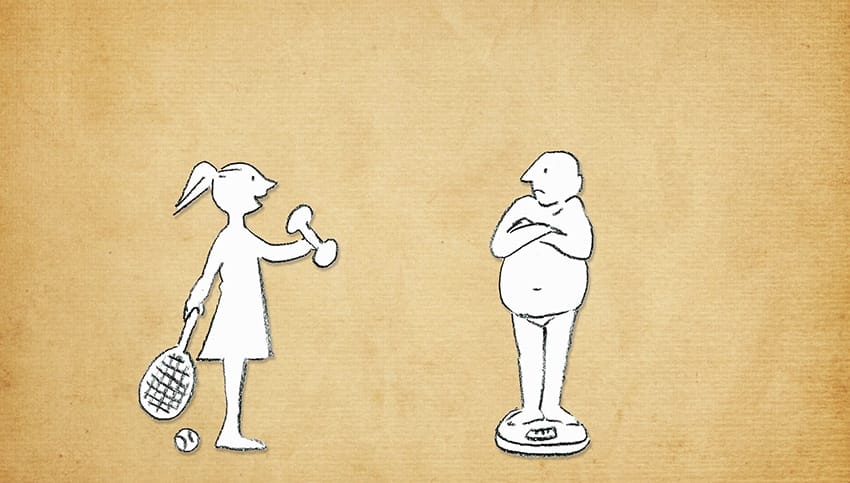
Therapeutic support can be very helpful in figuring out where change is possible and where it is not, in which areas it is important to become active and creative - and when 'acceptance' and 'serenity' would be the more promising qualities.
Can you answer the following questions:
- Am I ready to change something about myself?
- Am I ready to accept the other person as a whole?
- Am I prepared to (carefully) support the other person in achieving their personal goals – even if these do not align with my own?
In a consultation setting or an interactive online coaching session , it is possible to work out which specific areas of change and acceptance are involved.
If we stubbornly fight to change something that cannot be changed (e.g., because the other person cannot or will not achieve change), we will repeatedly get a bloody nose – essentially running into the same wall and refusing to believe that no gate can be opened there, no matter how persistent we are.
"Our starting point is very difficult!" - Does couples therapy still make sense?
Is couples therapy advisable after an affair?
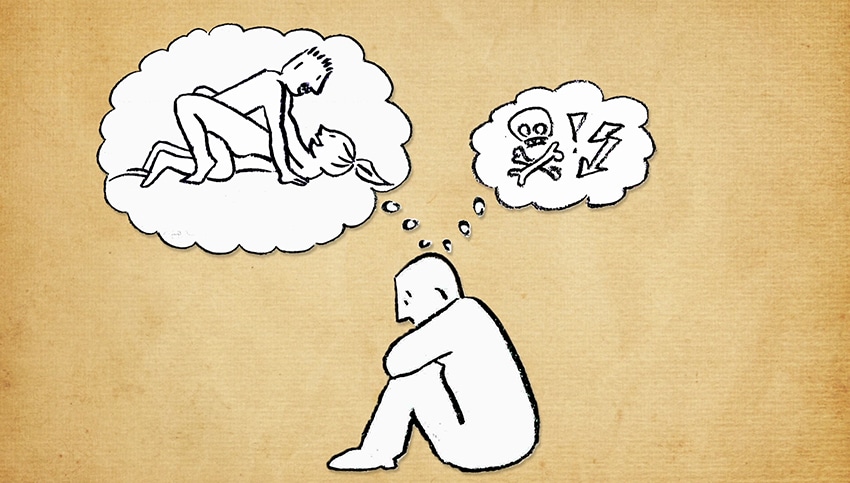
The ultimate disaster for relationships: An affair has been exposed!
The greatest possible breach of trust has occurred. The pain, anger, and despair are almost unbearable. To learn that the person you trust has betrayed and lied to you, that they didn't actively say "No!" to temptation, that they allowed themselves to be swept away in a maelstrom of temptation and lies, that they had intimacy and sex with another woman or man and were apparently able to completely ignore their committed relationship during that time:
That! Hurts! Infinitely!
For many couples, that's the reason for an immediate breakup.
In the mind of the betrayed person, the same films play on an endless loop:
A couple lies aroused, having sex.
The woman moans.
The man moans.
A short pause.
The woman whispers: I want you again.
The man whispers: I want you too.
And again from the beginning:
A couple lies aroused on top of each other and has sex.
The woman moans.
The man moans.
A short pause.
The woman whispers: (...) etc. etc.
In the betrayed person, the carousel of fantasies and thoughts spins incessantly and cannot be stopped.
"Isn't it all too late anyway once an affair has taken place?"
No!
"Does it even make sense to talk to an outsider after such a catastrophic breach of trust?"
Yes!
In many cases, it is possible to turn things around with professional help, so that those affected – even if they themselves would never have thought it possible at first – can often emerge from the chaos strengthened and mature (and most importantly: together!) .
Especially in such an exceptional situation, going to a couples therapist or engaging with a sound first-aid program for orientation after infidelity can be extremely important, so that no more china is broken in the heat of the moment.
How to behave 'correctly' and regain control of your life if your partner has cheated is explained in our article "Forgiving an Affair" .
"Crisis as an opportunity" – there's a lot of truth to that. The biggest crises often hold the greatest opportunities.
In light of this, we would therefore strongly recommend:
Get expert support!
For most people who have been cheated on, it is best to first come to terms with the situation on their own in order to regain their footing before the couple can think about how to proceed and what is needed to possibly attempt a fresh start.
Does couples therapy help when feelings are gone?

Perhaps you sometimes think: "Everything just plods along boringly between us now. Day in, day out. Not much is left of the initial passion and joy we had for each other. If only we would still argue!"
Arguing is often equated with: "There's still interest in the other person!" "There are still strong feelings!" "Where there are conflicts, passion is never far away," etc.
The converse conclusion – that where there are no (more) conflicts, a permanent lack of love and interest has spread – is not correct.
Rather, it is usually far more difficult to help couples who have deeply hurt each other in escalated arguments to rebuild a respectful relationship. Where much has been broken, much must be mended – what was once precious and beautiful will always remain damaged. Some wounds never fully heal.
Unearthing beautiful feelings that have been somewhat buried over time and bringing them back to life through regular 'watering' and 'fertilizing' is usually much easier and faster.

There are many proven strategies that can help reconnect with those intimate moments. Feelings can't be forced, but they can be rediscovered. And that's considerably easier when we're not simultaneously preoccupied with treating serious injuries.
Couple therapy or relationship coaching can be the perfect lever to restart and support the worthwhile process of becoming active, rediscovering, and establishing beautiful rituals.
Learn more about this topic in our two blog articles:
" Help! My relationship has gone stale ": When feelings have faded
" Relationship without initial infatuation ": When there were no strong feelings from the beginning.
Professional help through bibliotherapy and audio programs
Bibliotherapy refers to the targeted use of literature to support healing, for healing itself and/or for personal growth.
Those who enjoy reading should specifically look for serious literature or audiobooks on relationship topics relevant to them in their local library or bookstore, or on relevant book portals.
Highly recommended: workbooks and books with exercises and training units that offer space for your own thoughts and plans.
As a basic text, the popular self-help classic by renowned couples therapist Prof. Dr. Ludwig Schindler & colleagues is recommended here :
"Relationship problems? - How to make your relationship work - Handbook for couples" (Springer-Verlag; 6th edition)
ISBN number: 3662603357

Many people desperately seek support when an affair is discovered and their relationship is shaken to its core. For this group of people seeking help, we would like to draw your attention to the audio program "Taboo Topic: Affairs" ↗ , which offers structure and support in this exceptional situation through insightful interviews, clear guidance, and useful materials.

What is the process of a traditional couples therapy?
Although there are 'manuals' for couple therapists that offer guidance based on a proven guideline, the course of a therapy process and the content of the conversations are ultimately as different as the individuals themselves.
The optimal preparation for couples therapy
The best way to prepare for the start of couples therapy or counseling is to honestly examine the current state of your relationship: with all its similarities and strengths, as well as all its challenges and weaknesses.
The (free) relationship test from PaarBalance helps you with exactly this. In a relationship profile individually tailored to your personal situation (which you can save, print or send as a PDF), you receive a clear overview of your resources and areas of risk.
The relationship profile is a very good basis from which you can start further couples counseling together with your couples therapist.
If both partners answer the test authentically and then compare their relationship profiles, this can lead to an exciting and dynamic start to therapy.
During the consultation process, the following aspects typically come into focus:
The subjective perception of each individual
First, you are given the opportunity to talk about how you are feeling and how you experience your relationship. You are given the space to share your own feelings, personal perspectives, and perceptions, while the other person is encouraged to simply listen and understand – before they can offer their own perspective.
Topics, wishes & goals
A primary goal of almost every couples therapy is to restore a positive and constructive dialogue between the two partners.
This requires answering several key questions:
- Why and in what area do you (and your partner) need support?
- What brought you two together? What attracted you? What did you like about each other?
- Are there any wounds that have not yet healed?
- Are you (both) (in principle) willing to forgive each other for hurt feelings and to look ahead as a couple?
- What should stay the same?
- What would you like to be different than it is now?
- What goals for the partnership can be derived from this?
- What could be the first steps towards achieving these goals?
- What needs to happen for the meeting to have been 'worth it' for you?
Concrete solutions
Past attempts at finding solutions and their results are discussed. Sometimes (new) solutions emerge spontaneously, while other times it takes quite a while (and is part of the relationship work) before a couple (e.g., one that is very estranged) manages to formulate and agree upon concrete and realistic wishes and goals.
Feedback
The couples therapist will share their impressions and observations with you. Often, they will give you an "assignment," a suggestion for what you should (or could) do or avoid during a specific period – or you will develop plans together for the time between sessions. These "homework" tasks are usually discussed in detail before and after each session.
Time for implementation between sessions
Sufficient time is needed between sessions. This time is necessary to allow the topics discussed, as well as any "aha" moments, to sink in, for solutions to be implemented and observed, and for the resulting changes to take effect. The specific amount of time required for your individual relationship situation will be discussed with your couples therapist or relationship counselor from session to session.
Blendend Learning
From psychotherapy research we know that so-called 'blended learning' has the greatest effect on change: a combination of classic face-to-face contacts (with a personal advisor / therapist) and a scientifically verified online coaching program (such as PaarBalance ).
The reason: Both forms of intervention can complement each other perfectly and enrich each other mutually.
We hope that this overview article has helped you to choose the right path for yourself, and we wish you all the best!
Yours sincerely, Dr. Judith Gastner & the entire PaarBalance team
☝🏻 Related articles on the topic "Couples therapy - When is it useful?"
Frequently Asked Questions
What is couples therapy?
Couples therapy is a facilitated conversation between partners, in which the therapist imparts relationship knowledge and acts as a mediator. They promote a conciliatory and respectful attitude, ensure that both parties have the opportunity to speak (constructively), and help to find good compromises and new solutions.
Is couples therapy the same as couples counseling?
Couples therapy and couples counseling have much in common, but strictly speaking, they are not the same. Both methods offer help for self-help, but the focus differs somewhat: Couples therapy often delves deeper into the causes of current challenges, while couples counseling tends to seek quick solutions for specific problem areas.
When should you go to couples therapy?
Couples therapy can be beneficial at various stages of a relationship, for example, in cases of recurring conflicts, persistent communication problems, uncertainty about the future, or after infidelity. It can also be helpful as a preventative measure ("I want to avoid repeating past mistakes in my new relationship").
Who is couples therapy suitable for?
Couples therapy is aimed, among other things, at couples where taboo topics have become entrenched, topics that are not discussed, or where conflicts repeatedly arise due to the same triggers. If a couple can no longer find common ground or increasingly has thoughts of separation, couples therapy can be the best way to get their relationship back on track.
What can a couple expect in couples therapy?
The course of couples therapy depends on the individual style of the therapist and the specific couple. A typical process involves defining concrete goals after an initial consultation. The next step is to understand strengths, unmet desires and needs, as well as past hurts. New behaviors and attitudes are developed, which the couple then tries to implement between sessions.
What are the prerequisites for couples therapy?
Both partners must be willing to examine their existing attitudes and behavioral patterns, try out new things in everyday life, and practice them. Only then can couples therapy be successful. Patience, respect, and goodwill are essential prerequisites. Openness towards both the partner and the therapist is also crucial.