







☝🏻 Quick start: Couples counseling - Will it save our relationship?
Relationship stress is awful! It drains us like almost nothing else and robs us of all lightness. Unfortunately, many couples stumble at some point during a long-term relationship. But while most people rush to the dentist for a toothache, they hesitate for a long time before seeking professional help when their relationship is hurting. Why is that?
Relationship problems are still a taboo subject. The attitude that you're expected to sort things out yourself when things are tense at home is still widespread – and besides, no complete outsider can really help you when you're stressed with your partner. After all, they're very private problems... right?!
Fortunately, neither is correct!
- No one should have to cope with a serious crisis alone – not even a relationship crisis.
- There are professional support services and scientifically sound programs that can help with relationship problems – often surprisingly quickly.
Therefore: Get outside support if things aren't (or no longer) running smoothly at home – the sooner, the better. You have nothing to lose and everything to gain.
🚀 Already 65,511 people have gained clarity through the test.
Couples counseling can help you with these problems.
We strongly recommend that you start couples counseling if
- there is no (longer) respectful communication between you
- Closeness, respect , and goodwill have significantly decreased.
- infidelity has occurred
- there are “ taboo topics ” that overshadow the entire relationship.
- Significant changes (birth or departure of a child, caring for a relative, death of a family member, illness of a partner...) have completely turned your life upside down.
- There are recurring conflicts due to the same challenges.
- They feel like they're sitting on a powder keg that could explode at any moment.
- You might be wondering if you and your partner are even compatible .
- They feel that their relationship is developing in an unhealthy direction.
- They are thinking more and more often about separation or divorce
Even though most couples counseling sessions begin with a goal ( "We want to argue less" ) or a "task" ( "Help us process my wife's affair!" ), ultimately, couples counseling always has an open outcome. As the process unfolds, it will become clear where the journey will ultimately lead.
But in any case, it is invaluable to intensively examine your own needs and desires, strengths and challenges (within the context of the existing partnership).
Even if you should one day decide to go your separate ways: starting the future with the uncertainty of "Did I really try everything to save our love?" would be extremely detrimental.
Who is the right couples counselor for me?

The term "couples counselor" is not legally protected in Germany. Therefore, in principle, anyone can offer couples counseling. This makes it all the more important to pay attention to professional qualifications.
If the person holds a diploma in psychology or an M.Sc. in psychology, they have completed a thorough psychology degree.
Those who work as psychological psychotherapists have completed several years of additional training. However, social scientists, people from various healthcare professions, and theologians also often focus on couples therapy and counseling.
Besides their training, consultants also differ in their working methods (e.g., behavioral therapy, psychodynamic therapy, systemic therapy, etc.). It's worthwhile to find out in advance which approach best suits your own needs.
At besser:lieben you will find experienced advisors who will provide you with individual support – online or in person. Thanks to the search function, you can specifically select the support that best suits your personal situation.
Last but not least, personal feeling plays a significant role: A couples counselor who is a perfect fit for one couple may not be right for another – and vice versa. Make sure you feel comfortable with your counselor. If you feel uncertain after the initial consultation, it can be helpful to meet with an alternative counselor to find the best possible match.
Is it perhaps already too late for us?
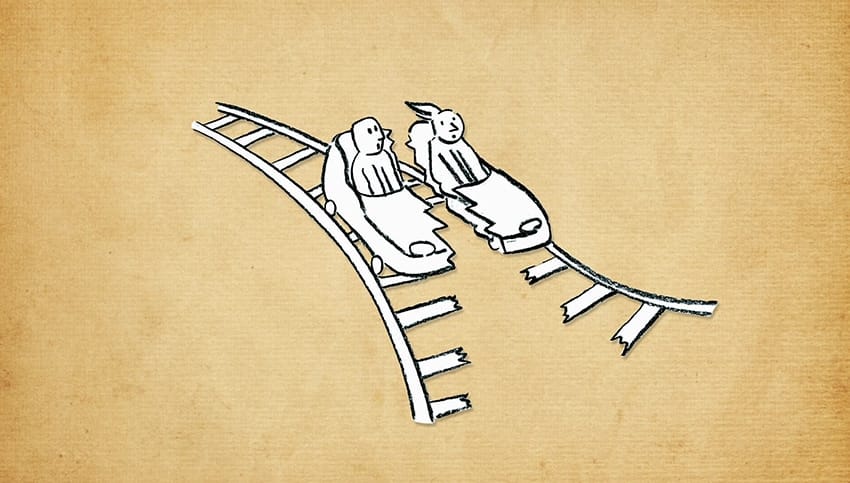
You may be having fundamental doubts about your relationship right now. Because everyday life together has become a "war zone" and you haven't treated each other kindly for quite some time. In such a crisis, it's perfectly understandable that you're no longer sure if there's anything left to save.
Examine the current state of your relationship as 'ruthlessly' as possible!
When arguments and misunderstandings are commonplace, the resources and positive aspects of the relationship so far are completely overshadowed. This makes it all the more important to take an unbiased look at the couple's relationship as a whole.
- What is worth fighting for?
- What has defined you both as a couple so far?
- Where do you stand today – and why?
The scientifically based CoupleBalance relationship test is ideal for summarizing the key strengths and weaknesses of your partnership at a glance. (Duration approx. 10 minutes, free & no obligation)
Take your relationship test now! (free)
How is your relationship?
What are your strengths and weaknesses?
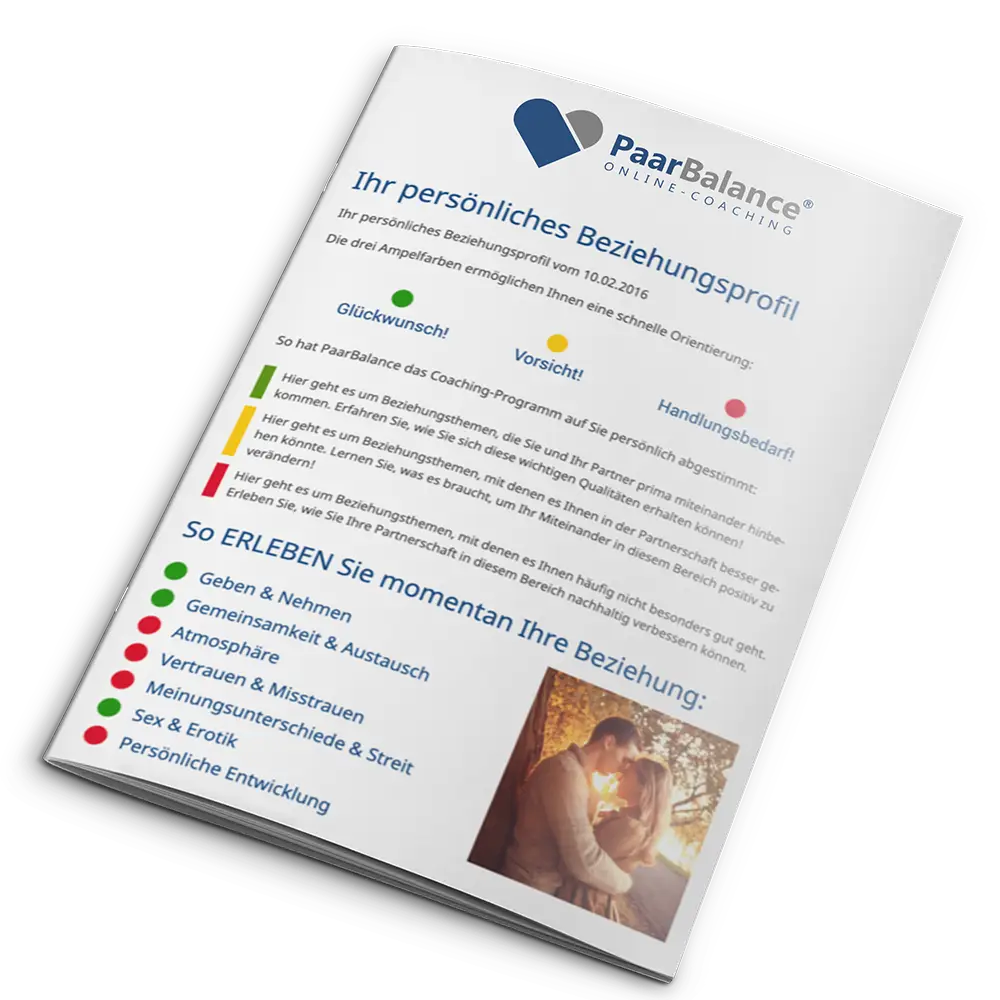
You will find out immediately afterwards in your personal PaarBalance relationship profile (free).
Start your relationship test now!
✓ Scientifically sound
✓ Includes detailed analysis
✓ Your data will not be shared
✓ 100% free & non-binding
100% secure. We comply with data protection regulations. Registration for the relationship test is free .
Please read this important information beforehand:
Data Protection ᐧ Terms and Conditions ᐧ General Information Agreement Terms and Conditions . Transparency Statement
After that, you will probably have a much clearer picture - and be able to make a good decision about what your next steps should be.
What can we expect in couples counseling?
How do couples counseling sessions work?
No two couples counseling sessions are alike. The counseling process is inextricably linked to the individual problems, experiences, and characteristics of the couple, the counselor's training and personal style, the relationship dynamics, the agreements of all involved, and their respective interactions. Therefore, we can only outline a prototypical process below:
The introductory meeting
Couples counseling usually begins with an initial consultation, during which the counselor and the couple meet in person for the first time. In this meeting, you will discuss your specific concerns and the quality of your relationship. The counselor will gain a first impression of who you are and how you interact. They will try to get as clear an overview as possible of your problem areas and strengths.
An important goal of this initial consultation is to determine whether there is a good rapport between all parties involved – as this is the fundamental prerequisite for a successful counseling process. You will be discussing intimate details of your life. A relationship of trust is therefore essential.
The objective
Following the initial consultation, a specific goal for couples counseling is usually defined. Areas where changes are desired are identified, and a target state is established as a goal to work towards. It is important that the partners can agree on a shared goal that both find desirable. Only then does it make sense to consider intermediate goals and concrete steps that allow both partners to confirm (and feel) that they are on the right track.
The process
In subsequent counseling sessions, the goal is to illuminate the couple's history and each partner's individual biographical background in such a way that all involved can understand as clearly as possible why the couple is where they are today. With this better understanding of their individual and shared developmental history, the couples counselor and the couple can work towards their agreed-upon goals step by step and anticipate or remove potential obstacles. The methods used depend on the individual counselor's approach. Many couples counselors also conduct individual sessions with each partner before resuming sessions with all three of them.
The general principle is that the most significant changes occur between counseling sessions. During these sessions, the partners work together to clarify, reflect, question, understand, correct, and experiment. This creates the conditions for new attitudes and behaviors to develop that are beneficial to the relationship. However, the partners must then implement what they have learned and developed at home.
An important part of the subsequent counseling session will be to reflect together on what worked, where difficulties arose, and how a particular change affected each individual's emotions and perspective, as well as the partnership as a whole. Anything that proves helpful must be gradually integrated into daily (relationship) life so that it can take root and have a long-term positive impact on the quality of the relationship.
The frequency of counseling sessions is determined jointly by the couple and the counselor. A weekly interval is often recommended to start. This can be gradually increased to several weeks as the therapy progresses, allowing the professional support to be phased out.
The closing session
The counseling usually concludes with a joint final session in which the changes are reflected upon and what has been learned is articulated and thus reinforced. Furthermore, a look toward the future is taken together, and helpful perspectives (in the sense of 'relapse prevention' and targeted 'empowerment') are developed.
How much does couples counseling cost?
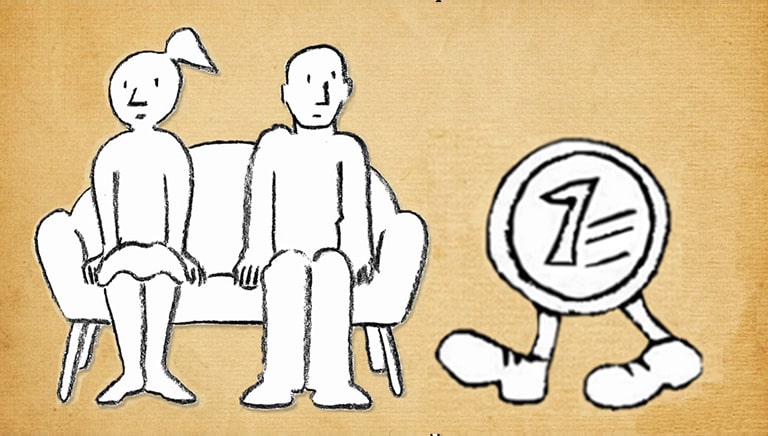
Although divorce rates in large cities (such as Hamburg, Berlin, Cologne or Munich...) are around 50 percent and separations are proven to have far-reaching negative health consequences, the costs of couples therapy are still not covered by health insurance and must therefore be borne by the couple themselves .
Generally, a self-employed couples counselor sets their own fees. Therefore, it's impossible to make universally applicable statements about the cost of relationship counseling. As a guideline, the price for a counseling session (usually lasting between 60 and 120 minutes) varies between €80 and €300. The number of sessions a couple requires is agreed upon individually. Often, about 6 to 10 sessions are helpful to achieve lasting improvements.
Depending on the problem areas, the severity of the conflicts, the counselor's working methods and pricing, the couple's treatment goals, etc., the total cost of couples counseling can vary considerably. It usually ranges from one thousand to several thousand euros .
At church-run or municipal marriage, family, and life counseling centers, the costs are often covered by the sponsoring organizations, so couples seeking help can receive support free of charge or on a donation basis. Find out which centers are available in your area.
And what if the relationship can no longer be saved?
Many relationships can be saved through couples counseling - even those that are in deep crisis and where the partners fear there is no hope left.
And yet: Not all partnerships have a (bright...) future. In some cases, counseling reveals that the partners have conflicting expectations of marriage, their future plans are incompatible, or their conflicts are irresolvable. Such couples may then, together with the therapist, conclude that separation is the best course of action. Counseling, therefore, is not designed to prevent a relationship from ending at all costs.
In solchen Fällen kann eine begleitete Trennung stattfinden: Der Paartherapeut wird zum Trennungsberater und wirkt mit, dass der Prozess des Auseinandergehens möglichst respektvoll gelingt. Ein Paar - und ggf. die ganze Familie - kann also auch dann sehr von einer Paarberatung profitieren, wenn sich die Beteiligten am Ende für eine Trennung entscheiden.
Lesen Sie in diesem Zusammenhang gerne auch unseren Artikel Beziehungen retten.
Welche Alternativen gibt es?
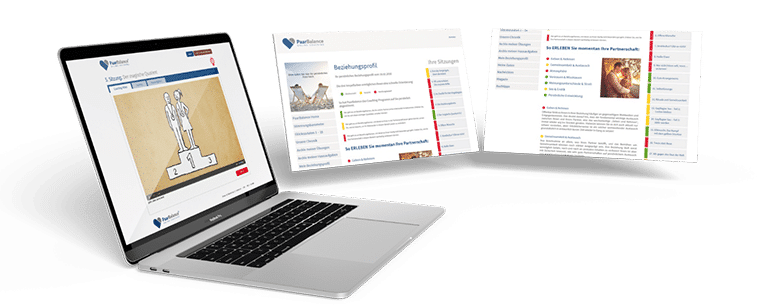
Vielleicht haben Sie zwar den Wunsch, sich mit professioneller Hilfe für Ihre Partnerschaft einzusetzen - eine Face-to-Face-Paarberatung erscheint Ihnen aktuell aber nur schwer realisierbar?
Sollte die persönliche Arbeit mit einem Paarberater oder einer niedergelassenen Paartherapeutin im Augenblick nicht das richtige für Sie sein (z.B. aus logistischen Gründen oder weil Ihr/e Partner/in nicht zu einer persönlichen Beratung zu motivieren ist), gibt es andere bewährte Möglichkeiten der Unterstützung.
Ein Selbsthilfeverfahren kann die aktuell beste Alternative sein. Internetbasierte Programme sind besonders beliebt, da sie interaktiv sind und jederzeit und überall genutzt werden können. Jeder Partner kann in seinem eigenen Tempo vorgehen und die wichtigsten Lektionen und Inhalte beliebig oft wiederholen. So können optimale Lerneffekte erzielt und die gewünschten positiven Veränderungen erreicht werden.
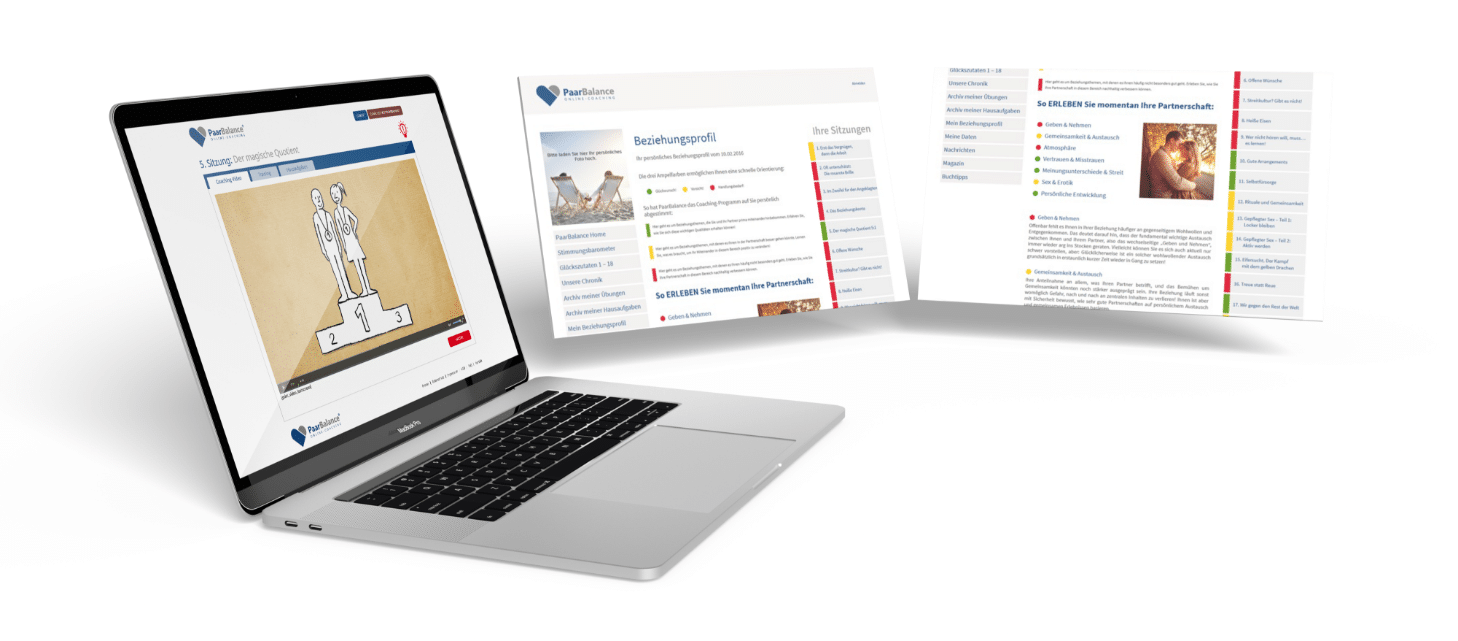
Das PaarBalance Online-Coaching
PaarBalance ist das einzige wissenschaftlich überprüfte, interaktive Online-Coaching zur Verbesserung von Paarbeziehungen im deutschsprachigen Raum, das auch vom einzelnen Partner durchgeführt werden kann. Es kann also auch dann genutzt werden, wenn der andere (noch) nicht bereit für eine gemeinsame Partnerschaftsberatung ist.
Anhand von 18 interaktiven Lektionen erhalten Sie in der Praxis erprobte Anleitung, wie Sie wieder zu mehr Leichtigkeit, Zufriedenheit und Wir-Gefühl finden werden.
Jede Sitzung enthält ein Coaching-Video, das die wichtigsten "Glückszutaten" auf den Punkt bringt, und eine dazu passende Anleitung, wie Sie diese Zutaten erfolgreich in Ihren Beziehungsalltag integrieren können. Unter diesem Link erfahren Sie mehr: www.paarbalance.de/online-coaching
Kann eine Paarberatung eine Trennung verhindern?
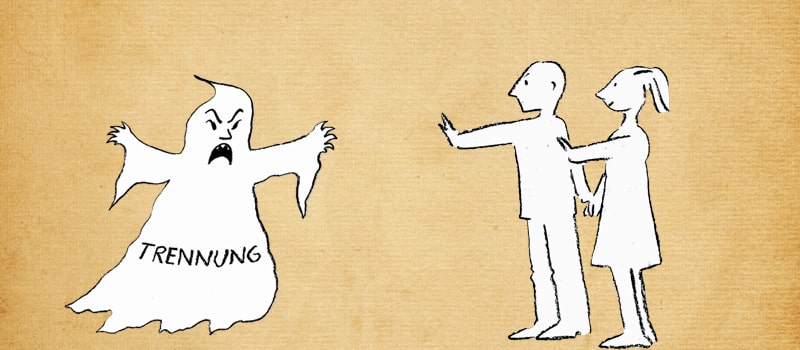
Wer sich für eine Paarberatung entscheidet, setzt in der Regel große Hoffnungen darauf, seine Partnerschaft doch noch zu retten - auch wenn es im Vorfeld bereits langandauernde Konflikte, Missverständnissen und Streit gegeben haben mag. Eine Garantie oder Gewissheit, dass eine Beratung die Liebe retten kann, gibt es leider nicht. Studien zeigen allerdings, dass etwa drei von vier Paaren, die eine Paarberatung nutzen, davon profitieren und ihre Beziehung deutlich verbessern können.
Here you will find our supplementary article on marriage counselling: A great opportunity for partnership problems and relationship crises .
Several factors increase the chances of success in couples counseling:
- Suitability : The consultant's qualifications and working methods should match the couple's individual wishes and problem areas.
- Willingness to reflect : Both partners must be willing to work on their relationship and reflect on their own behavior.
- Implementation : Both should aim to apply the suggestions from the consultation sessions in everyday life.
- Alternative : If on-site consultation is currently not feasible (or only possible under stress), a suitable alternative should be used (e.g., a well-founded online program).
The crucial point is: Don't carelessly give up what you've built together, but commit to your relationship. Give your love another real chance at a new beginning, following the motto:
" It's better to experience something new with your old partner than to experience the same old things with a new partner! "
We wish you all the best and send you our warmest regards.
Yours sincerely, Dr. Judith Gastner & the entire PaarBalance team
☝🏻 Related articles on the topic "Couple counseling - Will it save our relationship?"