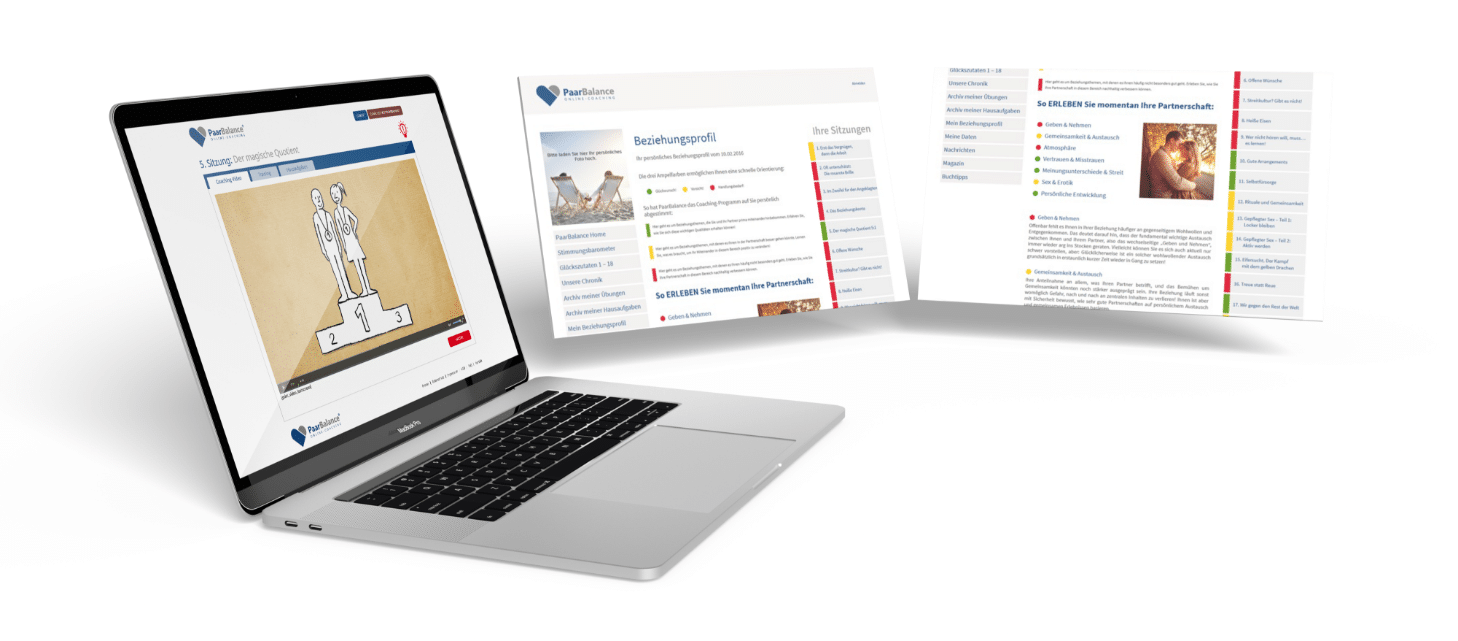



☝🏻 Quick start: Marriage counseling - a great opportunity
It's not unusual for relationships to experience occasional friction. If the foundation is solid, things usually smooth out on their own after a short time.
However, there are situations where problems prove very persistent, or where minor disagreements regularly escalate into serious arguments. So what should you do if:
- Does the interaction between both partners in the relationship prove to be persistently difficult ?
- What if the couple – with differing needs or opinions – is no longer able to quickly counteract an escalation on their own ?
- is the feeling of alienation becoming ever stronger?
Then marriage or couples therapy can be the ideal form of support to finally resolve the debilitating conflicts, persistent problems or constant misunderstandings and to help to focus again on what originally enriched life as a couple.
Fortunately, even relationships that are already severely damaged can often still be saved with the help of a 'neutral authority' (e.g. through conversations with a therapist or by using an online program on your own).
The only requirement is that both partners agree that they want to continue sharing their lives and future 'in principle' .
The most important questions before marriage counseling
Before seeking (online) couples counseling or (online) relationship coaching, most people seeking advice have numerous questions:
- What exactly happens in marriage counseling? What are the goals?
- When does couples therapy make sense? When does it not (anymore)?
- Would marriage counseling be beneficial in our specific situation?
- Can it sometimes be beneficial to start alone?
- Is couples counseling still worthwhile after a separation?
- Is reliable support only available in the form of face-to-face meetings on-site, or also as an online format?
- What helps us personally in our situation best: Fixed appointments at a counseling center (practice) or self-directed support that is not bound by time and location?
- How long does couples counseling take and what costs are involved?
etc.
In the following article, we will try to answer these and other questions about the right 'setting' for you.
🚀 Already 65,511 people have gained clarity through the test.
First of all: Why are you actually in your relationship?

Why do we enter into a romantic relationship?
Exactly! To be happier together than without each other.
To avoid feeling lonely (anymore) .
Because we want to enjoy life together . Because we long for a confidant – to talk to, to love, to hold, to share the present, to plan the future, to cherish memories, to start a family, to find meaning, to laugh together, and so on.
We humans are social beings. And: We are pleasure -seeking beings.
We long for love, for trust, for well-being. Presumably, no one enters into a relationship because they're looking for someone to argue with, or because they generally enjoy fighting another person, or because they're keen to work against someone at home, or because they generally want to make things as difficult as possible... To imagine such a deliberately created situation seems utterly absurd.
A relationship should enrich us , not burden us .
So how can we counteract this when we notice,
- That we've been doing fewer and fewer enjoyable things together lately?
- that our partner's quirks are getting on our nerves more and more?
- that we no longer speak openly about our needs and desires?
- That we sometimes don't really take each other seriously anymore?
- that we are finding it increasingly difficult to speak lovingly to each other?
- That we are generally more irritable?
- that we often no longer know exactly what is really on the other person's mind?
- That we hug each other less?
- that our relationship as a whole feels strained?
Step 1: Take a relationship test
with strengths and weaknesses analysis (free of charge, duration approx. 10 minutes):
" How is our relationship? "
To assess what kind of support is best in your situation, you need a goal (desired target state ) as well as a meaningful overview of where the resources and challenges currently lie in your relationship (current status ):
- What are (still) your strengths as a couple?
- In which areas is change needed ?
The scientifically based PaarBalance partnership test by Prof. Dr. Ludwig Schindler & colleagues (free of charge) offers you such a well-founded overview of the strengths and problem areas of your relationship.
Take your relationship test now! (free)
How is your relationship?
What are your strengths and weaknesses?
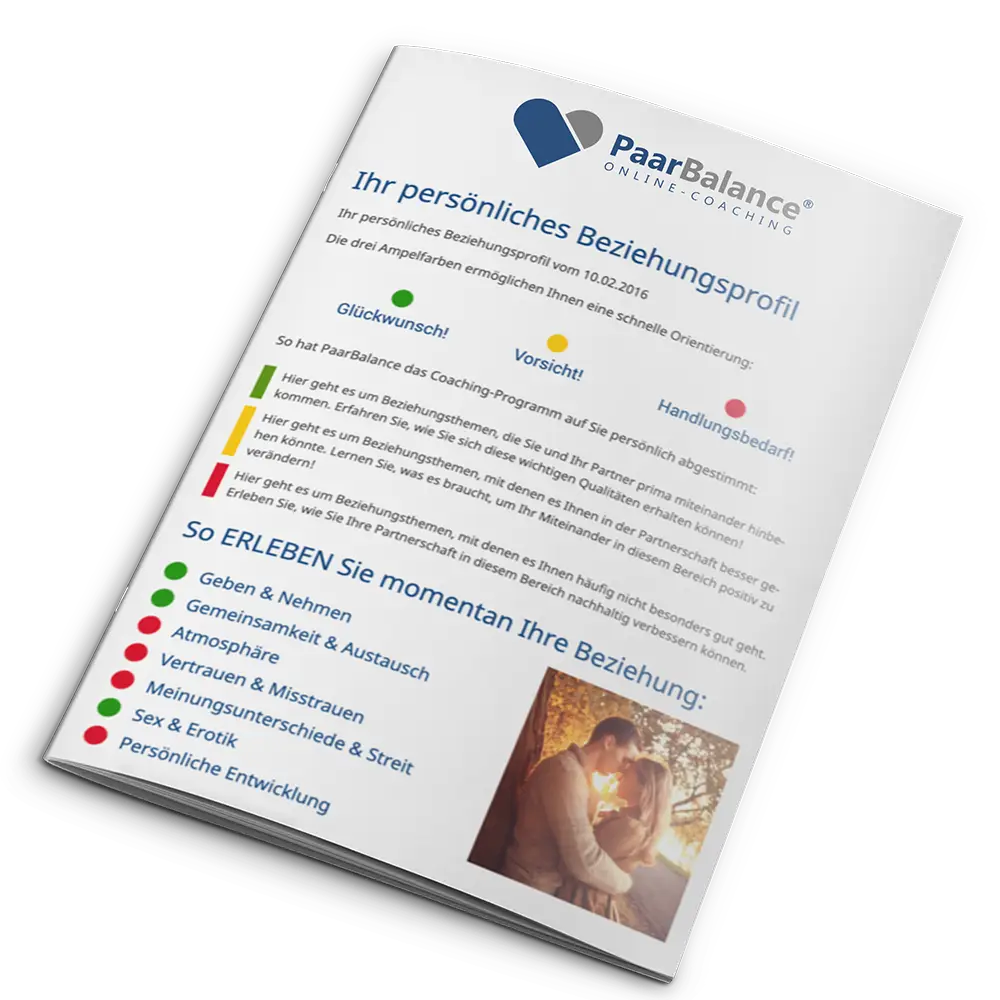
You will find out immediately afterwards in your personal PaarBalance relationship profile (free).
Start your relationship test now!
✓ Scientifically sound
✓ Includes detailed analysis
✓ Your data will not be shared
✓ 100% free & non-binding
100% secure. We comply with data protection regulations. Registration for the relationship test is free .
Please read this important information beforehand:
Data Protection ᐧ Terms and Conditions ᐧ General Information Agreement Terms and Conditions . Transparency Statement
Your personal relationship profile , which you will receive immediately afterwards, can help you decide which relationship issues you should address, how you should address them, and with what priority.
Marriage counseling: The earlier, the better?
It becomes increasingly difficult to overcome the rifts that have formed in a relationship once arguments and suspicion have become the norm, once trust has already been severely damaged, and once both partners feel that their respective wishes are being deliberately ignored by the other.
The answer is therefore clearly: Yes! We should take targeted countermeasures as quickly as possible and actively do something to ensure that our love and our sense of togetherness do not suffer irreparable damage and that our relationship does not enter an irreversible downward spiral.
To prevent the problems from becoming chronic, the affected partners, couples or families should be helped as soon as possible.
- to temporarily put their "hot irons" completely out of their hands and
- First and foremost, to be able to spend some nice moments together again and to talk to each other in a respectful manner.
But even when stress in the partnership (and consequently often in the entire family) has been wearing those affected down for a long time, the decision to actually seek appropriate professional help is usually preceded by a lengthy process. It almost always takes a considerable amount of time and preliminary work before both partners confront the issue and take action.
The good news:
Often, it doesn't even take both partners to noticeably defuse a tense situation. If one partner seriously starts making some adjustments, the atmosphere can improve significantly for both – according to the principle of so-called 'reciprocity' (meaning 'mutual effort'). And: It's almost never too late to give your relationship another real chance! 🙂
Key goals of marriage or couples counseling

The first step is to define: Is the overarching common goal truly...
- Staying together and having a good time together (a case for marriage counseling or online relationship coaching...)
and not
- To separate without a bitter divorce (a case for separation counseling...) or
- Not tearing each other apart after a breakup (a case for mediation...)?
But even with the common denominator of 'staying together', the treatment goals vary significantly from couple to couple and from relationship constellation to relationship constellation - depending on what each person is suffering from, what their respective strengths and weaknesses are, and what specific desires for change exist.
However, professional couples counseling almost always focuses on the following aspects and target areas:
- to (re) develop a future perspective together
- To resolve existing conflicts and reduce stress.
- To process hurts, to forgive each other, to reconcile.
- to gain the most comprehensive knowledge possible about relationship quality
- to deepen the understanding of one's own needs and those of others.
- to (re) learn the 'dos and don'ts' of empathetic communication
- to strengthen the relationship as a whole and to focus on the common ground
- To prevent separation (see also our blog article " Should I separate? The most important questions, considerations & help ")
Marriage counseling, couples therapy, relationship coaching - what can I expect from these terms?
Definition: Marriage or couples counseling, couples therapy, or relationship coaching. What's what?
This question is easy to answer. "Marriage counseling", "couples counseling", " couples therapy " or "relationship coaching" are not protected terms in German-speaking countries.
Therefore, there are no clear guidelines on this.
- how consultants should work
- which content needs to be covered and
- how the process of couples counseling should proceed.
The respective terms are often used synonymously, and the boundaries between 'counseling' and 'therapy' are also fluid.
What are the most important factors influencing couples counseling?
Marriage counseling is a highly individual matter. The initial consultation and subsequent course depend on several variables and their interactions, including, but not limited to...
- the specific challenges and problems of the couple
- the respective personalities of the partners
- the current circumstances of all involved (including any affected children)
- the framework conditions and the setting
- the person of the therapist, their training and professional experience
- the partners' motivation for change
, etc.
Therefore, a general answer to the question of what exactly is 'done' in couples therapy and how long an intervention lasts is hardly possible. However, what can be said is:
The more serious and existential the challenges a couple faces, the greater the expertise and experience of the counselor should be to ensure that the problems can be resolved sustainably
. It must be guaranteed that problem areas and hurts are not merely examined and thereby "magnified," but that effective methods are available to reliably help develop solutions to the existing problems and steer the overall quality of the relationship in a positive direction.
How does marriage counseling begin? What happens next?
Most of the following elements can be considered integral parts of the counseling process in the majority of face-to-face couples therapy sessions:
Initial Consultation & First Relief:
In the first session, the therapist and the couple get to know each other, discuss the framework and setting. The therapist needs to gain a general overview of the couple's situation.
At the beginning of the treatment process, partners are usually under considerable pressure and emotional distress. Each partner wants to unburden themselves of what is most burdensome (impairing, stressing, hurting, irritating, straining, worrying, wounding, etc.). Many couples therapists therefore emphasize conducting at least one individual session with each partner so that both can share their personal experiences as openly as possible.
Identifying Problem Areas:
From these initial discussions, the consultant tries to identify which problems are paramount and which are secondary, which challenges have been present the longest, and which have only arisen relatively recently.
All participants must decide whether they perceive the situation and the consulting approach as promising enough to proceed with the process and schedule a follow-up session ("We feel this could help us. The chemistry is already right.").
Triggers & Backgrounds:
The counselor will gradually analyze with the couple: What triggers and backgrounds exist for misunderstandings (hurt feelings, resentments, arguments, etc.)? What dynamic interactions are at play? When, how, and why is the couple at risk of entering undesirable downward spirals? What "biographical baggage" does each partner carry? Are their ideas about what constitutes a "happy relationship" similar? etc.
Understanding the couple's daily routines, routines, and patterns:
It's important to understand what constitutes the couple's life and relationship: What does their everyday relationship look like? How are roles distributed? Who feels responsible for what? What are typical routines?
Beginning of the Relationship & Resources
It is particularly important to focus on positive aspects: What are the couple's strengths? Why did they get together? What did they love and appreciate about each other? What of that is still there today? What does each of them understand by "love"? What helped them in the past (and helps them now) with problems and challenges?
Goal Setting:
What are the individual goals? Where should the development go? What possible solutions does each partner see? What would help, and what wouldn't, in each partner's opinion? Who wants to understand what better, learn more, or change what? What does each person want to work on individually , and what not? What should be tackled together ?
Willingness to cooperate & motivation:
How motivated is each individual to actually change negative patterns? Are there any limiting factors at present?
Treatment plan, dos & don'ts
Following this, the consultant often creates a treatment plan in order to derive suitable strategies and techniques and to review them regularly using this guide:
- Are all parties still on the original home stretch?
- Have any central or subordinate goals possibly changed during the course of the process?
- If so, how should one react?
At the beginning of the process, it can be useful to agree on certain dos and don'ts during the couples counseling process (e.g., no insults during therapy sessions, no continuing a second relationship, all "cards" are honestly laid on the table, the therapist does not become a 'keeper of secrets' during individual sessions, etc.).
Marriage counseling: Duration & costs
Behind the question of the duration of therapy usually lies both the desire not to have to suffer for too much longer, and the thought of the expected budget, which in the case of paid services usually depends on the number of sessions.
Duration: How long does couples counseling take?
There is no single answer to how much time should be allocated for couples counseling. In particular, the motivation and willingness to cooperate of both partners, as well as their sense of reality ("Are our desired changes to each other and to the relationship truly feasible and meaningful?"), have a decisive influence on how many sessions are needed for a successful counseling process (i.e., how long it takes until the atmosphere and the sense of togetherness have noticeably improved for both partners).
As a rough guideline:
- Couples who seek support early in couples counseling and are generally (still) well-disposed towards each other often only need a few sessions to make a small course correction and to strengthen and enjoy their relationship again ( approx. 3 to 5 sessions ).
- For moderately severe problems , longer-term support is usually needed to break bad patterns, implement new impulses and establish useful changes (often between 6 and 15 sessions ).
- If the problems are very serious and the couple's dynamics correspondingly complex , regular support over a longer period may be essential. Injuries need time to heal; a new shared path must be found, unhealthy patterns broken, and respectful interaction (re)learned and established. All of this requires time and space ( often about a year , sometimes several years with longer intervals between sessions).
Cost: How much does couples counseling cost?
Unfortunately, health insurance companies do not cover the costs of couples therapy. Therefore, when searching for suitable help, it makes sense to consider the expected costs in addition to the quality of the counseling services.
These costs can vary considerably. We have compiled detailed information, including specific price examples, on the individual factors that determine the cost of couples counseling, the advantages and disadvantages of different settings, etc., in our article on couples therapy costs .
Here are just a few keywords for a rough overview:
- A 50 to 90-minute marriage therapy session (in a practice with an experienced, established therapist) costs on average between 80 and 200 euros.
- A 50 to 90-minute session of marriage counseling with a counselor from a church-affiliated organization is often offered on a donation basis .
- The cost of an online session with a scientifically based, self-directed couples counseling program amounts to approximately 10 euros per unit.
These are the most common reasons for couples counseling
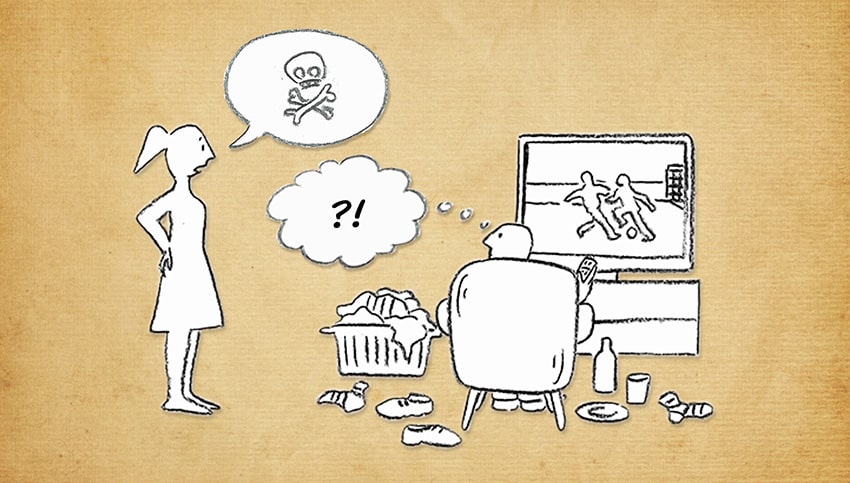
Those who had and still have role models for loving and stable partnerships in their own family of origin are lucky: satisfied parents, grandparents who still hold hands, cool parents of good friends…
But even then, it is not guaranteed that we – if we ourselves are in a relationship – will intuitively navigate all the relationship pitfalls safely, especially since there is always another person involved who in turn brings their own experiences with them ( see also our article "How relationships work - The biggest myths debunked" ).
How must it be for those who, as children and teenagers, had no happy couples as role models and only know: I do NOT want to do what my parents used to do (and still yell at each other)! How can I manage – especially under stress – not to fall into the same trap?
Some of the most common answers from couples seeking help to the question "What do you experience as the biggest challenge(s) in your relationship?" are:
- "We argue too much / too intensely."
- "I no longer feel seen / understood / supported."
- "I was very hurt/disappointed by the other person."
- "I hurt/disappointed the other person very much."
- "Sexuality & eroticism = difficult topic."
- "Somehow, we've all lost our enthusiasm."
- "Too much stress / worries / problems."
For whom is marriage counseling not suitable?
Helping a couple out of a crisis becomes very difficult, if not impossible, when
- massive psychological impairments (such as depression, severe anxiety, 'narcissism', obsessive-compulsive disorder) or addiction (drug, alcohol, gambling addiction, etc.) are present or
- the coexistence is characterized by suicidal crises, abuse or violence.
Does any of this apply to your relationship?
Then you should contact a suitable crisis center, a specialist doctor or a psychotherapist in your area as soon as possible (see also our addresses & contact persons for acute emergencies ).
Looking for marriage counseling? Here's how to find the right service.
Even when couples are under great pressure and in the midst of a crisis, they should carefully select the appropriate framework and couples therapy setting for themselves.
A) Personal consultation (“face-to-face”)
An external therapist (counselor), due to their emotional distance and impartiality, can often surprisingly quickly create a constructive atmosphere in couples therapy (marriage counseling) and convey to both partners that they are being heard. And once the framework for discussion is established, communication within the relationship can often resume rapidly.
If you are looking for suitable marriage counseling, besser:lieben can help you find qualified counselors who will provide you with individual support – online or in person. The platform allows you to choose the counseling that best suits your situation.
However, regardless of whether personal marriage counseling takes place online or in person: in order for it to be perceived as helpful, both partners must feel comfortable with the counselor.
When choosing the right face-to-face marriage counseling, those affected should consider the following points:
(1) Sympathy
Is there a good connection between us and the marriage or couples counselor? Studies show that this "fit" has a huge impact on the success of counseling. Of course, sound training, broad expertise, and extensive experience are also crucial for reputable marriage counseling. But even the best professional knowledge can do little if there's no rapport.
(2) Style
Everyone is different. This naturally also applies to experts in the field of relationship and marriage counseling. Personal differences are expressed, among other things, in the language used and in the respective attitude : Some therapists are very direct, others more cautious. Still others sometimes deliberately provoke a couple to elicit certain reactions. Every approach can be helpful, as long as it suits the couple. Therefore, it is important to ensure that both partners are comfortable with the counselor's style and personality.
(3) Methods and Theory
Various methods can be used in couples and marriage counseling . Not every method is equally suitable for every client and every situation. Marriage counseling after infidelity requires a completely different approach than counseling for disputes about untidiness or parenting issues.
- Behavioral marriage counseling typically offers a very structured approach. This makes it ideally suited for anyone who desires a clear framework and a goal-oriented approach.
- Psychodynamic marriage counseling can be particularly suitable when it comes to jointly resolving deep-seated hurts.
- Systemic marriage counseling is particularly helpful for couples who respond well to metaphors and can imagine working with 'constellations'.
- Marriage counseling with body-oriented therapeutic elements can be a good alternative to the usually very language-centered forms of counseling.
B) Self-directed online coaching (independent of time and place & also possible without a partner)
Traditional couples therapy is sometimes not an option – be it for cost or logistical reasons, or because the hurdle of visiting a therapist seems too high (or still too high). A proven online program like CoupleBalance Coaching can then be just the right thing – especially for those who prefer to tackle personal challenges online.
- self-determined,
- without any specific time or place,
- at your own pace
want to tackle this.
PaarBalance is the first scientifically verified digital solution in German-speaking countries that is tailored to the individual partner.
This means that even if the other partner does not (yet) want to participate in marriage counseling, PaarBalance can be used - and the quality of the relationship will improve.
The interactive online sessions can be conveniently completed from home. Often, just a few conscious minutes a day are enough to noticeably strengthen love (again) and to gradually become your own relationship expert.
PaarBalance's online couples therapy is designed so that the central partnership issues can be addressed in small units and positive impulses can be implemented directly in everyday life.
The program has proven to be highly effective in scientific studies.
But regardless of which type of support you choose:
Take action! As the saying goes: There is nothing good unless you do it (Erich Kaestner)
For our mental and physical health, there's hardly anything more worthwhile than strengthening our relationship. 🙂
All the best to you and warmest regards.
Your Prof. Dr. Ludwig Schindler, your Dr. Judith Gastner & the entire PaarBalance team
☝🏻 Related articles on the topic of "Marriage counselling - a great opportunity"
Frequently Asked Questions
What is marriage counseling?
Marriage counseling is a facilitated conversation between spouses, in which the counselor shares relationship insights and acts as a mediator. They ensure that both parties have the opportunity to speak (constructively), promote a conciliatory and respectful approach, and help to find good compromises and new solutions.
Is marriage counseling the same as marriage therapy?
Marriage counseling and marriage therapy have much in common, but strictly speaking, they are not the same. Both methods offer help for self-help, but the focus differs somewhat: Marriage counseling tends to seek quick solutions for specific problem areas, while marriage therapy often delves deeper into the underlying causes of current challenges.
Who is marriage counselling suitable for?
Marriage counseling is aimed, among other things, at couples who repeatedly experience conflicts due to the same triggers or who have become entrenched in taboo topics that are not discussed. If a couple can no longer find common ground or increasingly considers separation, marriage counseling can be the best way to get their relationship back on track.
What can a couple expect in marriage counseling?
How marriage counseling proceeds depends on the individual style of the counselor and the specific couple. A typical process: After an initial consultation, concrete goals are defined. The next step involves understanding strengths, vulnerabilities, and unmet desires and needs. New attitudes and behaviors are developed, which the couple then tries to implement between sessions.
What are the requirements for marriage counselling?
For marriage counseling to be successful, both partners must be willing to examine their existing attitudes and behavioral patterns, try out new approaches in their daily lives, and practice them. Patience, respect, and goodwill are essential prerequisites. Equally important is openness towards both the counselor and the partner.