








☝🏻 Quick start: Relationship without initial infatuation
Rose-tinted glasses. Butterflies in the stomach. Exciting eroticism. Thoughts revolve solely around the object of desire. A state of total euphoria.
Perhaps you have experienced something similar at the beginning of a previous relationship.
In your current relationship (or your next potential relationship), however, this kind of passion was absent. The initial infatuation was somehow—never really there. Or: only very briefly. Or: only in isolated moments. Or: … Hmmm. In any case, it is…—not felt!
So what now? Is it possible to have a satisfying partnership without being in love?
Learn the most important information about this relevant topic here.
🚀 Already 65,511 people have gained clarity through the test.
Is being in love necessary for a good relationship?
First and foremost, it's important to keep reminding yourself: Every relationship is different. And every relationship begins differently.
- For some couples, it's love at first sight . They both fall instantly and intensely in love with each other and can't keep their hands off each other after the first date.
- Others approach the relationship much more cautiously and slowly , and may only experience the phase of headlong infatuation later - or not at all.
- In other cases, one of them is struck by Cupid's arrow and knows immediately: "This is the person I've always longed for and want to grow old with!" And the other? Scandalously, it takes quite a while before they can be patiently persuaded to at least give a relationship a try ...
- Others remain 'good friends' for years - until one of them suddenly feels - for whatever reason - attracted to the other in a new, unknown way that goes beyond the previous 'pure friendship'.
These are just a few examples of initial scenarios for long-term partnerships.
What do studies say about the topic of initial infatuation?
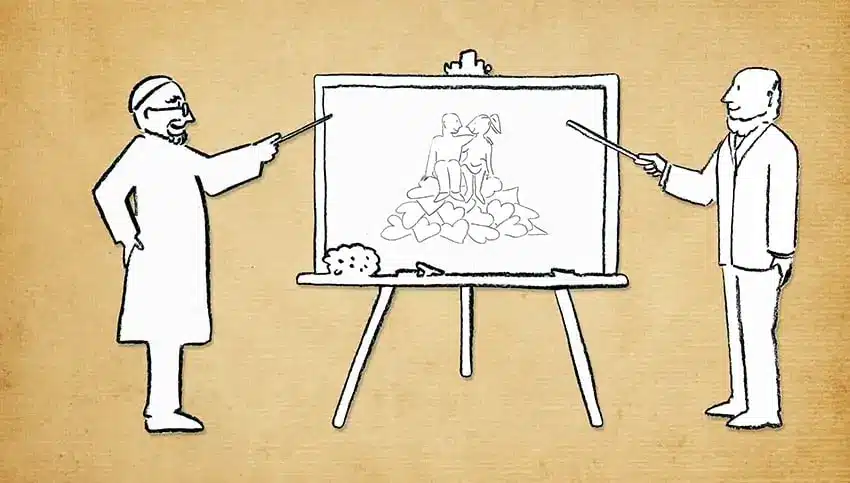
Das Spannende ist: In Langzeit-Untersuchungen über Beziehungszufriedenheit hatte sich gezeigt, dass die empfundene Zuneigung in langen Partnerschaften sogar bei sogenannten „gestifteten Ehen“ (also bei Paaren, die einander nicht selbst auswählen konnten und bei deren Kennenlernen auf beiden Seiten von Verliebtheit nicht die Rede sein konnte) nach 10 Jahren im Durchschnitt gleich stark war wie in „Liebesehen“ (mit beidseitiger heftiger Anfangs-Verliebtheit).
Die Gefühle von Paaren, deren Beziehungsstart unterschiedlicher nicht hätte sein können, gleichen sich im Laufe eines Jahrzehnts offenbar stark an.
Wie kann das sein? Weshalb ist das so? Was hat das zu bedeuten?
Alle Paare, sowohl die zunächst verliebten wie auch die nicht verliebten, haben über die Jahre viel miteinander erlebt: Schönes, Aufregendes, Trauriges, Lustiges. Sie haben Herausforderungen gemeinsam bewältigt, den anderen in seinen unterschiedlichsten Facetten kennengelernt, zusammen schwierige Erfahrungen gemacht und glückliche Momente geteilt.
Im Laufe der Zeit ist das entstanden, was wir „Bindung“ nennen und als Wir-Gefühl empfinden. Der Partner ist Teil der eigenen Biographie, Teil des eigenen Selbst geworden. Wenn es keine gegenseitigen Verletzungen gab, die so groß waren, dass sie nicht gemeinsam überwunden werden konnten, dann entstand über die Zeit Verbundenheit. Nähe. Ja … - Liebe.
Wohin verschwindet die anfängliche Verliebtheit in einer Beziehung?
Doch was ist aus den ursprünglich bis über beide Ohren Verliebten geworden? Schauen wir der Realität ins Auge: Die flatternden Schmetterlinge im Bauch werden über die Jahre in jedem Fall weniger werden. Und zwar bei allen Paaren. Unabhängig davon, wie furios, leidenschaftlich und überwältigend die Zeit der ersten Verliebtheit auch gewesen sein mag.
Doch wann, warum und wohin verabschiedet sich das intensive Gefühl der Versessenheit nach dem Anderen bei all denen, die zunächst im Liebesrausch waren?
Es ist wie fast immer: Pauschal lässt sich diese Frage nicht beantworten. Mit absoluter Sicherheit kann jedoch vorausgesagt werden, dass sich die Gefühle aller Paare zueinander über die Zeit verändern werden.
Der Prozess der Verwandlung
Je nach Konstellation kann dieser Veränderungsprozess von Verliebtheit in eine neue Form der Verbundenheit bereits nach einigen Wochen - oder auch erst nach ein paar Jahren - einsetzen.
Gefühle für den anderen gehen also nicht verloren - aber sie verändern sich:
- Aus dem anfänglichen Herzklopfen wird womöglich eine warme Gewissheit im Bauch.
- Aus der unberechenbaren Leidenschaft wird vielleicht vertraute Innigkeit.
- The euphoria of discovering a new commonality turns into joy at the shared sense of humor.
- Ideally, the exciting stranger becomes a reliable friend .
Perhaps you are among those who have never consciously gone through (or will never go through) this transformation from heart palpitations, passion, euphoria and excitement into certainty, familiarity, intimacy and friendship - possibly because you have always perceived your partner primarily as a reliable, trusted friend - and not as the object of months of erotic fantasies.
But rest assured: having found a loved one who has become a trusted friend is a wonderful basis for maintaining a stable, relaxed and enriching relationship for many years and decades.
What is important in a 'good' relationship?
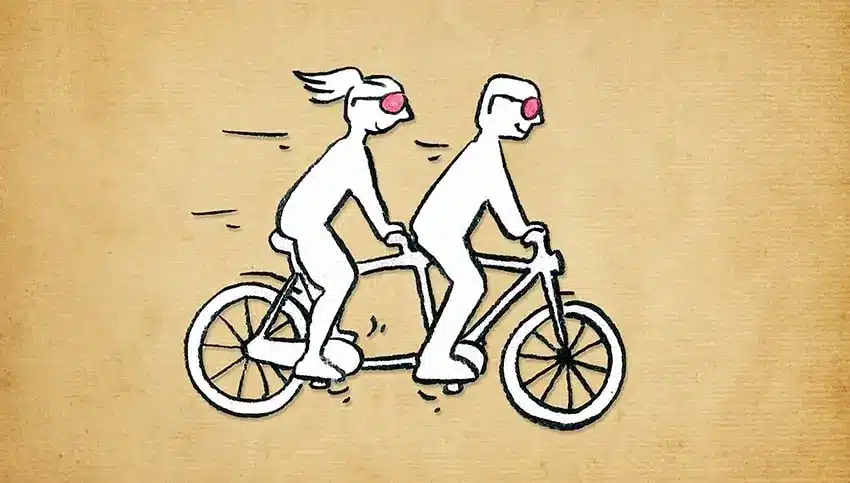
Every person is unique – and therefore, the specific constellation that arises when two people come together is also unique. That's why there's no magic formula for what ultimately makes a happy relationship, but:
Everyone has their own sense of what is particularly important to them in their relationship – and what (might) no longer be important. Over time, these priorities usually shift in some areas.
For example, if as a teenager you did everything you could to go out with the supposedly 'prettiest' girl or 'coolest' boy in your class – no matter how complicated and difficult the relationship might have been – as a young adult you might increasingly focus on having someone you can 'steal horses with' by your side, or a partner with whom you can share your passions (music, sports, cooking, culture, travel, nature experiences, etc.) – so that physical appearance may have faded into the background. Or perhaps it was exactly the opposite.
If your relationship were a table…
When is a table stable and secure (assuming the floor is level overall)?
Exactly! When:
- … he has enough table legs,
- … these table legs are approximately the same length and
- …they don't wobble too much.
And now consider this carefully:
- What are the key 'pillars' of your partnership for you personally ?
(e.g., shared interests, similar sense of humor, tenderness, reliability, etc.)
- What aspects of what is particularly important to you today can you experience with your (potential) partner ?
- If you were to rate the quality and stability of each table leg on a scale of 1 to 6 , how would your relationship report card
reflect on it ? Is everything "in the green zone" or "at risk of failing"?
- Regarding the topics that don't (yet) feel sufficiently stable to you (i.e., grades 5 and 6), is there room for improvement ?
- What attempts have you already made to change the deficient and inadequate areas in a positive direction for you ?
For anyone who would like a quick and thorough overview of the resources and challenges in their relationship , we have developed the scientifically validated "Couple Balance Relationship Test ," which you can complete online and free of charge right here . The test is tailored to each individual partner. It will take you approximately 10 minutes to answer the questions.
Take your relationship test now! (free)
How is your relationship?
What are your strengths and weaknesses?
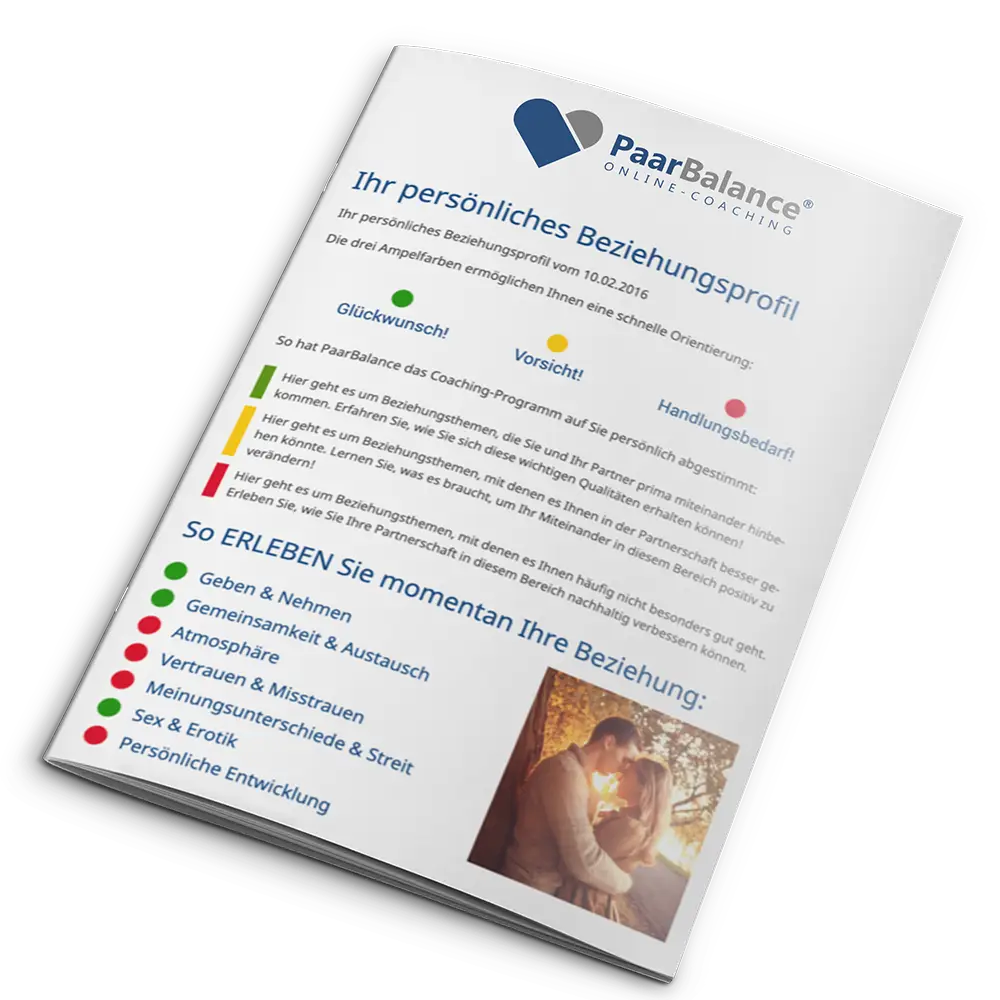
You will find out immediately afterwards in your personal PaarBalance relationship profile (free).
Start your relationship test now!
✓ Scientifically sound
✓ Includes detailed analysis
✓ Your data will not be shared
✓ 100% free & non-binding
100% secure. We comply with data protection regulations. Registration for the relationship test is free .
Please read this important information beforehand:
Data Protection ᐧ Terms and Conditions ᐧ General Information Agreement Terms and Conditions . Transparency Statement
Many people in long-term relationships tend to focus more and more intensely on the areas that are perceived as imperfect and could be better - and in doing so, they increasingly forget what feels good and what is exactly (or at least similar to) what they had hoped for.
Is it possible to have a good relationship without being (or having been) truly in love?
The answer is short and simple: Yes! You can.
The fact that initial infatuation has increasingly disappeared - or perhaps was never really there - is not a cause for concern, but rather quite 'normal'.
For anyone who has been in a partnership that is perceived as generally intact for a longer period of time, exciting infatuation gradually gives way to a feeling of connection and belonging.
However, this doesn't mean that moments of romance and fulfilling sexuality are impossible in long-term relationships. Nor does it mean that couples inevitably become disillusioned and loveless over the years, merely 'functioning well alongside each other'.
Over the past decades, couple research, through the scientific study of countless couples, has been able to clearly distill some "ingredients" for a fulfilling and enriching relationship, as well as signals for the increasing erosion of love.
Those who are aware of these attitudes and the most important "dos & don'ts" know the 'secrets of happy partnerships'.
Even if a relationship has gone awry or if there is concern that a partnership may no longer have a future because feelings of infatuation are (no longer) present:
Anyone who consciously decides to do something good for their relationship (again) has the chance for a fulfilling partnership.
You don't need a new partnership to experience relationship happiness again, but rather new impulses .
Set the right focus.
You probably came to this page because you were worried. Worried that...
- Perhaps you haven't found the right partner yet.
- Their relationship may have become stagnant.
- Perhaps those beautiful feelings of being in love will never exist again.
- From now on, the relationship can only "go downhill" oam
It's important to accept that initial infatuation in any relationship eventually fades or changes in some way. Focus on the bond between the two of you. Concentrate on love , not infatuation .
Test: How strong is your love really?
If you haven't yet taken the (free) PaarBalance relationship test and we haven't been able to create a (free) relationship profile for you:
Gain clarity now about the true state of your love life. Take a step back and analyze your relationship from a bird's-eye view. Once you have a concrete and scientifically sound evaluation of how you experience your partnership and how you shape it , you will gain a much sharper perspective on your shared resources and challenges.
It will take you about 10 minutes to fill out the questions.
Take your relationship test now! (free)
How is your relationship?
What are your strengths and weaknesses?
You will find out immediately afterwards in your personal PaarBalance relationship profile (free).
Start your relationship test now!
✓ Scientifically sound
✓ Includes detailed analysis
✓ Your data will not be shared
✓ 100% free & non-binding
100% secure. We comply with data protection regulations. Registration for the relationship test is free .
Please read this important information beforehand:
Data Protection ᐧ Terms and Conditions ᐧ General Information Agreement Terms and Conditions . Transparency Statement
All the best to you and your relationship!
Yours sincerely, Dr. Judith Gastner & Prof. Dr. Ludwig Schindler
☝🏻 Related articles on the topic of relationships without initial infatuation

Frequently Asked Questions
Is a good relationship possible without being in love?
Yes, a happy relationship can develop even without initial butterflies in your stomach. Love often develops over time, as you share experiences and get to know each other better. After a few years, couples who were very much in love are no different from those who started out as friends.
What are the consequences if there was no infatuation at the beginning of a relationship?
A relationship doesn't have to start passionately. Shared interests, common life goals, or similar life circumstances can form the basis for growing intimacy and a stable partnership. Open, supportive, and respectful communication are the most important ingredients for a happy relationship in the long run.
Can a relationship without romantic feelings work in the long run?
Yes, a lasting and fulfilling relationship can develop even without initial infatuation. It always requires the commitment of both partners to create new, shared experiences. When shared experiences and open communication are cultivated, the sense of togetherness deepens naturally, leading to ever greater intimacy.
Are there differences between a relationship with and without infatuation?
A relationship without initial infatuation initially feels more like a special kind of friendship. A relationship that begins with infatuation is usually accompanied by passion and romance and is therefore experienced as more fast-paced and exciting. However, the feelings of couples who are initially in love and those who are not are comparable after a few years.
What are the advantages and disadvantages of a relationship without initial infatuation?
A relationship without initial infatuation has the advantage of often being built on shared interests, understanding, and friendship. Love and deep connection develop over time. A disadvantage can be that a relationship is initially perceived as less appealing and exciting if there are no butterflies in the stomach.