







☝🏻 Quick Start: Systemic Couple Therapy - Complete Overview
🚀 Already 65,511 people have gained clarity through the test.
Love, laughter, passion – all this and much more is what every couple desires. After all, most people dream of a lifelong, happy relationship where they can let their guard down and receive support in every situation.
But everyday life often gets in the way. The longer a relationship lasts, the more problems arise for many couples: arguments about housework, the division of childcare responsibilities, or overtime at work are commonplace. On top of these daily conflicts, the "big questions" often arise:
Do we still share the same values and outlook on life? Where and how do we want to live in the long term? Do we want to have (more) children? What is important to us in raising children? Do we still find ourselves attractive – inside and out? etc. etc.
When arguments become more frequent and seemingly unsolvable relationship problems emerge, this is the reason for many couples to consider separation for the first time.
Is our relationship over?

You may also be at a point where you keep thinking about ending your relationship. However, a separation is a radical step. It ends everything you have built together (possibly over years or even decades). Therefore, separation should only be considered as a last resort, after all other options for rebuilding the relationship on a solid foundation have been exhausted.
How is our relationship?
To improve one's partnership, it is essential to first understand the current situation. The here and now is the starting point from which the desired state, i.e., the goal, can be defined.
A thorough analysis of your relationship can help you identify the areas where you need to focus your efforts to positively transform your partnership. It's also important to (re)focus on your strengths as a couple. Only with this awareness can you successfully address existing challenges.
With the scientifically based & free CoupleBalance relationship test, you can gain a comprehensive overview of the resources and challenges in your partnership.
Immediately afterwards you will receive your personal relationship profile with an individual strengths and weaknesses analysis (free of charge and without obligation).
Take your relationship test now! (free)
How is your relationship?
What are your strengths and weaknesses?
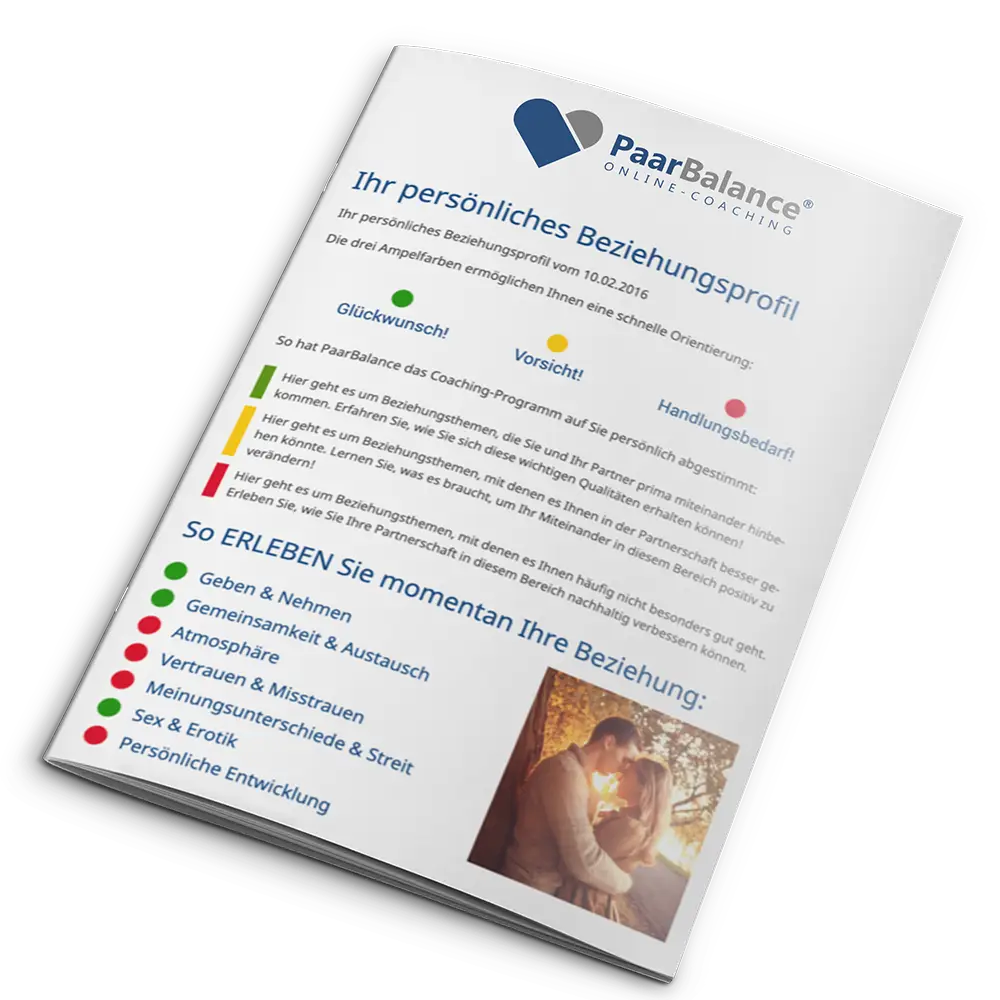
You will find out immediately afterwards in your personal PaarBalance relationship profile (free).
Start your relationship test now!
✓ Scientifically sound
✓ Includes detailed analysis
✓ Your data will not be shared
✓ 100% free & non-binding
100% secure. We comply with data protection regulations. Registration for the relationship test is free .
Please read this important information beforehand:
Data Protection ᐧ Terms and Conditions ᐧ General Information Agreement Terms and Conditions . Transparency Statement
How can we save our relationship?
Perhaps the Couple Balance Test has just revealed some conflict issues and patterns that you would like to change. What will it take for your "red" (attention!) and "yellow" (watch out!) issues to (re)enter the "green" (congratulations!) zone?

In any case, it's important that you take initiative and remain as proactive as you are now. Waiting for the other person to change would be understandable, but unwise. You might find yourself waiting week after week and month after month for things to become easier and more pleasant between you again. Instead, adopt the motto: "Act, don't react." Because, as Erich Kästner said, "There is nothing good unless you do it." Your own quality of life and health will improve significantly when you build a new foundation for your relationship.
When is couples therapy advisable?
To save a relationship in crisis, input from experienced relationship experts can be the best and most effective way to foster greater intimacy, communication, and a stronger sense of togetherness. Generally speaking, professional support is always beneficial when...
- Relationship conflicts have been ongoing for some time,
- the positive aspects and the love in the partnership are clearly overshadowed and
- You are “at your wit’s end”, meaning you no longer know what else you can do to improve the situation.
In our overview article " Marriage Therapy: Yes or No? " you will find decision-making aids for (and against) couples therapy.

Do you recognize yourself in this description and would like to know more? Then take a look at our comprehensive article on couples therapy . There you will find all the important information about the applications and process of couples therapy.
After making the fundamental decision to undergo couples therapy, the next question immediately arises: " Which method is right for us?" Anyone who deals with the topic of "couples therapy" quickly discovers that there are various forms of therapy.
One of the most frequently used methods is systemic couples therapy. In this article, we will therefore present this treatment approach in more detail.
Find professional support
If you are interested in couples therapy or personal counseling, it's important to find the right support. Through besser:lieben, you gain access to qualified counselors who will provide you with individual support – online or in person. The platform helps you choose the counseling that best suits your personal situation.
What is special about systemic couples therapy?

Systemic couple therapy is a scientifically recognized method for counseling and treating couples with recurring relationship conflicts.
In systemic approaches, a person is never viewed in isolation, but always in the context of their relationships.
Therefore, systemic therapy is also suitable as family therapy. In addition to the parents, (especially older) children can also be involved, either if they are directly involved in the conflicts or are highly stressed by the disputes between their parents.
What assumptions underlie systemic therapy?
Systemic therapy is based on the understanding that every person's experience, thoughts, feelings, and actions always arise in interaction with their social environment . Thus, a couple is seen as a system of two people who develop and change within the context of their partnership. Therefore, systemic couples therapy never involves only one partner, but always works with both.
The fundamental premise of systemic couples therapy is that what matters is not "reality," but how individuals perceive a situation . This can lead to problems in partnerships: Both partners usually assume automatically that the other experiences and interprets the world similarly to themselves. However, this is often not the case.
The result: a lack of understanding for the partner's perspectives and behaviors. According to the basic assumption of systemic therapy, this leads to conflicts within the relationship.
The goal of systemic couples therapy is therefore to sensitize both partners to their differing perspectives and to make the other's point of view understandable. In this way, disturbances in the couple or family structure can be resolved.
For whom is systemic couples therapy suitable?
Whether systemic therapy is right for you and your relationship cannot be judged by an outsider. Only you can find that out – in dialogue with your partner. Answering the following questions may be helpful:
Are there recurring conflicts and challenges in your relationship that you haven't been able to resolve together?
In this case, (systemic) couple therapy can be useful to adopt new perspectives and develop strategies so that you can approach the conflicts with fresh ideas for solutions and thus also resolve communication problems.
Are you and your partner ready to examine your relationship and change your own contributions?
This is the basic prerequisite for benefiting from (systemic) couples therapy. However, a certain degree of skepticism before starting therapy is not unusual – and definitely not a reason to rule it out. If you are both willing to overcome this skepticism, the insights gained can be incredibly helpful.
Are you convinced by the basic assumptions of systemic therapy?
Which form of couples therapy is right for you is an individual decision. If the above-mentioned systemic principles resonate with you, systemic couples therapy may be the right approach.
You answered "yes" to all three questions and would like more information?
Below we have summarized an introduction to the working methods, underlying concepts, process and expected costs of systemic couple therapy.
How does systemic couple therapy work?
Systemic couples therapy always takes a solution- and resource-oriented approach. This means that the focus is not primarily on the couple's deficits or a specific conflict, but rather on the partners' abilities and strengths.
This means that the primary focus is not on analyzing and exploring the problems and their origins. Instead, a systemic couples therapist in practice is interested in what is currently maintaining the conflicts , in order to specifically change these conditions .
Systemic couple therapists support the couple in identifying and appreciating their own competencies and strengths. Together with both partners, they work out how they can actively use these strengths to overcome their problems and challenges.
How does systemic couples therapy work?
Systemic couples therapy can be imagined as a "moderated" conversation between partners, taking place in the therapist's office. The therapist assumes the role of a neutral moderator – creating a kind of triangle between the partners and the therapist. Some systemic couples therapists work in pairs, for example, as a team consisting of a female and a male therapist. This can have the advantage of making both partners feel even better understood.
In systemic family therapy, the couple's children participate alongside the father and mother. They are actively involved by the therapists as part of the "family system" and help determine the focus and topics of the therapy.
What is the role of a systemic couples therapist?
In therapy sessions, the therapist or therapy team supports the couple by asking open, guiding questions to honestly discuss their needs, desires and roles in the relationship, to find their own strengths and to work out solutions together.
The therapist, or the team of two therapists, helps both partners to better understand their "relationship system" and to recognize typical patterns in their interactions that are not immediately apparent. In this way, the therapist or team of therapists supports both partners (or the entire family) in recognizing the connection between their own perceptions, communication, and the emergence of conflicts. Furthermore, the therapist or team helps the couples to adopt each other's perspectives, thereby fostering mutual understanding.
At the same time, the therapist or therapist duo reminds the partners to maintain a respectful and loving approach when a discussion threatens to become too heated. They also ensure that both partners have roughly equal speaking time, so that everyone feels heard.
What tasks does the systemic couples therapist NOT have?
A systemic couples therapist will NOT actively intervene in discussions or take sides during therapy in order to change the "system" of the couple's relationship. This also means that they do not intend to impose their own views or solutions. Their role is to encourage the development of the couple's own solutions and, at most, to offer inspiration to the couple or family. They support the couple in developing their own insights and concepts that are tailored to their individual relationship dynamic.
How long does a session last?
Depending on the therapist's approach and agreements with the couple, a session in therapy typically lasts between 50 and 90 minutes. Often, couples are given a task at the end of a session to complete together before their next appointment. This motivates couples to continue working on their relationship between therapy sessions and to try out new strategies.
How often do the meetings take place?
In order to have enough time to test new solutions and assess their impact on the "family system", sessions in practice usually take place at intervals of about 2 to 3 weeks.
The number of sessions a couple will require is not predetermined. This is determined individually during the course of therapy, depending on the specific challenges in the relationship, current conflicts, and the progress the partners make. Each couple ultimately decides for themselves when further sessions are no longer needed and the systemic therapy can be concluded.
What costs will couples incur?
Unfortunately, the costs for systemic couples therapy or family therapy are not covered by health insurance. Therefore, they must be borne by the couple themselves. Depending on the therapist's approach (e.g., one therapist or two), they usually range from approximately €100 to €180 per session. Depending on the duration of therapy, the total costs can range from several hundred to well over €1,000.
Alternatives: Self-help instead of couples therapy?
You are convinced that your partnership could benefit from external support – but currently consider couples therapy with a private practitioner in a therapy practice to be unrealistic?
In this case, self-help formats can also be the right tool to work on improving the relationship at your own pace, using a proven guide. Research good self-help books or audiobooks on your specific topic, and listen to or watch various podcasts and expert videos .
It may take a little time to find reputable and suitable authors in the jungle of the internet - but you will most likely soon come across a handful of relationship experts whose recommendations and explanations will be particularly helpful and stimulating for you.
Couple Balance - a scientifically based self-help program
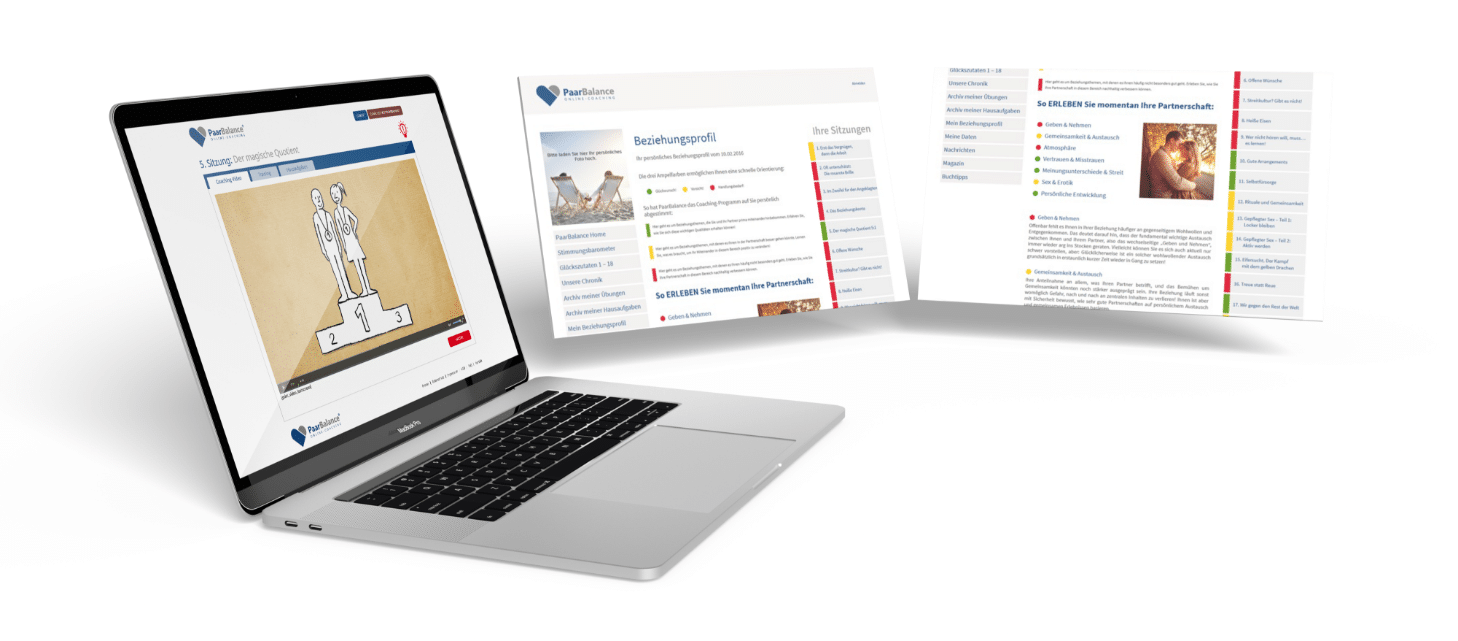
An alternative or supplement to face-to-face couples counseling or "bibliotherapy" can be the internet-based online coaching program PaarBalance. The PaarBalance program is the only scientifically validated, interactive online coaching program for improving couples' relationships in German-speaking countries, and it can also be used by individual partners .
PaarBalance can be used flexibly and independently – regardless of the opening hours of a couples therapy practice.
Over 18 sessions, key knowledge from couple therapy research is imparted, along with practical tools that will enable you to improve the atmosphere in the shortest possible time and find more joy and ease in life.
Strengthen your relationship: with PaarBalance,
the online couples therapy for individuals.
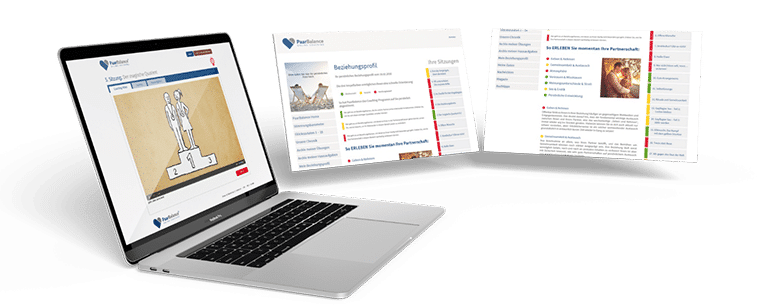
Developed by couples therapists. No waiting lists. Self-determined. Affordable.
Whether you choose (systemic) couples therapy in a practice, couples counseling, working with a textbook, or the online coaching method:
The key is that you continue to be as actively involved in your partnership as you are now 🙂 – because this is how a painful separation and thus the dissolution of the "family system" can be prevented in most cases, and life as a team can be enjoyed again!
☝🏻 Related articles on the topic of "Systemic Couple Therapy"