







☝🏻 Quick start: Breakup despite love
Breakups are among the most emotionally impactful and stressful experiences in our lives - and this also applies to couples who have not felt truly connected or 'liked' each other for a long time.
However, it becomes truly painful when love is still there - and yet a separation is on the horizon.
- What are the possible reasons for a breakup despite love ?
- Why do couples repeatedly choose to end a relationship despite loving each other?
- When is this advisable from a couples therapy perspective ?
- When not?
You can find out more about this topic in our blog article.
🚀 Already 65,511 people have gained clarity through the test.
Beware of unprofessional advisors!
In planning this article, we first looked around a bit in the vicinity of Dr. Google for the keyword “separation despite love” to get a sense of what can already be found 'on the net' about this not so rare topic.
Therefore, we would like to issue a warning at this point:
The first search results for “separation despite love” included several articles that, in our opinion, far too readily recommend ending what we believe to be a generally stable relationship.
As relationship researchers and long-time couple therapists, we would like to emphasize how important professional support is:
Many of the reasons given there for why a relationship should be ended do not, in most cases, constitute valid arguments for a final separation – especially not in the case of a potential “separation despite love”.
If there is still a good deal of affection, connection and love between the partners, then separating – even though they love each other – is only very rarely advisable.
Avoid separation - why?
One of the most important principles in research on relationships and happiness is:
It's better to experience something new with an old partner than to repeat the same old things with a new partner.
Divorce is one of the most drastic and stressful life events imaginable. We humans are attachment beings – a bond that has grown over time cannot simply be severed. It is almost always worthwhile to fight for a relationship and not end it hastily – due to (usually surmountable) challenges or (temporary) headwinds – especially if both partners still feel love, if there is a family involved, and/or if much in the shared history of the relationship was or still is good.
In the following sections, we will take a closer look at the reasons for ending a relationship and the possible solutions for the many 'other cases'.
First and foremost: Honestly examine the various issues in your relationship!
If we have the impression that things aren't (or no longer are) going smoothly in our partnership, we should n't end the relationship as quickly as possible and break up with each other forever. Instead, we should first do everything we can to understand as precisely as possible why and in which areas the problems are currently occurring.
A clear view of the resources and challenges in the couple relationship, as well as the search for causes and reasons for the current dissatisfaction, are the most important prerequisites for taking the right path forward.
How is your relationship doing right now? Take the test! (free)
For this purpose, the renowned relationship expert Prof. Dr. Ludwig Schindler and colleagues developed the scientifically based CoupleBalance relationship test (for German-speaking countries). It allows people in existing partnerships to see the most important aspects of their relationship quality and the challenges they face in their partnership at a glance.
- Where do our strengths lie?
- Where and why is it creaking?
- What exactly do we need to feel better as quickly as possible?
- What constitutes a fulfilling love?
Using the test results, a personal relationship profile is created for you, giving you an immediate overview of where you currently stand in your relationship.
Find out if and how your relationship still has a real chance of becoming happy (or happier) again - or most likely not.
Take your relationship test now! (free)
How is your relationship?
What are your strengths and weaknesses?
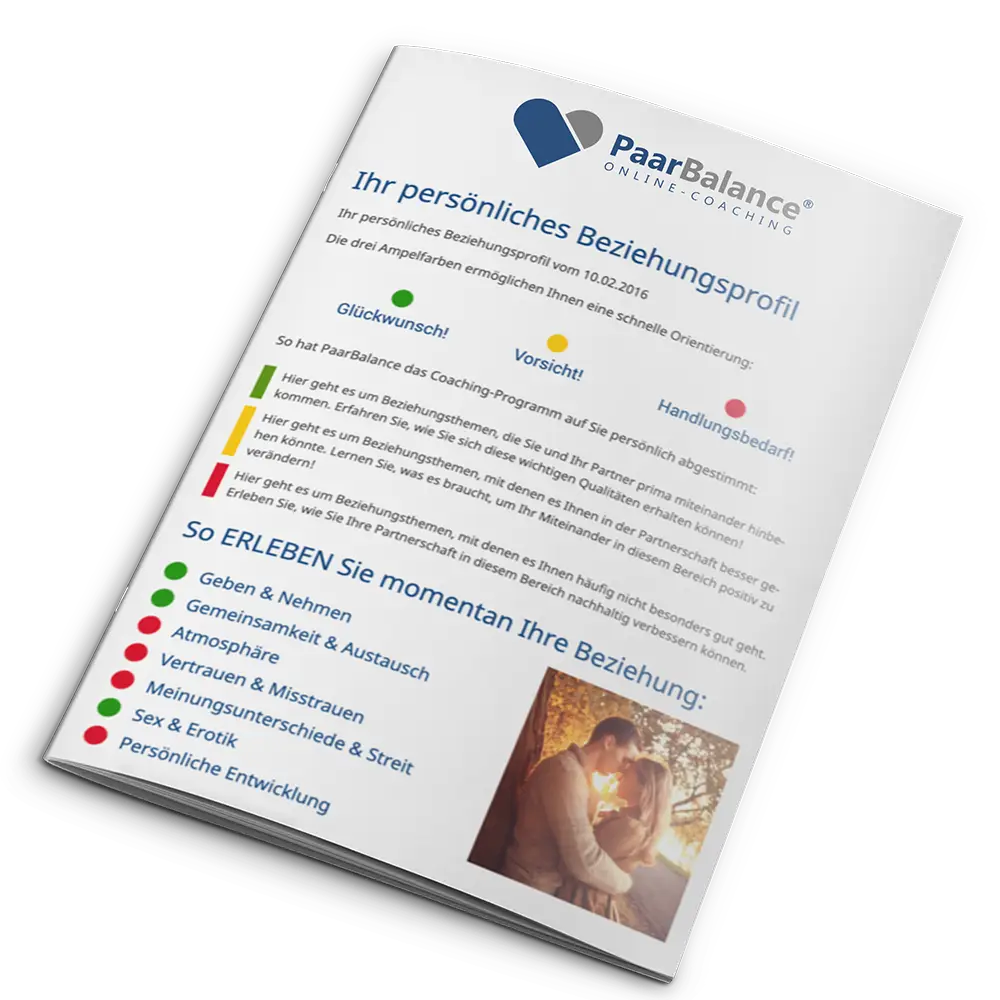
You will find out immediately afterwards in your personal PaarBalance relationship profile (free).
Start your relationship test now!
✓ Scientifically sound
✓ Includes detailed analysis
✓ Your data will not be shared
✓ 100% free & non-binding
100% secure. We comply with data protection regulations. Registration for the relationship test is free .
Please read this important information beforehand:
Data Protection ᐧ Terms and Conditions ᐧ General Information Agreement Terms and Conditions . Transparency Statement
The most important questions you should ask yourself now
Before you continue reading, you should try to answer the following two basic questions intuitively:
- Do I basically want to continue my relationship?
-> (rather) YES/(rather) NO
- Do I feel that my partner basically wants to continue our relationship?
-> (rather) YES/(rather) NO
Very important: Listen to your gut feeling at this point!
Do you perceive a clear "NO!" within yourself?
Does this mean you no longer feel a sense of "we", you no longer believe that you can be happy together, and the idea of continuing to share life into old age perhaps even fills you with vague anxiety?
-> Then a " temporary separation " could be the next important step to experience what life without each other is really like or would feel like in the long term .
Are you prepared for a separation with all its consequences ?
So you are absolutely sure that you want to separate permanently and no longer need a 'test phase' (in the sense of a temporary separation)?
-> Then, accompanying mediation for the specific steps of the separation should be considered - especially if a fair arrangement regarding shared children, pets or shared property needs to be found.
Is your intuitive answer "YES!"?
Does that mean you still like each other and would 'actually' prefer to stay together?
Then you should seriously consider how a (possibly already severely) strained relationship can be transformed so that both partners once again experience being together as enriching. Read the entire blog article to the end in peace and quiet, ideally without interruptions.
It is quite 'normal' that we often find it difficult to focus our 'inner spotlight' on the positive aspects of our partnership.
Our 'internal critic' persistently points out when something is not the way we would like it to be, and often whispers phrases in our ear such as:
- You no longer treat each other with respect.
- Your trust has been damaged.
- You let yourself be treated too much!
- You don't talk to each other nearly enough - and certainly not honestly.
- It scares you to think about the future with him/her.
- When was the last time you two had a relaxed period?
- Didn't you say yourself recently that you're no longer happy?
- You see absolutely no point in torturing yourselves any longer.
etc. etc.
Although this voice is an important inner 'warning voice' and points to areas where there is clearly a need for change, you should currently avoid being fundamentally unsettled by such thoughts and being carried away by (pre)happy decisions.
If there is still love in your relationship and you have been happy together for extended periods in the past, it helps to first remove as much pressure as possible. Consciously allow yourselves a period of reflection – with an extensive review of the past and an open-ended outlook. Allow yourselves to do things a little differently than before and to try new things without having to immediately commit to a medium- and long-term plan.
You can always separate if necessary - but usually there are many reasons to first take stock and conduct a reality check:
- What can likely be changed? What cannot?
- Where should we invest energy for change?
- In what respects would more acceptance and composure be needed?
Only then can meaningful further decisions be made.
Before the coaching begins, you can (free of charge) take the PaarBalance relationship test to receive sound feedback on the areas where your resources as a couple lie and where there is concrete potential for improvement.
10 typical reasons for a breakup despite love
What are the most common reasons why people seriously consider a " separation despite love "? What is experienced as so stressful that at least one of them talks about the topic of separation or that a separation actually occurs?
Even though your personal relationship situation is certainly unique, couples often struggle with similar issues over the course of long-term partnerships – yet almost no one (not even close friends) really talks about it openly. Fear of loss is, after all, extremely closely related to jealousy…
Do you recognize your personal “relationship issues” in the following?
(1) Jealousy
Intense jealousy can put a tremendous strain on a relationship. It is sometimes referred to as the "flip side of the coin of love ".
Those who love (and perhaps also have the perception that they love the other person more than vice versa) desperately want to 'keep' their loved one and consequently struggle with fears of loss.
Fear of loss is closely linked to jealousy ... Unfortunately, these feelings can become so dominant that all the good moments are increasingly pushed into the background.
In most cases (unless it's pathological jealousy accompanied by threats and violence), you shouldn't end a long-standing, happy relationship— provided the excessively jealous partner is willing to work on their overwhelming feelings.
In our blog article on fighting jealousy , we explain how to overcome attacks of jealousy .
(2) Extramarital affair
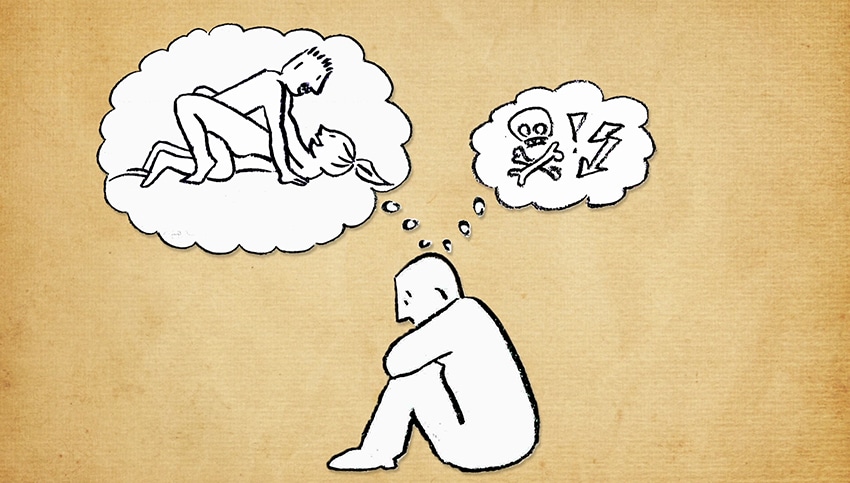
Extramarital affairs and infidelity are among the most common causes of a "separation despite love".
The stronger the feelings, the more the breach of trust hurts. Often we simply don't know (anymore) what could help us lessen the suffering – except: ending the relationship.
Those who find themselves in such a desperate situation and talk to close friends or acquaintances are often prematurely advised to separate. Although those close to you mean well , they may not always be good (or objective) advisors. From the perspective of relationship research, there are various constructive ways to deal with infidelity. However, a 'separation despite love' is usually not the best choice. Those who separate too hastily deprive themselves and their partner of the crucial opportunity to learn from the mess—both individually and together—and ultimately emerge from this disastrous situation as a stronger couple.
Even though it may sound unimaginable at first: Most couples who have managed to stay together despite the relationship catastrophe of infidelity and to change important aspects later report an openness and equality they had never experienced before.
We have also written a separate article on this topic entitled " Forgiving an Affair " ↗, which should help you in this situation.
(3) Different lifestyles
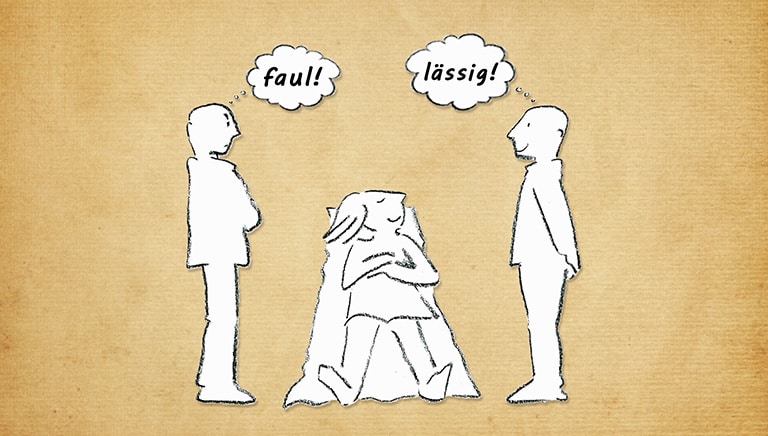
While life plans for the distant future may initially seem secondary in the early stages of a relationship, they gain increasing importance in longer partnerships. Sometimes this importance is so profound that couples ultimately separate – even though they actually love each other.
If you and your partner have a generally good relationship, the motto is: Find compromises ! Compromises are only good if both parties are willing to compromise to roughly the same extent.
Of course, you can't have half a child – but in many areas, a solution is possible. For example: One partner dreams of traveling the world, while the other is currently focused on their career. In cases like these, a "temporary separation" could be considered, allowing both partners to develop their potential without either feeling frustrated or living in conflict with their needs – while ultimately ensuring they can stay together or find their way back to each other.
However, such a temporary separation needs to be well thought out and well prepared, which is why we have written a separate article on the topic of "temporary separation" .
In any case, the following applies: Be creative and work together on solutions that you may not have encountered in your environment before and that may initially seem very unconventional.
(4) Unrequited love
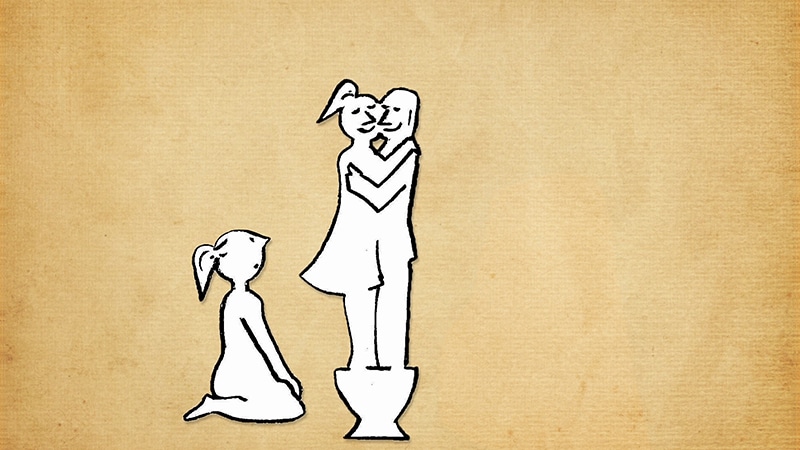
Does one partner invest a huge amount in the relationship over a long period of time, but receive hardly anything in return?
Engage in the most open communication possible with your partner to find out if a lack of love is truly the cause of his/her behavior.
There can also be completely different reasons why 'giving and taking' (at times) no longer feels balanced.
Worries, personal problems, fear of commitment, stress, introversion and many other factors could play a role here and be mistakenly interpreted as a 'lack of love'.
However, it's also quite possible that one partner simply loves differently than the other, meaning they express their affection in a different way than you intuitively do and 'understand'. For more information, please read our article on the 5 Love Languages .
Therefore, considering a separation despite love only makes sense if it has been proven that one partner truly feels significantly less than the other.
Otherwise, especially in a relationship constellation that is (still) not perceived as optimal, where there is a conscious effort to find a good way of interacting, lasting positive changes can occur, with which everyone ultimately feels (significantly) more comfortable.
(5) Constant dispute
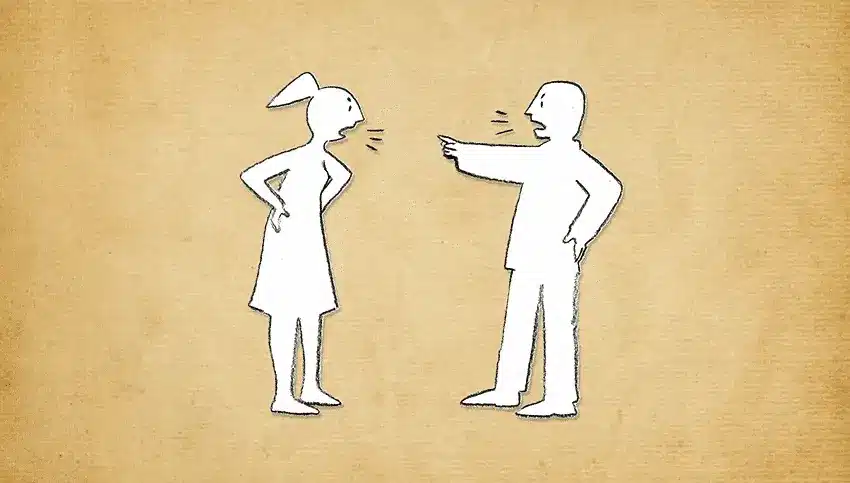
Another typical scenario that can lead to couples considering separation, even if they love each other, is when they argue intensely and regularly. Arguments are draining. Arguments hurt. Arguments leave scars.
Strong feelings of love often quickly escalate a delicate situation and can contribute to frequent conflicts. The situation can repeatedly escalate to such a degree that separation – despite the love – seems like the only viable solution.
However, even on this point, couple research offers reassurance:
Even in cases of prolonged and intense conflict escalation, the vicious cycle can often be broken – if at least one of the two parties truly wants to do so and bravely tackles the issue of "resolving conflicts more constructively".
You can find out how this can be achieved in our article "Constant arguments in your relationship? Here's what you should know!" .
(6) Too little time for each other

Especially when love in a partnership is strong (or was very strong at the beginning of the relationship), it hurts when there is hardly any time spent together anymore. This can go so far that one partner experiences almost chronic heartbreak and, out of grief and pain, eventually even considers separation – despite love (and indeed, great love!).
That's not a good idea in this particular case. Because finding more time (in the sense of 'quality time') for each other is almost always 'just' a matter of logistics, setting priorities, and self-organization.
This article offers suggestions on how to successfully integrate more enriching partner time into everyday life: "Too little time in the relationship"
(7) Lost Passion

No relationship is as passionate after five years as it was in the first few months. Often, the passion diminishes so much (or even disappears completely) that one's own needs are no longer met for an extended period.
In fact, sometimes this even leads to an extremely painful breakup despite love, because one of them longs for the passionate feelings to be rekindled and is convinced that the only solution is a new partner.
However, here too we strongly advise you to first make a conscious attempt to (re)discover the buried desire with your current partner.
(8) Lack of respect and interest

What helps when one partner becomes increasingly disinterested or even disrespectful towards the other?
-> Clear boundaries and direct communication!
No one should tolerate disrespect. Even if the other person "didn't mean any harm" but was simply careless, it's important to address it directly and clearly without starting an argument.
If the situation does not improve, it must be clearly stated that things cannot continue this way.
Being regularly belittled or humiliated destroys one's self-esteem in the long run. If even after clarifying conversations, a more respectful approach doesn't develop, separation (despite love) may ultimately be the best option.
It is highly likely that another partner can be found with whom a loving relationship on equal terms is possible, characterized by respect and goodwill.
(9) Toxic relationship

The term " toxic relationship " is being used increasingly without context. Just because a couple occasionally argues or one of them hasn't always been 100% honest, doesn't mean it's a chronically toxic relationship.
Unfortunately, there are relationships that are so characterized by lies, manipulation, threats and blame from one partner and subservience, self-abandonment and unconditional tolerance from the other partner that they can actually be described as "toxic" (i.e.: poisonous, toxic, damaging).
In these situations, separation may ultimately be the only viable option, even if love persists . The manipulative partner often lacks the ability or willingness for the necessary self-reflection, or is not motivated to permanently change their behavior.
To learn how to specifically recognize whether your relationship is toxic, and what you should or shouldn't do in this case, read our article: Toxic Relationship - How to Recognize It and What to Do?
(10) violence

Repeated physical violence and a violent partner who is unwilling to control their aggression is indeed one of the few cases where there is no other professional advice besides ending the relationship as soon as possible. You should protect your own health and safety as early as possible.
Unfortunately, in cases of domestic violence, the outbreaks often become more violent and frequent over time, and boundaries are increasingly broken down.
Even if you still love your partner, you should definitely put a stop to it before it's too late in the worst-case scenario.
You can find competent contacts in such an emergency situation, among other places, at our emergency contact addresses .
Why you should (almost always) give your love another chance
We have outlined the most common reasons for a 'separation despite love'. Perhaps you recognized yourself in one or more of the described dynamics, or perhaps there is a completely different, individual reason why you are considering a separation – even though you 'actually' still love the person by your side.
Our urgent appeal (provided that you are not involved in a toxic and/or violent situation):
If love is still palpable and you are not 100% sure whether there can be a future as a couple or not, then in case of doubt, try everything again to save your relationship!
Even if you ultimately conclude that separation (despite love) is the only viable option, you won't have to struggle later with the nagging question: "Did I give up too soon? Should we have given each other another chance? Did we really try everything? What if...?"
The uncertainty after the breakup
Separation from a partner is – even if ultimately all reasons speak in favor of it – usually extremely painful and is one of the most stressful so-called 'life events'.
If uncertainty arises as to whether you have really made the right decision, the emotional crisis is prolonged and worsened.
Furthermore, if children are involved, the feeling of not having tried everything to save the family can potentially stay with you for a lifetime.
Therefore, apart from the aforementioned exceptional cases, it is almost always worthwhile to fight for the relationship again and give each other a fair chance.
Use professional support!
You've decided to give it your all to save your relationship? Congratulations! Then you've already taken the most important first step. 🙂
Now we can only urge you:
Seek professional support! No one should have to face a relationship/life crisis alone without professional support.
The minefield of relationships
Anyone actively considering a breakup despite still being in love probably feels like their relationship is a minefield, or their daily life is dominated by the worry that the next misunderstanding or momentary lapse in judgment could ignite another argument in seconds. Both partners often feel emotionally overwhelmed. Unfortunately, hurt feelings can all too easily cloud their judgment.
Such a minefield should be defused as quickly and permanently as possible. To do this, one should know as precisely as possible what to do and what to avoid at all costs. Having a professional explosives expert on hand can be advantageous in this situation. 😉
Ideally, the current danger zone will gradually transform back into a lush green meadow where one can feel safe and comfortable.
If you do not wish to seek personal advice, there are also options to deal with your relationship independently – regardless of time and place – within a structured professional framework.
PaarBalance offers such a possibility .
Save your relationship with CoupleBalance - Scientifically sound help from the comfort of your home
The CoupleBalance coaching program provides you with a clear structure that allows you to systematically solve relationship problems and (re)establish your partnership on a firm, harmonious foundation.
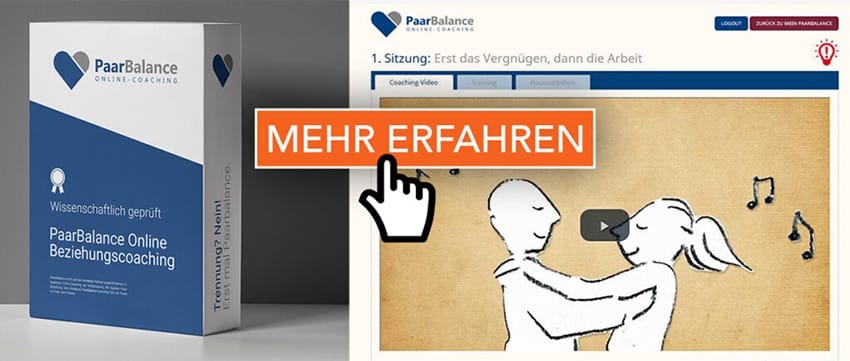
PaarBalance ist das einzige wissenschaftlich überprüfte, interaktive Online-Coaching-Programm zur Verbesserung von Paarbeziehungen im deutschsprachigen Raum, das auch vom einzelnen Partner durchgeführt werden kann.
Anhand von 18 Online-Lektionen erhalten Sie praktische Empfehlungen und konkrete Handlungsanweisungen, wie Sie Ihre Beziehungsqualität verbessern, (auch langjährige) Probleme lösen, eine Partnerschaft auf Augenhöhe führen und wieder zu mehr Leichtigkeit und Lebensfreude finden können.
Starten Sie Ihr Coaching mit einem klaren Bild Ihrer Beziehung! Nutzen Sie unseren kostenlosen PaarBalance Beziehungstest, um wertvolle Einblicke in Ihre Beziehung zu erhalten. Der Test zeigt Ihnen auf, wo Ihre gemeinsamen Stärken liegen und in welchen Bereichen Verbesserungspotenzial besteht. So können Sie Ihr Coaching gezielt angehen und Ihre Beziehung noch weiter stärken.
Vertrauen Sie auf Ihr Bauchgefühl: Sie wissen selbst am besten, welche Art von Unterstützung gerade die passende ist, um eine Entscheidung bei der großen Frage "Soll ich mich (trotz Liebe) trennen oder sollen wir noch einmal alles versuchen?" treffen zu können. Hauptsache, Sie legen beherzt und konsequent los!!
Ich wünsche Ihnen alles Gute und grüße Sie herzlich
Ihre Dr. Judith Gastner & das gesamte PaarBalance-Team
☝🏻 Passend zum Thema Trennung trotz Liebe

Article in FAZ+
with contributions by Dr. Judith Gastner
Frequently Asked Questions
Can love lead to a breakup?
Yes, it's possible for couples to separate even though they still love each other. Incompatible life goals, differing ideas about relationships, or irreconcilable conflicts can be the reason. Some couples manage to transform their love into a deep friendship after a period of separation and remain connected.
When is a breakup better despite love?
The decision to separate despite love is often preceded by great inner struggle. It takes courage and self-reflection to recognize that a relationship has no future and that it is probably better to let go and "release" each other. It is important that each partner remains true to themselves – even if the breakup is painful.
Better to break up or try the relationship again?
The general motto is: "It's better to experience something new with your old partner than to repeat the same old things with a new partner." If you still love each other, you should make even more of an effort to overcome existing problems together. Is separation the better option, or should you try the relationship again? Separation makes sense if life plans and personal goals are no longer compatible and you are suffering greatly as a result.
Is love alone enough for a happy relationship?
To maintain a lasting, healthy relationship, more than 'just' infatuation and romantic feelings are usually needed. This includes, among other things, a broad agreement in personal values and life plans. Tolerance and the ability to compromise are further important ingredients for a stable partnership based on equality.
How to rebuild trust after a breakup, even if you're still in love.
Breakups are painful, but the feeling of having loved should be cherished. Don't rewrite a past relationship. You know you are capable of love. There are so many special people in this world— trust that you will meet someone again who will appreciate your love.