







☝🏻 Quick start: Trust in relationships
"A happy relationship without trust is impossible" – most people would probably agree with this statement. Trust is considered the foundation for a sincere, reliable partnership.
But why is trust actually of such central importance ?
How can it be rebuilt or strengthened when the feeling of deep connection has diminished?
🚀 Already 65,511 people have gained clarity through the test.
Without trust, there is no intimacy.

Trust is considered the foundation of all interpersonal relationships. To truly connect with another person, we need to experience predictability and reliability. This is especially crucial in a romantic relationship.
According to the classic definition, trust is the expectation of one person (trustor) that another (trustee) will act in their best interests.
Having trust in another person and being able to open up to them gives us support and makes a partnership truly enriching. If our partner is trustworthy, we can rely on them to adhere to the rules and boundaries we have agreed upon for our relationship (or which implicitly apply to both of us). We can be sure that the other person does not intend to harm or hurt us with their behavior.
Only this kind of security allows us to be vulnerable with another person and to present ourselves as we truly are. This "letting someone see behind the scenes" makes a significant contribution to building a deep connection, which is crucial for a happy long-term relationship. Only when we trust the other person can they truly get to know us—that is, our emotions, our strengths, our weaknesses, our abilities, and so on.
Without trust, there is no support.

Trust and reliability are the foundation for effective mutual support and thus the prerequisite for a shared life. Only when we feel we can rely on another person are we ready to plan a shared future and make far-reaching decisions (such as starting a family, moving, buying an apartment or house, etc.) with that person.
While mutual trust doesn't offer complete protection against conflict, it is immensely helpful in negotiating differences of opinion constructively and effectively. When two people trust and can rely on each other, they don't have to question the very foundations of their partnership during discussions or when their needs differ.
This allows both partners to express their point of view and seek fair compromises without fearing that the relationship will not survive the disagreement.
These two cornerstones strengthen mutual trust.

Although most couples initially love each other intensely, many eventually feel like they're living parallel lives rather than truly together . Even without a major breach of trust, many long-term couples eventually lose that deep connection. As a result, the partnership is no longer experienced as loving and supportive as both partners originally hoped. The partners become increasingly distant.
If both partners eventually ask themselves what's actually keeping them in the relationship, it's high time to take action!
Does this sound familiar? Are you worried that love might slip away from you forever if you don't soon re-establish more closeness and security? Then take the following two measures to heart as cornerstones for a trusting relationship:
Pillar 1: Communicate honestly
The most important step in building trust is honest, intimate conversations. Consciously open up to your loved one (again) and show them (again and again) who you truly are. Allow your partner to present themselves in all their facets. Remain as empathetic and respectful as possible when they show you vulnerability. It is so valuable to feel you can confide in someone in every situation and to know that your worries and concerns, mistakes and mishaps, dreams and visions are safe with them.
Pillar 2: Be loyal & reliable
Never divulge your partner's secrets or point out sensitive issues – even if it's meant harmlessly or jokingly. We all crave emotional security . Try to always adhere to agreed-upon relationship rules and agreements, as violations can permanently damage mutual trust.
What to do after a breach of trust?
For most people, the worst breach of trust is an affair or infidelity by their partner. Being cheated on is perceived as so serious that the foundation of the relationship feels shattered. Often, couples find it difficult or impossible to rebuild the lost trust on their own.
After such a massive breach of trust , couples counseling or couples therapy can be helpful in cooperation with a couples therapist to examine whether and, if so, with which strategies the relationship can be put back on a common foundation.
However, even without such an incident, some people find it difficult to build deep trust in another person. The reasons for this can lie in childhood experiences or experiences with previous relationships that have damaged basic trust and fostered attachment anxiety . In such cases, psychotherapy or couples counseling can also provide appropriate support to work through the underlying causes and strengthen the capacity for trust.
How strong is the foundation of trust in your relationship? Take the relationship check! (10 minutes, scientifically based & free)
To strengthen or expand existing trust in a partnership, it is necessary to have a good sense of which areas are already "running smoothly" and where there is "room for improvement".
If you have a clear overview of where you have particular strengths in your interactions and where you should be careful (because it is "sensitive territory"), unintentional injuries and a resulting gradual loss of trust are much less likely to occur.
How do you experience your relationship?
How do you shape your relationship?
What level of trust and distrust exists between the two of you?
The PaarBalance relationship test provides you with well-founded answers to these questions. Immediately after completing the test, you will receive your personal relationship profile with a helpful overview of strengths and weaknesses.
Take your relationship test now! (free)
How is your relationship?
What are your strengths and weaknesses?
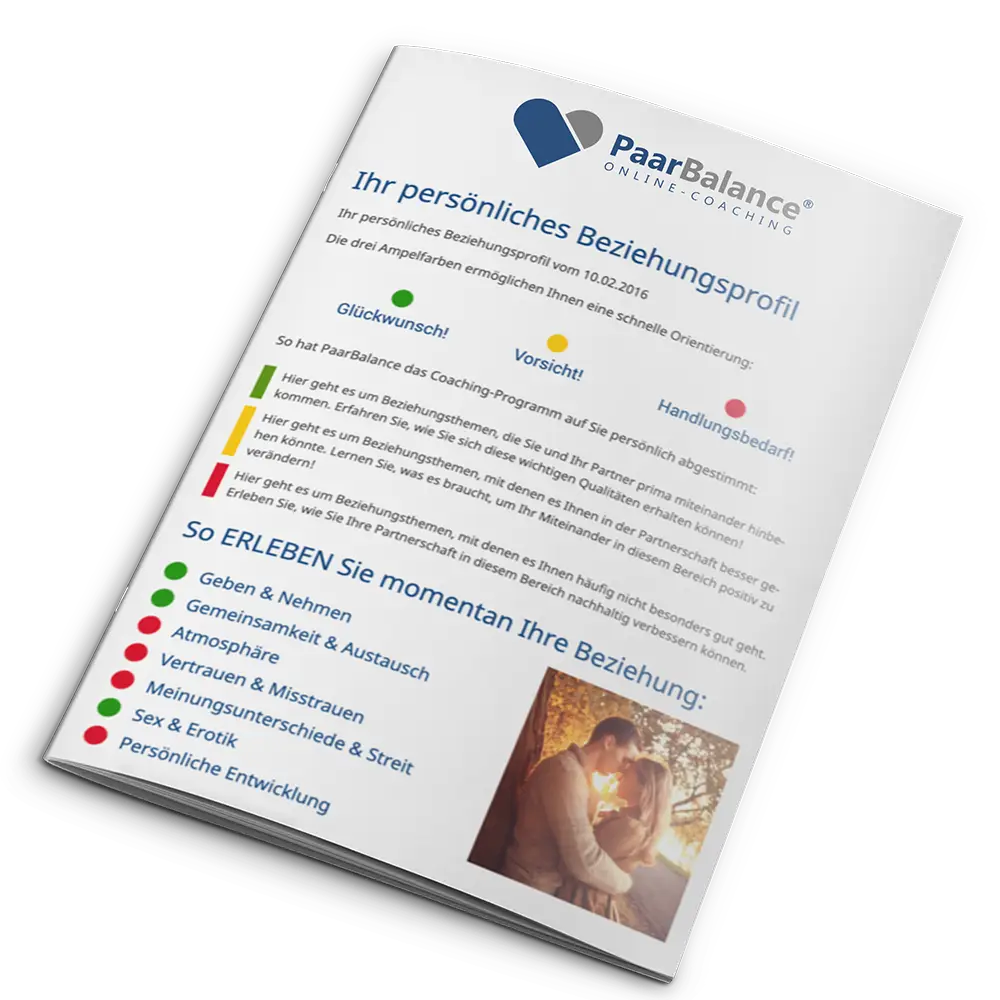
You will find out immediately afterwards in your personal PaarBalance relationship profile (free).
Start your relationship test now!
✓ Scientifically sound
✓ Includes detailed analysis
✓ Your data will not be shared
✓ 100% free & non-binding
100% secure. We comply with data protection regulations. Registration for the relationship test is free .
Please read this important information beforehand:
Data Protection ᐧ Terms and Conditions ᐧ General Information Agreement Terms and Conditions . Transparency Statement
☝🏻 Related articles on the topic of trust in relationships