







The following article aims to help you keep a clear head, realistically assess various signs of possible infidelity, and take the right next steps for you.

☝🏻 Quick start: Recognizing infidelity
🚀 Already 65,511 people have gained clarity through the test.
Once the thought carousel starts spinning...
Imagination is, first and foremost, something beautiful - and being imaginative and creative is considered a positive trait.
However, if our imagination conjures up a colorful mental movie with detailed scenes of our partner instigating an affair, having sex with another person, denying our relationship, or experiencing infidelity as part of their everyday life – without our conscious intention or ability to control it – then a vivid imagination becomes a torment.
Nobody wants to be persistently haunted by thoughts, questions, and images like:
- "It's surely no coincidence that the image of him beaming at that blonde woman at the party and how intimate the conversation seemed keeps recurring in my mind."
- "Why do I so often get the feeling that she suddenly has a guilty conscience?"
- I simply can't imagine him suddenly having so much work. I'm afraid something might be brewing with that attractive new colleague..."
- "I don't think my feeling is completely wrong: She behaved very differently at the beginning of our relationship. Now she often seems almost like a different person."
- "Can I even be sure of our love? He's way too into flirting and never wants to tell me when he's been out with his friends..."
- "Why should I trust her 100 percent? After all, even her closest friends have openly admitted that she used to be quite a handful. Why should that suddenly change?" etc. etc.
The longer and faster the thought carousel spins, the harder it is to find a way out.
For most people, discovering their partner's infidelity is a complete disaster in the relationship.

Nothing is ever the same again. After an affair or prolonged infidelity, things between the cheating partner and the betrayed partner will never be exactly the same as they once were.
When infidelity comes to light and one partner discovers they've been lied to by their loved one, the relationship loses some of its original magic forever. Will it lead to a breakup? Will forgiveness be possible, and will there be a reconciliation? Most of the time, everything remains to be seen.
Self-reproach and despair: Why couldn't I recognize the danger in time?
The particularly painful aspect is that when this relationship catastrophe occurs, not only does our love lie before us like a pile of shards and our trust in the other person is deeply shaken, but often our belief in our own judgment and perception abilities is also massively shaken.
- "I will never forgive myself for not realizing sooner what was happening behind my back!"
- "Why was I so incredibly blind and didn't ask more questions about all these sudden overtime hours?!"
- "How naive was I to not take the signs of infidelity more seriously?!"
- "All my partner's friends must have known about his infidelity for a long time – only I didn't realize it! So humiliating! I never want to face them again."
etc. etc.
We humans usually choose the supposedly lower risk.
It is therefore not surprising that many people often prefer to take the risk of becoming suspicious early on (without good reason) rather than being devastated afterwards (with good reason).
But: Is it really the smaller risk for our partnership and our overall life satisfaction in the medium and long term if we are constantly on high alert and continuously watching to see if our partner is behaving differently than usual?
What underlies our suspicion: concrete evidence or a vague sense of unease?

Part-time job: Detective! - Is that really what we wanted?
Nobody likes the role of spying on their partner and constantly feeling driven to search for signs of cheating , affairs, or infidelity.
But being cheated on in a relationship?! The horror! Then it's definitely better to be on your guard and get to the bottom of any inconsistencies, so you're not led astray and can detect infidelity as quickly as possible. - Or am I wrong?!
Concrete suspicions or vague uncertainty? - That's often difficult to distinguish.
If there were a simple and clear answer to the question of your partner's reliability and fidelity, you would surely know it by now—and would have already acted accordingly. But since things are more complicated, it's especially important to ask yourself the fundamental question once again: How 'justified' is my current suspicion, really?
Is there actually a concrete reason to suspect your loved one of having an affair? Would most other people in your situation be similarly alarmed?
... Falls Ihre Antwort "Leider ja!" lautet, macht es nachvollziehbarerweise Sinn, dass Sie sich mit möglichen Anzeichen für Fremdgehen auseinandersetzen und für sich zu klären versuchen, was es nun zu tun gilt, falls sich Ihre Vermutung bestätigen sollte.
Oder sind Sie aus einem unbestimmten Gefühl der Verunsicherung (das Sie vielleicht schon aus früheren Beziehungen kennen) und einer generellen Neigung zu Misstrauen und Eifersucht auf diesen Artikel gestoßen?
... Falls dem so sein sollte, empfehlen wir Ihnen: Lesen Sie sich zunächst den Abschnitt über 'Eifersucht' im vorliegenden Blogartikel sowie unseren spezifischen Artikel zum Thema 'Eifersucht bekämpfen' durch. Mit großer Wahrscheinlichkeit ist es vor diesem Hintergrund (ganz unabhängig vom Verhalten des anderen) hilfreich, seine persönlichen Muster (Einstellungen, Sorgen, Befürchtungen ...) genauer zu betrachten, ggf. selbst an der einen oder anderen Stellschraube zu drehen und fürs Erste dafür zu sorgen, dass sich die eigene Lebensqualität erhöht.
Sich weitere Szenarien auszumalen, dass-wann-wie-mit wem-warum einen der eigene Partner womöglich betrügen oder einen Seitensprung gehabt haben könnte (obwohl es keinen objektiven Grund dafür gibt, ihm/ihr das zu unterstellen), sorgt sonst nur dafür, dass Ihre Liebe weiteren Schaden nimmt - und beendet nicht das zugrundeliegende Problem (wie Verlustangst oder Selbstunsicherheit).
Nehmen Sie zunächst Ihre Beziehungsqualität insgesamt unter die Lupe!
Wenn sich Unsicherheit und Misstrauen in die Beziehung geschlichen haben und das Miteinander zu einem Minenfeld geworden ist, auf dem sich keiner mehr unbefangen bewegen kann, lohnt es sich immer, die gesamte Beziehungsqualität auf den Prüfstand zu stellen.
Bevor wir uns im Weiteren mit konkreten Anzeichen für Untreue beschäftigen, sollten Sie daher versuchen,
- Ihr (Beziehungs-)Leben insgesamt (d.h. die Entwicklung Ihrer Partnerschaft in den vergangenen Monaten, die Energie, die Sie zuletzt in Ihre Liebe investiert haben etc.) mit etwas Abstand zu betrachten und
- grundsätzliche Fragen zu der von Ihnen erlebten Zufriedenheit in Ihrer Partnerschaft zu beantworten.
Die Sorge, dass der Partner fremdgeht, und das Erleben, dass das Vertrauen erschüttert ist, kann nicht isoliert, sondern nur im Kontext der gesamten Beziehungsgestaltung eines Paares verstanden und aufgelöst werden.
Der klare Blick auf die eigenen Stärken und Schwachstellen der Beziehung ist die Grundlage dafür, die passenden Maßnahmen für mehr Vertrauen, Innigkeit und Geborgenheit zu ergreifen und - falls es tatsächlich zum Worst Case gekommen sein sollte - die durch Untreue entstandene Krise als Herausforderung annehmen und letzten Endes als Paar bewältigen zu können.
Wie steht es aktuell um die wichtigsten Bereiche in Ihrer Partnerschaft?
Machen Sie den PaarBalance-Beziehungstest (kostenfrei)!
Machen Sie jetzt Ihren Beziehungstest! (kostenfrei)
Wie steht es um Ihre Beziehung?
Was sind Ihre Stärken & Schwächen?
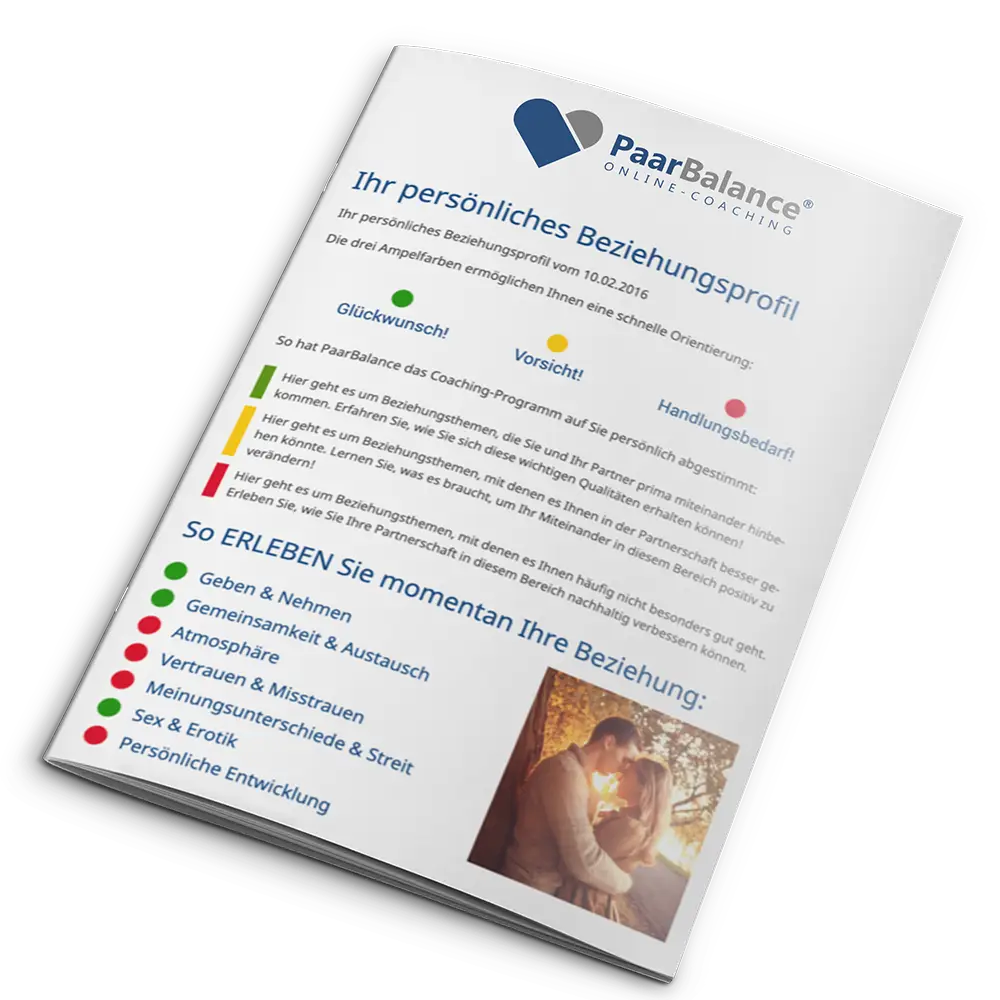
Das erfahren Sie sofort im Anschluss in Ihrem persönlichen PaarBalance-Beziehungsprofil (gratis).
Starten Sie jetzt mit dem Beziehungstest!
✓ Wissenschaftlich fundiert
✓ Inklusive detaillierter Auswertung
✓ Keine Weitergabe Ihrer Daten
✓ 100% gratis & unverbindlich
100% sicher. Wir halten uns an den Datenschutz. Die Anmeldung für den Beziehungstest ist kostenlos.
Bitte lesen Sie zuvor diese wichtigen Informationen:
Datenschutz ᐧ AGB ᐧ Allgemeine Informationsvertragsbedingungen . Transparenzerklärung
Der PaarBalance-Beziehungstest wurde von dem renommierten Paartherapeuten Prof. Dr. Ludwig Schindler & Kollegen entwickelt und seine Aussagekraft in einer wissenschaftlichen Studie an einer großen Stichprobe überprüft.
In Ihrem persönlichen Beziehungsprofil (kostenfrei) können Sie sofort sehen, was es braucht, um in den Bereichen Treue, Erotik, Eifersucht, Wir-Gefühl, Konfliktbewältigung, Kommunikation, Geben & Nehmen etc. baldmöglichst wieder einen gemeinsamen Weg einschlagen zu können.
Die 5 zentralen Fragen des vorliegenden Blogartikels
In den folgenden Abschnitten beschäftigen wir uns mit diesen Themen:
1. Die Frage nach der Herkunft unserer Angst
Warum erschüttert uns (Männer wie Frauen gleichermaßen) allein die Vorstellung, dass unser Partner fremdgehen könnte, so sehr? Macht es dabei einen Unterschied, ob sich der Fremdgeher einen rein sexuellen Seitensprung 'erlaubt' oder es bei der Untreue einen emotional bedeutsamen Aspekt gibt?
2. Die Frage nach der Unterscheidung
Wie kann die Unterscheidung gelingen, ob das Kernproblem 'nur' das eigene übermäßige Misstrauen ist oder tatsächlich eine verheimlichte Affäre (bzw. ein Seitensprung) der/s anderen?
3. Die Frage nach dem Umgang mit Eifersucht
Wie kann ggf. mit der eigenen, aus der Biographie resultierenden, Unsicherheit und Eifersucht so umgegangen werden, dass die Partnerschaft nicht dauerhaft Schaden nimmt?
4. Die Frage nach den Anzeichen
An welchen Anzeichen kann man - zumindest mit hoher Wahrscheinlichkeit - Fremdgehen erkennen?
5. Die Frage nach dem: Was nun?
Falls sich der Verdacht der Untreue erhärten sollte und der Partner zugibt, dass er tatsächlich fremdgeht oder untreu gewesen ist: Was nun? Was tun? Was tunlichst vermeiden?
Qualvolle Eifersucht - woher kommt sie?

Fortunately, behind the nagging suspicion that the other person might be cheating, there are not always justified signs of an affair or even chronic infidelity.
Regardless of whether the suspicion of infidelity is confirmed or not, it is helpful to be aware of why the mere idea that one's partner might be interested in other women or men is often accompanied by a deep sense of unease.
What is the reason we are so sensitive and vigilant about the issue of 'possible infidelity' in general ?
One of the main reasons for persistent (and often debilitating) insecurity is jealousy.
There are plenty of valid reasons to suffer from jealousy.
The most common causes of pronounced jealousy include:
- a previous affair from a past relationship and the resulting general mistrust
- low self-esteem and the habit of constantly comparing oneself to others
- a painful loss experience (possibly from a very long time ago)
- A guilty conscience , because one may have already indulged in one or two affairs oneself, and the associated worry "Maybe the other person is doing the same thing...?!"
The fear that our partner is cheating
Those who haven't experienced it themselves (yet) can imagine: An affair shakes a relationship as fundamentally as almost nothing else – regardless of whether the infidelity is a one-time affair, repeated transgressions, or a longer affair.
Forgiving is incredibly difficult for both women and men after such a serious hurt. Forgetting is simply not an option.
Therefore, everyone either wants to avoid this experience or definitely not experience it again.
Secretly, we hope that the other person comes into contact with as few potential adventures as possible and is not tempted in the first place...

Another typical scenario that can lead to couples considering separation , even if they love each other, is when they argue intensely and regularly. Arguments are draining. Arguments hurt. Arguments leave scars.
Strong feelings of love often quickly escalate a delicate situation and can contribute to frequent conflicts. The situation can repeatedly escalate to such a degree that separation – despite the love – seems like the only viable solution.
However, even on this point, couple research offers reassurance:
Even in cases of prolonged and intense conflict escalation, the vicious cycle can often be broken – if at least one of the two parties truly wants to do so and bravely tackles the issue of "resolving conflicts more constructively".
You can find out how this can be achieved in our article "Constant arguments in your relationship? Here's what you should know!" .
Flirting can happen almost anywhere.
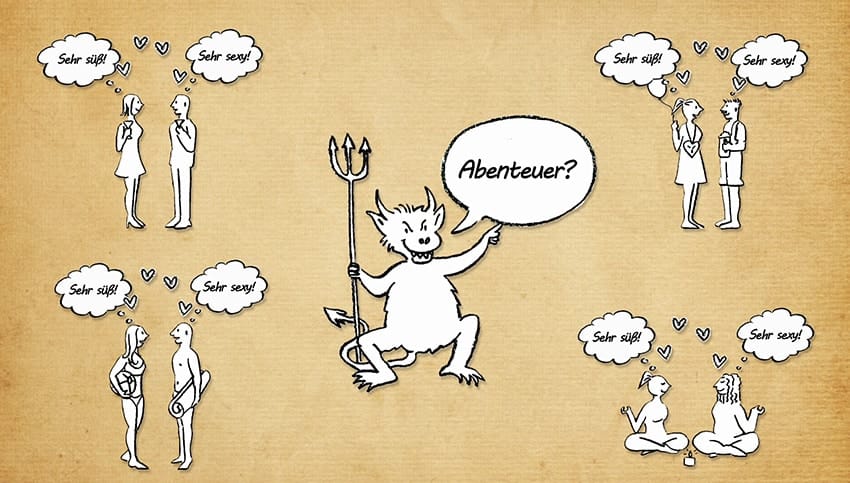
The fact is, it's more than likely that we'll encounter a few people in our professional or personal lives to whom we feel erotically and/or personally attracted. And presumably, most people in committed relationships have already experienced 'temptations'.
Anyone who doesn't go through life with blinders on will automatically encounter attractive people who might be able to trigger one or two "what if" fantasies.
A little flirtation that doesn't further shake the relationship is usually experienced by men and women alike as a welcome confirmation of self-esteem and as an invigorating change in the daily grind.
The idea that one's partner might also occasionally have an exciting encounter and experience something new, however, feels anything but thrilling.
Loyalty is an active process!
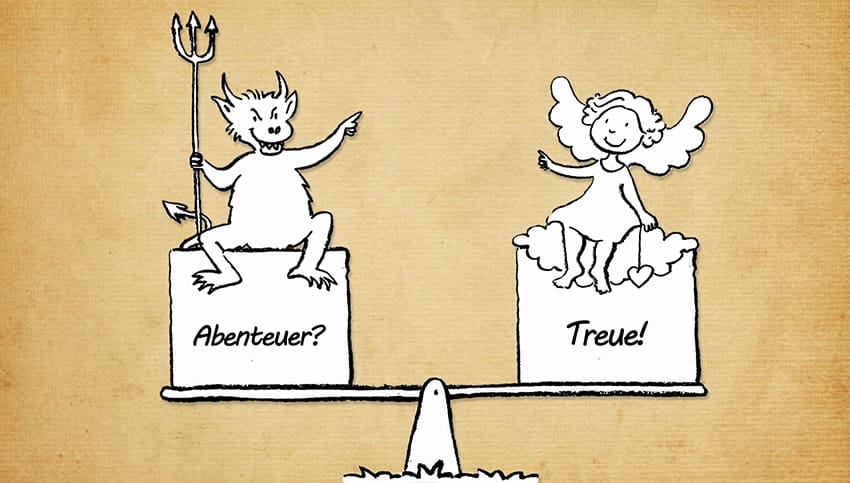
"I just sort of stumbled into it!", "I wasn't looking for an adventure at all!", "It just happened, I never wanted to cheat.", "Before, I was convinced I was at no risk when it came to affairs and infidelity."
Surprisingly, but true: Many people who have cheated on their partner for the first time weren't really aware beforehand that fidelity is an active process . But: "Passive fidelity" doesn't exist.
The need to set or maintain boundaries
Before a seemingly harmless flirtation threatens to get out of hand, a clear and unambiguous boundary must be consciously set (or adhered to): This far and no further.
Those who have cheated often describe their experiences during the initial stages of reconciliation with words like: " I just sort of got swept up in it. It suddenly had an extreme pull. The feeling of being truly desired again felt incredibly good. I couldn't resist it."
Being faithful when there are 'few opportunities' is no heroic act.
When opportunities are scarce, it's relatively 'easy' to be faithful. It only becomes exciting – because it's challenging – when greater temptations arise.
The more often someone is flirted with, or the more strongly they feel attracted to another person, the more reason they have to be proud of being able to look in the mirror after an encounter with strong 'flirting potential' and say to themselves:
Wow, she (he) really is (was) attractive (or charming, or intelligent, or funny, or interesting...). How great that you still managed (again) not to get too swept up in the excitement of the new relationship. You can be proud of yourself for remaining loyal and maintaining clear boundaries for the sake of your partner (and your relationship).
Jealousy - an evolutionary pattern?

To better understand jealousy—this emotional rollercoaster of love, mistrust, fear of loss, and insecurity—it helps to consider the consequences of infidelity in our human history. It's important to know that jealousy is a universal phenomenon experienced by almost everyone . The fear of losing a loved one (which includes the fear of infidelity) is deeply ingrained in our psychological makeup.
Jealousy can be understood as an alarm system that is used to avert potential harm in time.
From an evolutionary biological perspective, the infidelity of a partner could not only mean the end of one's own genetic line, but for our ancestors it could even mean endangering their own lives.
The dangers associated with infidelity and cheating manifested themselves differently for men and women, but were accompanied by the same feelings: fear and jealousy.
Jealousy in men

From an evolutionary point of view, the great 'danger' for men is that (without modern science) it is hardly possible to find out with 100 percent certainty who the biological father of a child is.
Even a single affair by his partner can result in a man (unwittingly) investing his own resources in the child of another biological father for decades.
If our organism has enshrined the 'passing on of its own genes' as the 'central task for our species', then this scenario ( "I am firmly convinced that I have a biological child - but that is not the case at all" ) is a great emotional threat.
Important:
Here we are only considering one evolutionary biological aspect of "jealousy and parenthood". Of course, there have been and still are countless examples of successful social parenthood, i.e., viable constellations with close bonds between adults and non-biological children within the context of blended families, adoption, foster care, etc.
And of course, we can also experience the feeling of 'jealousy' beyond the thought of 'passing on one's own genes' (see, for example, jealousy between children or between very elderly partners).
Jealousy in women

While men cannot readily and with absolute certainty say whether the child they are raising is actually their biological child , women know with almost complete certainty whether they are the biological mother or not.
However, from an evolutionary perspective, women faced a different major 'risk' if their partner cheated and turned to another partner.
In times when our existence was a constant struggle for survival, the situation of being "pregnant and/or left alone with a small child/small children" could quickly become life-threatening.
It was therefore essential to prevent the Stone Age man from suddenly developing a bond with another Stone Age woman from the neighboring cave and withdrawing his resources as provider and protector.
These evolutionary differences are often cited as the reason why women (on average) react somewhat more strongly to emotional infidelity by their partner (underlying main fear: "He might leave me for her.") - while men tend to have a greater fear of their wife having a sexual affair ("She might get pregnant by someone else.").
Evidence collection and prosecution? - How does one deal 'correctly' with a suspicion?
As described above, our sense of jealousy acts as a warning system. One characteristic of this system is that it prefers to trigger a false alarm rather than overlook a real danger. Therefore, many people tend to be overly suspicious and to overinterpret perceived signs of disloyalty.
Against this background, the signs listed below, which are more frequently found when a partner is 'leading two men', should not be understood as proof , but merely as indications of possible infidelity.
What does it mean to deal 'correctly' with a suspicion?
Should the best course of action be to immediately confront the other person with all suspicions and question them? Gather evidence, note inconsistencies – and ideally catch the partner red-handed in the act of secrecy to force a confession?
Please don't do that! Or rather: Please don't do that to yourself !
That would only exacerbate the current situation and very likely cause a major tragedy with potentially serious (further) injuries.
Therefore: Try to remain calm! Don't make a scene with your partner! Don't follow them to catch them in a possible lie. Don't insult them, don't yell at them, don't threaten them.
First, give yourself as much time as possible to calm down if you are feeling agitated and uncertain. Do you have a trusted friend or close female friend in your life? If so, can you confide in them openly and share your worries, fears, and suspicions?
Receiving initial feedback from someone who is sure to have your best interests at heart can take some of the pressure off.
We will take a closer look at when, where and how you could talk directly to your partner at a later time to gain certainty about your relationship situation.
Recognizing infidelity: Typical signs of cheating

In the following, we will examine the most common signs that are regularly described in connection with infidelity.
The classic scenario: Changed ('strange') behavior on the mobile phone
Perhaps the most common sign that an affair or extramarital relationship might be developing, or that a second relationship already exists, is a change in the partner's behavior regarding their mobile phone that is perceived as strange.
Especially when a couple lives together, it often becomes difficult for the unfaithful partner to maintain a lively, close relationship without the betrayed partner noticing. Therefore, communication is shifted to places where the cheater is alone and feels supposedly unobserved.
Suddenly, the mobile phone is no longer left on the kitchen table, but taken into the shower, the partner stays in the toilet for an unusually long time or suddenly goes outside to make phone calls much more often than before.
This is typical behavior after infidelity , which is becoming more common in the age of smartphones.
Unusual secrecy
Since an unfaithful partner is very afraid of being found out, he/she will take appropriate measures to prevent this.
Here, too, a typical point of attack is the mobile phone. Suddenly the unlock code is changed, the phone is always placed with the screen facing down, regularly switched off completely or airplane mode is used – out of fear that the affair partner might call at the wrong time.
Secrecy can also manifest itself in the partner suddenly being much more reserved with information and, for example, answering questions about how his/her day was unusually briefly and evasively.
The way people interact is changing.
Almost always, when one partner is unfaithful, their behavior in the relationship will change. Interestingly, this doesn't necessarily have to be 'negative' and manifest itself in things like lack of desire, irritability, etc. Often, the unfaithful partner feels so guilty about betraying their partner that they unconsciously try to somehow 'make amends' for the gnawing guilt.
Of course, you shouldn't scrutinize every sign of affection or every little gift from your partner! However, a sudden and significant change in their behavior towards you, combined with other signs described here, could indicate that your partner is currently going astray.
Sex is changing.
When one partner has an affair, the sex life in the relationship often changes. The partner might suddenly show (even) less or no erotic interest at all because their desire is being satisfied elsewhere (see also our article "No More Sex in the Marriage" ). However, there might also be an increase in passion. In male cheaters, a generally higher libido can be related to elevated testosterone levels.
It can sometimes also be 'suspicious' if the partner suddenly wants to constantly 'try out' new things in bed, but then seems extremely experienced and appears to have 'mastered' them perfectly out of nowhere.
Excuses, excuses, excuses
Maintaining an affair over an extended period requires a considerable amount of time and organization. In most cases, this means that the partner suddenly starts coming home significantly later on a very regular basis or is no longer reachable at the usual times. When confronted with this, explanations are naturally required. The most common explanation—because it's easiest for many who work outside the home—is:
Overtime, overtime, overtime... Sooooo much work right now! Additional meetings, changes in the order situation, unforeseen difficulties with a project, covering for sick colleagues, and so on and so forth.
If you repeatedly notice that the stated reasons do not correspond to reality or even contradict each other, this is often an indication that the partner is already involved in logistical – and therefore usually also emotional – difficulties.
The crucial factor is the type and timing of changes.
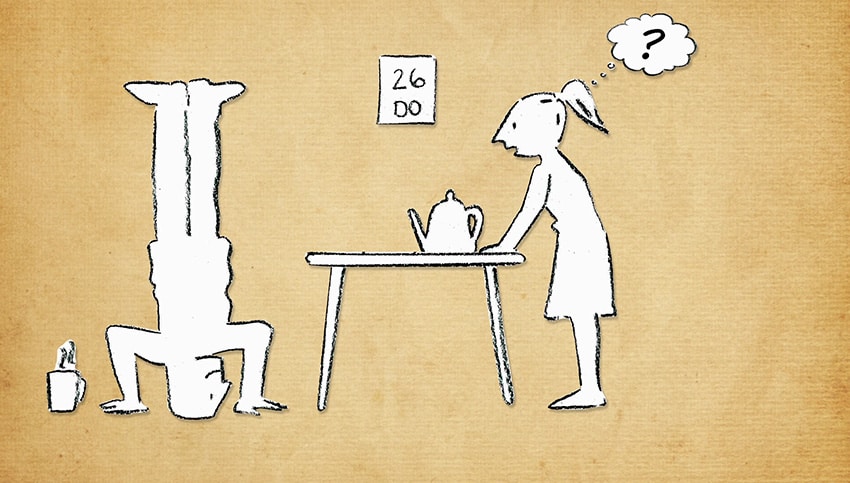
The crucial point regarding the above-mentioned possible signs of infidelity is the sudden transformation and the accumulation of behavioral changes that are incomprehensible or barely understandable.
- If your partner has always enjoyed trying new things during sex, then a varied sex life in the partnership has obviously always been important to him/her (and will continue to be so).
- If your partner has always regularly taken their mobile phone into the bathroom, then perhaps they simply enjoy being entertained by YouTube videos while brushing their teeth.
- Is your partner generally an adventurous type? Then, in itself, it's not surprising if he/she constantly reinvents himself/herself and plays with throwing rituals overboard.
It only becomes 'suspicious' when behaviors change completely unexpectedly and/or on a larger scale - and you cannot see any plausible reason for it.
I'm still afraid my partner is cheating on me. What now?
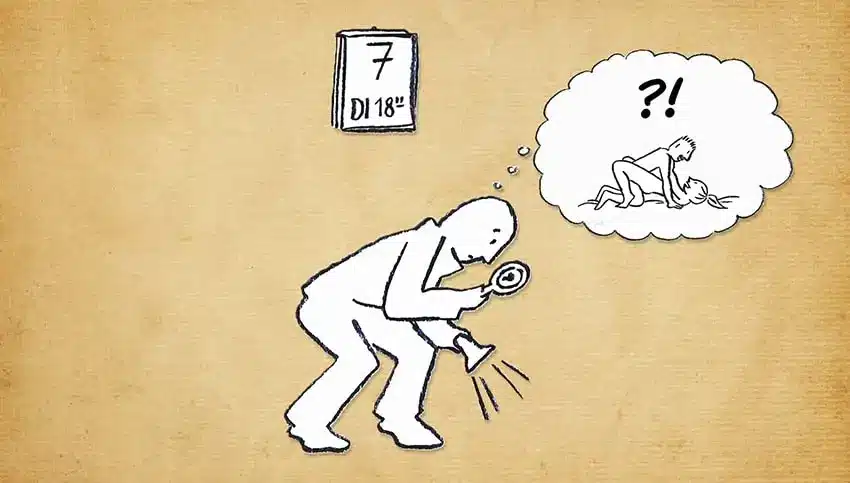
Should your suspicions become increasingly confirmed, that is of course far from what we would have wished for you.
That makes it all the more important to calmly summarize what exactly has worried you in the past.
It's best to jot down all your observations (and the accompanying feelings and questions) in bullet points. Putting our thoughts and feelings into words and writing them down allows us to evaluate them much better (or re-examine them if necessary), and it also prepares us when we talk to the other person.
Should I bring it up or not?
What is right in the current situation ? What is wrong ? Is there even a clear right or wrong ?
Often it goes like this: Either the jealous partner keeps their feelings completely to themselves (and torments themselves more and more), or they confront the other person impulsively and uncensored (i.e. accompanied by out-of-control emotions) with their suspicions.
Neither is advisable - neither to remain stuck in one's feelings nor to lash out.
If we say nothing, we become increasingly insecure, tense, and tight-lipped. If we lash out—and the suspicion later proves false—the relationship may suffer irreversible damage: Someone who is innocent will experience being confronted with such serious accusations in such a brutal way as a massive breach of trust.
So what is the solution?
This is how the conversation succeeds.
If the suspicion persists and cannot be resolved (neither through personal reflection nor through discussion with a trusted confidant), the partner should be spoken to directly.
A key to preventing a conversation from escalating is often to address the issue as simply and directly as possible – ideally by asking the other person mostly questions. This works best the sooner it's done. Waiting longer and searching for more and more clues only makes the situation worse.
Phrase your observations and related questions in such a way as to avoid causing harm if your partner has not actually cheated.
Start by telling your partner that you're finding it difficult to talk right now and that you're feeling quite upset. As calmly as possible, describe your observations and your uncertainty, and give your partner a real chance to explain themselves and their behavior, and to reassure you if your suspicions turn out to be unfounded.
No cross-examination!
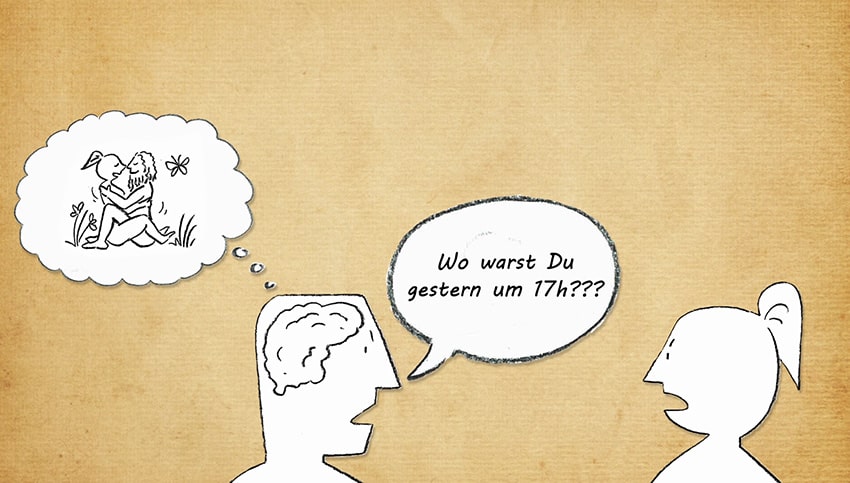
Important: Under no circumstances should you interrogate your partner. Don't bombard them with detailed accusations. Don't commit to anything from the outset. As already mentioned: If they have never been unfaithful, they will understandably feel unfairly 'punished' and be angry if bombarded with accusations such as:
- "You were probably unavailable for a good reason this afternoon - right?!"
- "Then you can surely prove to me that you were at work until 9 p.m. yesterday."
- "I am now absolutely certain that you deliberately did not introduce me to the blonde woman you talked to for so long at the party."
- "Did you just turn your phone upside down again so I can't see who the message is from?!"
Sentences like these, or similar ones, should be avoided whenever possible. In extreme cases, persistent insinuations can lead to exactly what we fear most happening.
One client from our practice reported that he had suffered greatly for many years from his girlfriend's intense jealousy and had endured countless scenes for which there was absolutely no justification. Eventually, he gave up and stopped trying to prove to his girlfriend that there was no basis for her accusations—he hadn't been able to anyway. After being punished for so long for something he hadn't done, he became so frustrated, and the relationship had suffered so much damage, that he finally sought out an affair and fully committed to it—thinking, "Then I'll just do exactly what I'm constantly accused of doing." This affair ultimately served as a way to end the increasingly unhappy relationship.
Avoid such a development!
Recognizing the truth
Presumably, almost every 'accused' (if they were unable to prepare for the conversation) will reflexively deny all accusations at the moment of being 'surprised' - even if they should be true or at least 'there is some truth to them'.
Being 'caught' is always humiliating. Even when a minor fib or a 'white lie' is exposed, those affected would rather disappear into the ground. What kind of reaction can be expected, then, when someone is convicted of a massively damaging, complex, and deeply hurtful 'lie'?
Hearing "Yes, there was an affair with XY" or "You're right. I've been having an affair with YZ for two months" right at the beginning of the first conversation is therefore unlikely to happen.
But you probably know your partner well enough to have a sense of how credible his/her answers sound.
If your partner has plausible explanations for your observations, please try to let their statements sink in first – preferably without making a hasty judgment.
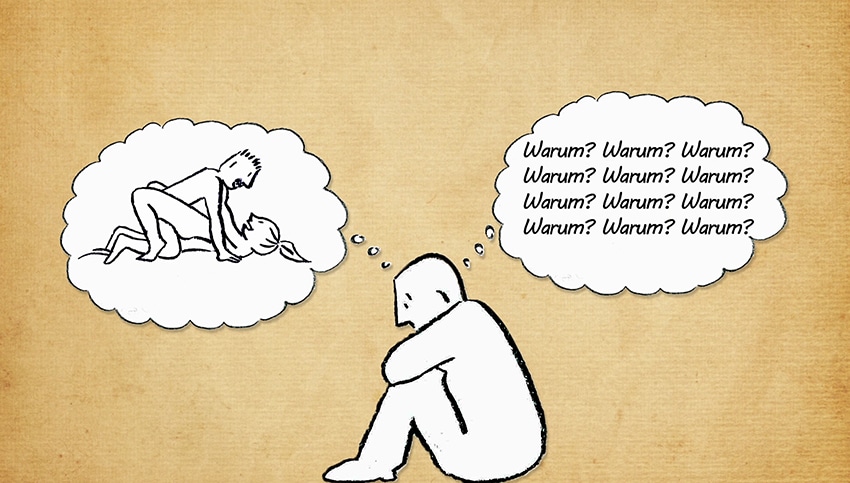
If the suspicion is further substantiated
If your partner's answers didn't reassure you, but instead made you even more suspicious, the motto still (!) remains (!):
Don't rush into anything!
Avoid bringing up the topic again for a few days if possible. Use this time to calmly review your assumptions and any contradictions.
Remember: writing things down helps! Organize your current thoughts and arguments by putting them on paper.
Should you encounter further inconsistencies, revisit the issue. It could sound something like this:
"I just can't shake the feeling that issue XY is bothering me, so I have to bring it up again. Maybe you can help me sort things out. Last week you said X – but when I think about it, I don't think that could have been the case because of Y. Maybe I'm just missing some important piece of the puzzle? Right now, I just don't know what to believe anymore. Please tell me a little more about it."
When infidelity is discovered, both partners enter a phase that is often more stressful and exhausting than anything they have experienced in the relationship before. It is therefore not surprising that in this exceptional situation, many things can be done 'wrong', which would only worsen the already unbearable situation.
Therefore, we would like to emphasize once again: Don't rush into anything now!
Should you find yourself in the unfortunate position of being cheated on, we strongly recommend that you take a look around our website – specifically on the topic of infidelity and cheating: Affairs & Infidelity – How to best deal with this exceptional situation
Frequently Asked Questions
Why do I have the feeling that my partner might be cheating?
On the one hand, concrete reasons such as noticeable changes in a partner's behavior can trigger this fear. On the other hand, diffuse emotions can also be the underlying cause. General fear of loss or painful past experiences can fuel jealousy and fear of abandonment – even without any objective evidence of infidelity on the part of the current partner.
Why do people get jealous?
From an evolutionary biology perspective, jealousy was vital for survival: If a Stone Age woman had an affair and became pregnant, a Stone Age man would invest his resources in a child who wouldn't pass on his genes. With an unfaithful Stone Age man, there was a risk that he would divert his care from his existing partner (and children) – this could be life-threatening.
How do I deal with the suspicion that my partner might be unfaithful?
Confronting your partner with your own agonizing suspicions in a highly emotional moment is almost never helpful. First, write down your fears or discuss them with a trusted friend. Only then should you calmly talk to your partner about it (no interrogation!). Give them a genuine opportunity to explain themselves.
Are there typical signs of infidelity?
Sudden changes in a partner's behavior without any apparent reason can be a sign of infidelity. Often, the mobile phone is increasingly protected from unauthorized access. General secrecy can also be an indicator of infidelity, as can a change in sexual behavior. Another clear warning sign: questions are increasingly dismissed with obvious excuses.
What can I do if my suspicions are confirmed and my partner has been unfaithful?
Infidelity is one of the most hurtful experiences a relationship can have. Well-meaning advice from friends can be counterproductive. Seek professional support, such as reliable self-help guides, self-help programs, or professional couples counseling, to prevent the already tense situation from escalating further.
☝🏻 Related articles on the topic of "Recognizing infidelity"