






☝🏻 Quick start: No more sex in marriage
Many couples eventually reach the same point: things aren't really working (much) in bed anymore.
Where once passionate lovers fell upon each other daily, erotic intimacy has now become a rarity. For some couples, this is due to the daily grind, which leaves little room for undisturbed time together. For others, one partner simply experiences a decrease in (or almost complete, or even no) desire for sex.
Those affected often make the mistake of looking for someone to blame for such changes:
Is her unenthusiastic wife (her unenthusiastic husband) the one to blame?
Is the lack of sex due to one's own shortcomings?
Is the overall quality of the relationship to blame? etc. etc.
But is this really about the question of guilt ?
In this article, we examine the most widespread beliefs about sexuality and passion and check whether they make sense and whether they are good for us – or whether they might completely take away our desire for pleasure. 😉
Are you currently experiencing an erotic lull, are you simply sailing in calmer waters, or are you perhaps even more sexually active than other couples?
Take the self-test now!
🚀 4,470 couples have discovered new closeness and passion.
Sex myth 1: Only spontaneous sex is truly good sex. That's right! Or is it?
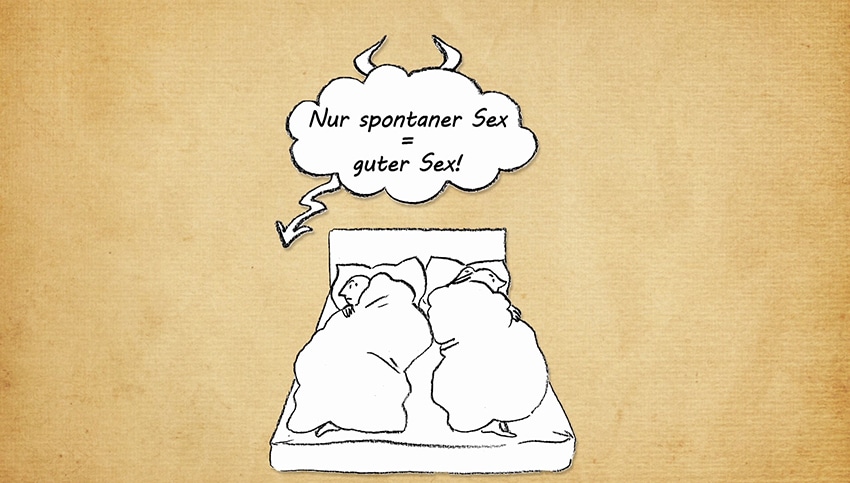
For couples where "two" has become "three," a "spontaneous fling" becomes an absolute exception. Unplanned trysts are simply out of the question for most parents of young children (due to exhaustion and constant availability).
But a large proportion of childless couples also find, after a longer period of relationship, that their former spontaneity regarding lust and sensuality has increasingly disappeared.
If the initial spark ("Back then we were all over each other and couldn't get enough of each other!") is stylized as a must-have for lived eroticism, it can happen that in a marriage there is no longer any sexual intercourse at all.
Therefore, it's important to remember: arranging sex doesn't have to be unsexy at all! In fact, it's often the prerequisite for creating space and time for sensuality again. Even better than a specific sex date, however, would be an arrangement for cuddly time together (without external distractions), where sex might happen – but doesn't have to . This way, no pressure builds up, and everything unfolds a little more easily, relaxed (and usually more effortlessly).
Sex myth 2: Sex is only really good if both partners are in the mood at the same time. Or is it?
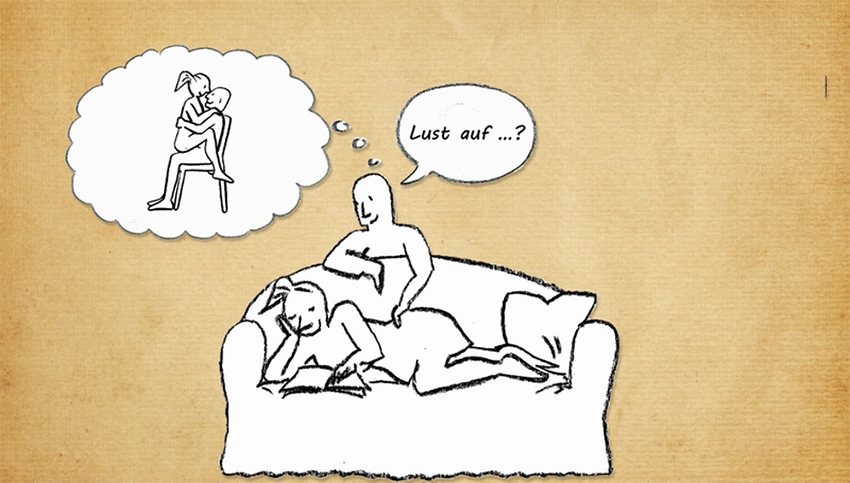
This, too, will become increasingly rare in long-term relationships: the absolute synchronicity of desire. Much more likely: one partner feels desire rising within them while the other is working on their shopping list, writing an email, urgently preparing something for an upcoming children's birthday party, or something else entirely…
Waiting in a long-term marriage for both partners to experience an erotic surge at exactly the same time – and preferably regularly – is highly likely to result in very little sex.
Even at the risk of sounding rather unromantic at first, try this thought experiment: Your husband/wife is in the mood for sex. But you aren't. Your first thought might be : "I don't want to have to 'force' it. Sex is supposed to be 'authentic,' after all. And if I'm not in the mood, I'd have to fake it. So let's just forget it." But how about trying this instead: "So what! Even if I'm not (yet?) aroused myself, why not still do something for my partner's pleasure? I'll simply try to enjoy our physical closeness. So: Come on, babe..."
Before supposed "authenticity" automatically leads to you practically having no sex at all—then: get rid of it! And: Even sex that initially seems "altruistic" shouldn't be ruled out from the start. Especially since it probably won't remain altruistic (and one-sidedly pleasurable) for very long once you've engaged with it...
Sex Myth 3: Talking about sex is pointless. Either it works – or it doesn't. Really?

There are probably as many ideas about perfect sex and exciting eroticism as there are women and men. And preferences that one might have had at 20 may not be the same a year later.
Erotic desires and sexual preferences change over the years – for each individual and therefore also in every relationship. And not just once, but repeatedly. It's therefore important that you – together with your partner – remain flexible and look for suitable descriptions and a way to communicate with each other about what "enjoyable eroticism" or "having good sex" means to you in your current phase of life.
But be careful: Don't accept anyone else's definition of "good sex" and don't trust reports about how many couples supposedly "end up in bed" and how often . Only you know what kind of eroticism you enjoy most. For example, whether sex has a "starter," "main course," and "dessert" for you—or whether you're a big fan of generous "appetizer plates." Perhaps you'd even skip all the other courses for that. You decide! Nobody else. But of course, your partner needs to know your likes and preferences—otherwise, they can't take you to the right restaurant…
Surveys on sexuality have shown that people in committed relationships would gladly fulfill their partner's erotic desires – if only they knew what they were. And unfortunately, that's all too often not the case – even in long-term relationships.
A charming way to overcome awkward silences and still have a very concrete conversation about sex: Get yourself a book about sex and eroticism that appeals to you personally – both aesthetically and in terms of content. Highlight all the passages where you discover suggestions or images that you find exciting. Then, with a smile, give this "edited" book to your partner to read. You'll probably be surprised how quickly desires can sometimes come true – simply because the other person doesn't have to read your mind as much…
Sex Myth 4: An affair can revitalize a long-term marriage! Hmm. Is "revitalize " really the right word here?
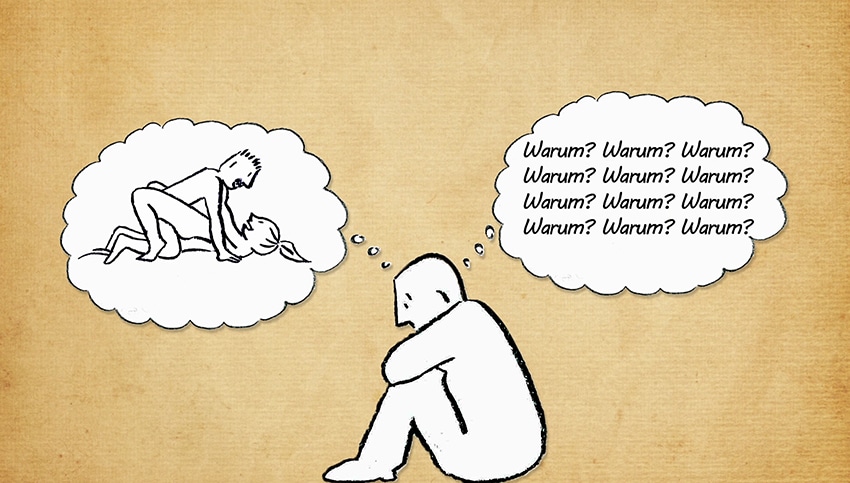
What does relationship research say about this sensitive topic?
Affairs are a tricky thing: In the course of a long-term partnership, many people – men and women alike – believe that they could (or already have) succeed in plunging into an exciting secret fling alongside their committed long-term relationship for a while – without it throwing them off track too much.
However, they would never expect that of their steady partner – and would never allow it.
Sounds strange? But it's true. Why? In this delicate area, double standards often prevail: You yourself would gladly indulge in the occasional adventure (or have already done so) – but your partner is expected to be absolutely faithful and never succumb to temptation. Never! Why would he cheat?! He has ME, after all!
Many people believe they are perfectly capable of distinguishing between love and passion, but that their partner would certainly not be able to do the same. They would make their partner's life a living hell if their affair were discovered. A marital crisis would be inevitable. Conversely, they would claim with absolute conviction: "That really had ABSOLUTELY NOTHING to do with either of us." The "opponent" would argue, with complete conviction, that there is a positive effect if potential frustration over a lack of sex in the marriage is prevented by having an affair. However, very few of those who have recently been cheated on share this view—unless the concept of an "open relationship" has been mutually agreed upon and decided upon as an option by both partners beforehand.
Conclusion: If you care about your relationship (and you are not 'openly in an open relationship' with your partner), you should try your best to remain faithful.
When an affair is exposed, the betrayed partner experiences one of the worst imaginable insults. Moreover, the relationship is catapulted into a completely different dimension from one moment to the next. And it means (at best) a huge amount of work to mend the deep rift that has been created.
And yet: For a marriage that both partners experienced as happy and loving before the infidelity, it is always worth fighting for, and one should try nothing less than everything to give the familiar 'we' another real chance.
Sex Myth 5: If an affair is discovered, the marriage is basically over. It's doomed anyway. Or is it?

Even though it leads (see above) to most couples finding themselves in an emotionally exceptional state like never before, it happens at some point in many long-term relationships (i.e., regardless of the gender constellation: women-men, women-women, men-men...) :
At least one partner succumbs to temptation. And one day the affair is exposed. The foundation of the relationship is shattered beyond repair. Everything threatens to collapse. Nothing is the same anymore. Nothing feels 'normal' anymore. Things have completely changed in an instant. Pure stress – and no solution in sight. Both partners often lose their ability to see clearly. They lack perspective. The relentless, agonizing thoughts can drive the betrayed partner almost insane .
Why on earth could this happen? How could I have been so wrong! That he/she would do something like that! How could he/she do THAT to me! Why couldn't I see clearly what was going on and when? Is there something fundamental missing in our relationship? Were we having too little sex, less intimacy than usual, problems I wasn't aware of? And maybe this had been going on for months? Or even years? I was convinced we didn't have any major problems and that we still loved each other. etc. etc.
The many unanswered questions are tormenting, the immense uncertainty is causing immense fear. What will the future bring? Will what has provided stability for years suddenly be destroyed?
Should one perhaps separate as soon as possible so that this torment doesn't last forever? What are the arguments for and against?
This complex topic is beyond the scope of this article. Therefore, if you are affected or simply want to learn more, we would like to refer you to our blog post specifically on the topic of "What to do after infidelity?" : Forgiving infidelity and affairs
Sex myth number 6: Separate bedrooms are the beginning of the end. There's some truth to that, isn't there?

Typical gossip: "They've had separate bedrooms for quite some time now. Something must be wrong..."
It might be true – but it doesn't have to be. The fact is: no outsider can definitively determine which rituals, agreements, and circumstances represent the best solutions for a couple or family at any given stage of their lives. And this naturally includes sleeping habits and the distribution of sleeping arrangements.
Because it's like this: it's better for a cheerful and well-rested couple to greet each other in the morning than for one to be snapping at the other in the same bed. Because one has tossed and turned half the night again and, from 2:00 AM onwards, has become increasingly frustrated and annoyed, as the other has once again been sound asleep – but snoring loudly to themselves.
The arrangement of the beds at night does not automatically reveal much about whether a couple is affectionate with each other, or has sex often or rarely.
So don't let any warnings from outsiders unsettle you! Only you can know which sleeping habits suit your life and your relationship and which solution makes you both happy – and if you don't know for sure yet, then simply try out different options.
Sex Myth 7: Sex should work – regardless of how things are going in the relationship otherwise!

That would be nice. At least theoretically, it's a good way to quickly reconnect. But: Unfortunately, that's not how it works. At least, almost never. Because the opposite is true: Sex is inseparable from the overall atmosphere of a relationship!
In other words: once there's serious friction in a relationship, sex is almost always the FIRST thing to go. And when things gradually improve, sex is almost always the LAST thing to return, or rather, to gradually regain its place in the partnership. That's just how it is.
Therefore: Anyone who wants to keep the sex life alive in their marriage should realize that even unsexy activities like taking out the trash unprompted or going along to the in-laws' house without complaining definitely have something to do with their own sex life… 😉
No more sex at all! So what?
Of course, there are also numerous couples between whom – perhaps for a long time – no erotic encounters have taken place, and who nevertheless do not struggle with it. For these couples , the absence of sex in their marriage or partnership is a daily reality – sometimes for years, sometimes for decades.
But don't these 'no-sex' couples (or at least one of them) eventually suffer from missing out on sex? From the absence of passion? From the lack of sensuality in their marriage?
Isn't a crucial component of a fulfilling relationship missing when a couple 'no longer sleeps together'? Isn't such a situation (or the development towards it) completely 'unnatural' and ultimately jeopardizing every partnership?
The answer is: No. Not necessarily. Namely, not if both are genuinely happy with it .
Statements like the following are not uncommon from couples who have been together for a very long time or who have already 'grown old together':
- "Our priorities have changed over the years. Sex no longer plays a role between us."
- "We don't miss anything. At some point, we just lost the desire to jump into a coffin."
- "Sex? It became less and less frequent for us - and eventually no one took the initiative anymore."
- "The fact that we no longer have sex has nothing to do with not loving or feeling connected to each other. We simply enjoy doing other things together now."
- "A happy marriage without sex? For us, it works! We're the best example of it. And we're happy the way things are."
But as I said: Such a relationship model – love yes, sex no – can only work if both partners feel similarly. If one or the other is tormented by thoughts like, "I'm simply a sensual person and often feel like it – but my husband doesn't want sex (anymore). That's bitter for me," or "My wife doesn't want sex – no matter how hard I try to make us closer again. It frustrates me," then the issue must be taken seriously as soon as possible and changed in a direction that both can live with.
Sometimes, however, living together without sex feels right for both partners for a long time and neither 'misses anything' - but at some point the situation changes because one of them suddenly feels that they (again) have a need for lived sensuality, for desire and being desired.
Therefore, consciously focus your attention on your own needs at regular intervals and pay attention to (or ask about) those of your partner.
Is one of you now dissatisfied or even unhappy with 'too little sex and physical intimacy' ? Then it is important to think together – as calmly, thoughtfully and creatively as possible – about ways to achieve more physical intimacy that could feel good for both of you in the near future.
More love, more sex: Back to your dream relationship
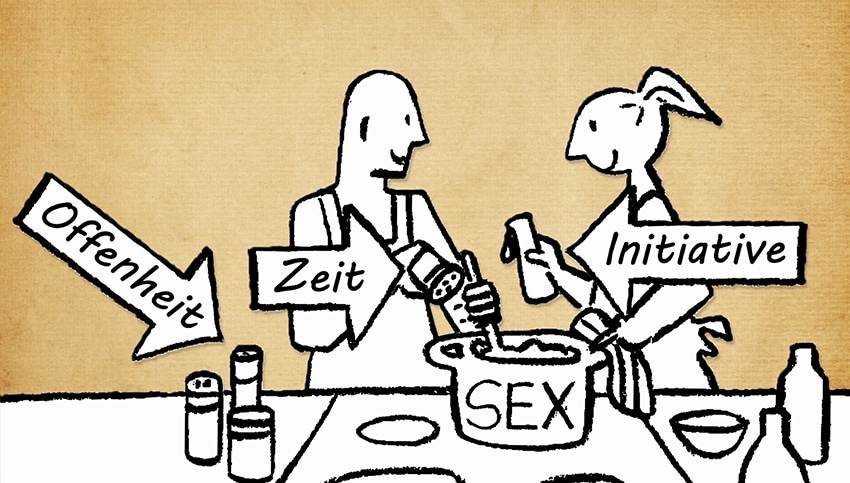
You've read this far – we're delighted! It's clear you care a lot about yourselves as a couple. Instead of accepting the decline of eroticism as inevitable, you're consciously exploring solutions: Does it require acceptance? Does it need new impetus? If so, what kind?
Regardless of whether they currently have little or no sex, whether they are often or rarely affectionate with each other - this willingness is the basic prerequisite for positive change.
The good news: A marriage is far from over just because the sex could be better.
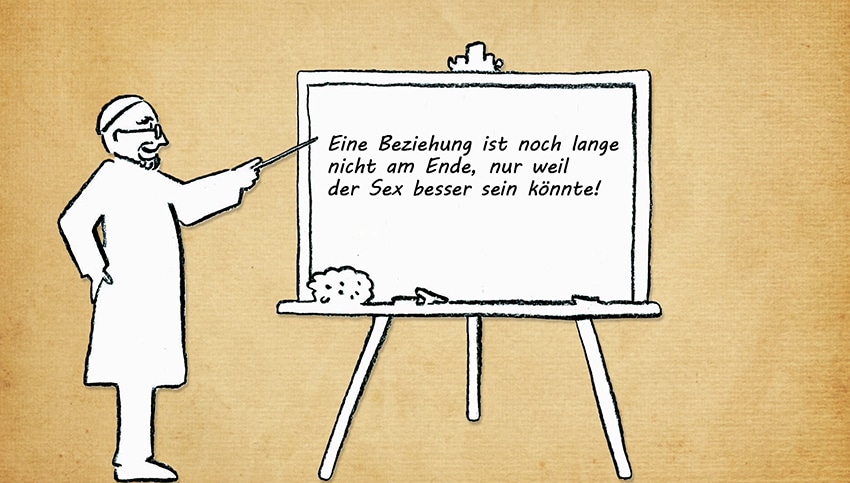
Our experience in couples therapy shows that with a positive attitude and the right know-how, dormant sexuality can usually be revived relatively quickly. And this often sets off a real upward spiral: More sex frequently means more intimacy. More intimacy leads to more mutual acceptance. More mutual acceptance prevents many arguments. And so on and so forth...
That sounds great! But where exactly do I begin?
The fundamental first step is to gain a comprehensive awareness of your dynamics as a couple (and the reasons for the current lull in your sex life).
Start your self-test now!
We wish you all the best for your marriage!
Yours sincerely, Dr. Judith Gastner
☝🏻 Related articles on the topic "No more sex in marriage"
Loss of libido can strain relationships and has various causes, such as physical illness, stress, and relationship problems. To counteract this, open communication, stress reduction, and, if necessary, professional help are important steps. Improved relationship quality and openness to new ideas can help restore intimacy and sexual desire.
Frequently Asked Questions
What are the reasons for too little sex in marriage?
There are many reasons why sex and eroticism might diminish. Has the overall quality of the relationship deteriorated (e.g., is interaction less affectionate)? Or are there other reasons unrelated to a lack of love (e.g., stress, fatigue, physical problems)? Only by understanding the cause can one effectively seek suitable ways to rekindle eroticism.
What are common causes of low libido in women?
Low sexual desire in women can be due to a variety of factors, including physical and mental illnesses (e.g., hormonal imbalances, depression), side effects of medications, excessive stress, and relationship problems.
What are common causes of low libido in men?
Low sexual desire in men can also occur due to various physical factors, including hormonal imbalances such as testosterone deficiency, aging processes, and the use of certain medications that can impair libido. Psychological stress and chronic stress can also play a role.
How can one revive sexual desire?
Every couple needs to find their own way of communicating about sexual needs and desires. What would you enjoy? How well does your partner know your erotic preferences? What turns your partner on? Be brave! Be open! And once you've learned more about each other, arrange a "let's-see-what-happens" date.
What are the consequences of too little sex in marriage?
If a prolonged period of intimacy in the bedroom persists—and at least one partner wishes it were different—frustration and estrangement are inevitable. A lack of physical closeness is often reflected in a lack of emotional intimacy. If the issue isn't taken seriously, there's a risk that the sexually frustrated partner will seek intimacy in an extramarital affair.
How do you talk about it when you're missing sex in your marriage?
Every couple needs to find their own way of communicating about sexual needs and desires. In any case, it's important to find an undisturbed, quiet time slot and a respectful setting. Be sure to speak about your own feelings, desires, and concerns using "I" statements, without blaming your partner.
What are the reasons for the loss of sexual desire?
There are many reasons for a loss of libido. Has the overall quality of the relationship declined (e.g., due to a lack of affection)? Or are there other reasons unrelated to a lack of love (such as fatigue, stress, or physical problems)? Only when the causes are known can the appropriate ways to revive desire and sensuality be sought.
Is intimacy possible without sex?
Intimacy doesn't have to mean sex. It can also be felt through massages, hugs, or loving touches. Furthermore, an intense emotional exchange, whispered love, or a deeply moving shared experience can be perceived as even more intimate than a thrilling erotic encounter.