







☝🏻 Quick start: In love with someone else! Now what?
What's the truth behind the cliché: 'People in relationships' seem more attractive than 'singles'?
Surveys actually indicate that people in committed relationships have a particularly appealing aura. No wonder, then, that they are often courted or engage in flirting themselves. Many are easily tempted by the occasional flirtation – with the charming colleague from work, the cheerful new neighbor, or the old friend from school with whom they recently had so much fun...
Such a crush can't hurt anyone, after all. Nothing bad can happen, right? Or can it?
What if harmless flirting turns into something more? What if things suddenly develop completely differently than expected? What if you feel increasingly drawn to the other man or woman and get caught in an emotional vortex – even though you're in a committed relationship?
This article will tell you what it means for a relationship when one partner falls in love with someone else, what the reasons behind it are, and what you can do if you yourself are seriously in love with someone else in your relationship.
Test: Am I in love with someone else?
Take the test and find out if it's a temporary attraction or if you've truly fallen in love with someone else .
🚀 3,277 people have gained clarity through this free test.
Butterflies in your stomach when your new colleague is around? Weak knees at the mere thought of them? Emotional turmoil. Confusion. Sleepless nights. Now what?
Perhaps you're feeling this way right now, or something similar. And you're wondering,
- How could it happen that you think about someone right before falling asleep and right after waking up, someone who until recently played absolutely no role in your life?
- what reasons there are for falling in love with someone else despite an overall stable partnership, and what the possible consequences might be.
- How can help with the decision: Continue the existing partnership or end it?
- How best to deal with the experience of falling in love with someone else - after deciding to stay with your partner.
"If a relationship is healthy, an outsider doesn't stand a chance!" - That's true, isn't it?
If you are currently in love with someone else despite being in a committed relationship, you probably know this mixture of excitement, worry, and guilt.
What happens next? It's hard to predict how things will develop. Perhaps you haven't been this head over heels for someone in a long time. Perhaps you've never been in such a complicated situation before.
And you probably have a phrase in the back of your mind that you've heard many times before: "If a relationship is intact, an outsider has no chance." Then one would never cheat .
But is that really true? Do feelings for another person automatically mean that something is fundamentally wrong with the partnership or marriage, or that the relationship is already doomed to fail?
Breakup – the logical next step when in love with someone else?
Should one "draw the consequences" and separate as quickly as possible if one's partner is clearly no longer "enough" for oneself – in the sense of: "Better an end with horror than horror without end"? After all, it didn't happen by chance that the other person was able to emotionally possess one so completely...
The answer is: No! Stay calm. Don't rush into anything. Don't make any far-reaching decisions at this time.
Separation is a radical step that ends everything a couple has built together. Especially when children are involved, separation should be the last resort – only after all other measures to save the relationship have been exhausted.
The hormones that flood us when we are newly in love often prevent us from realistically assessing a complex situation.
In the throes of hormonal euphoria, much like under the influence of alcohol, we sometimes don't really consider the potential consequences of our actions. Our sense of proportion and a sober view of possible collateral damage are lost as long as we are intoxicated (by alcohol or love)...
Let us be aware that every high is followed by a period of sobering up or disillusionment. Decisions with far-reaching consequences should always be made in the clearest possible terms.
In this article, we have compiled the most important information, questions and answers on the complex topic of "falling in love with someone else" as an initial guide for you in this turbulent phase of life.
What does it mean for the relationship when one partner falls in love with someone else?
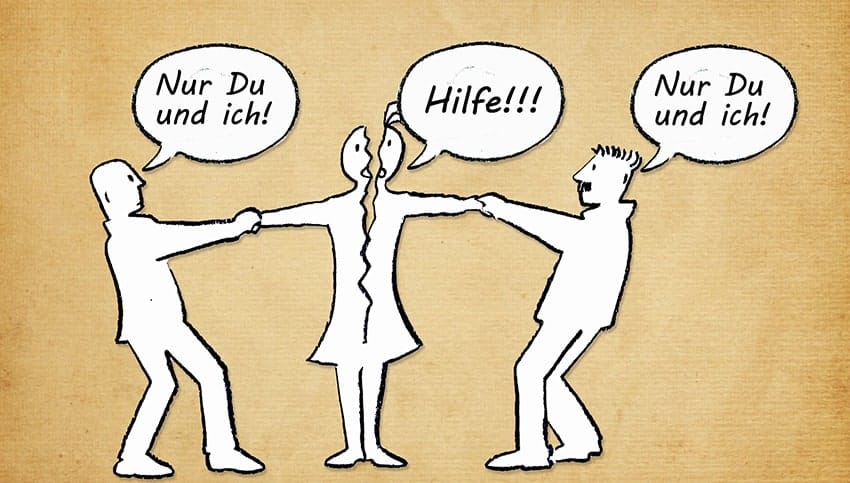
As already mentioned: The assumption that one would not fall in love with someone else in an overall happy partnership has shaped most of us.
However, surveys paint a different picture: According to them, about half of all people feel intensely attracted to someone else at least once while in a relationship they don't consider disastrous. Many couples worldwide have this experience, and in itself, this situation is no cause for panic.
The idea that both are possible – i.e., that the existing partnership is experienced as positive and at the same time a new person captivates us for a while – is not very common in our society.
Most people who develop feelings for someone else are, on the one hand, filled with the invigorating new sensations, but on the other hand, they value the security and comfort that their familiar partner offers them. They don't want to give up either one.
Is it infatuation with someone else , or love for someone else ? Is it a superficial crush or deep feelings? Are they the oft-cited butterflies in the stomach that, as quickly as they fluttered off, can be calmed down again, or do we actually feel a great, unknown emotional closeness?
Being newly in love and still in a stable relationship - is that possible?
Feelings for another person don't automatically have to lead to a disastrous affair. Being in contact with people who make us feel alive and inspired is, in itself, nothing to be ashamed of.
Things that increase self-esteem and one's own joy in life can also benefit the existing relationship.
However, this requires a high degree of relationship stability, trust , and self-reflection: " I am absolutely certain that I do not want to jeopardize our relationship " and " I know that I can actively say 'No!' if a temptation should become too great ."
Each couple has to find their own way of determining whether and what kind of external flirting or self-esteem boosting is 'okay' for both of them, and whether and how they might discuss it (e.g., "The new colleague X seems to find me attractive..." or "Don't be surprised: I've been in a funny WhatsApp ping-pong with Y since yesterday").
Every person and every couple has different boundaries regarding what feels (still) good and what no longer feels good.
Infatuation with someone else usually begins with a superficial attraction. Initially, there is no emotional intimacy. If the new contact is experienced and handled as enriching but not threatening to the existing relationship, occasional flirting can be beneficial.
Nevertheless, increased openness to intense flirting shouldn't be taken lightly. As we know, an initial crush can develop into love. Waiting for the butterflies in your stomach to disappear on their own could be dangerous.
If the other person is already seen as an "alternative" to your current partner or long-term partner, the relationship is at risk. Are you increasingly thinking about what a life with this attractive "new" person might be like? Perhaps even more appealing than your current life?
If such fantasies become excessive, the risk of a breakup is high.
Consider the realization that it was apparently possible to fall in love with someone else in your current emotional universe as an invitation to examine your feelings, needs, and existing partnership more closely.
Seriously in love with someone else? These could be the reasons behind it.
Why has one partner in a committed relationship developed feelings for someone else? Why does another person suddenly become so important? To understand why people in committed relationships develop strong feelings for someone else and what consequences should be drawn from this, it's crucial to investigate the underlying causes. Because developing feelings for someone else can have a variety of reasons.
(1) Problems in the partnership
As already mentioned, most people consider relationship problems the most obvious reason. If we fall in love with someone else, surely we must be experiencing a relationship crisis! In some cases, that may be true – but certainly not in all.
If there are recurring conflict issues in the relationship that increasingly lead to arguments and cannot be resolved, this can result in chronic dissatisfaction and alienation between the partners.
The positive aspects of the relationship are increasingly overshadowed by problems and arguments. Good feelings diminish, love fades – and space opens up for romantic feelings towards another person.
(2) Something is missing in the relationship
But it's not only the difficulties in a relationship that can become the basis for a crush, but also what is no longer there or never was. When a relationship has lasted for years or decades, it has long since become clear what it cannot offer and which needs it cannot fulfill.
For example, if a partner lacks support, security, or tenderness, this leads to latent dissatisfaction.
The relationship does not fulfill all the central hopes and expectations that the partner had of them. Furthermore, if the interests or future plans of both partners diverge over time, an increasingly wide emotional gap can develop.
This can create a need to fill this lack of a sense of belonging and shared perspective with another person.
(3) Special case: Lack of attention
At the beginning of a new relationship, those in love shower each other with empathy and attention. They have a genuine interest in each other's wishes, goals, needs, and even problems – and every small movement or personal change is noted. Conversations during this phase of the relationship often last all night.
If this mutual interest in everyday life has diminished for quite some time and suddenly someone else becomes more interested in you, this can be very good for your self-esteem – and create a feeling of vitality that had almost been forgotten.
(4) Habituation
Relationships change over time: The small gestures of the early days have long since faded. You might hardly remember the last time your partner surprised you with a small, spontaneous gesture. Instead, you now know exactly what their snoring sounds like or how long their morning routine takes. And you really do know every single bad habit of the other person. The initial spark is gone.
Now, when another person enters your life who is charming and polite, who wants to know everything about you, who is interested in your thoughts, feelings and needs, suddenly all the butterflies in your stomach that had been dormant for so long start to stir again.
The temptation to let these feelings flutter even longer is strong. The infatuation with each other intensifies; you feel more alive and 'seen' than you have in a long time.
(5) There are no reasons
But this is also possible: Your relationship is wonderful, you were absolutely not looking to flirt or find a new partner, because you genuinely love your partner. And yet, feelings for another person have developed. You feel yourself falling irresistibly in love with someone else.
There aren't always underlying reasons for this. Having a crush on someone else doesn't have to replace the love you have for your partner. It's also possible to love multiple people at the same time. There's a reason relationship models like open relationships or polyamory exist .
Since the desire not to have to share one's beloved partner – and the worry of possibly losing them at some point – is deeply rooted in most people and is accompanied by unpleasant feelings such as jealousy and fear of loss , only a relatively small number of couples manage to live open relationship models in such a way that all involved are happy with them in the long term.
Here's what you can do if you're seriously in love with someone else.

Almost everyone who develops feelings for someone else is confused by their own emotions and worried about their relationship. Generally, they don't want to hurt their partner or make the already complicated situation even more difficult. Therefore, someone who develops feelings for someone else almost always asks themselves: "How should I behave in the near future? What would be wise, and what wouldn't?"
We want to support you in dealing with this upsetting situation as constructively as possible. Therefore, we have compiled the most important tips and recommendations for you.
(1) Do not try to suppress your feelings
Out of fear of uncovering fundamental relationship problems or hurting their partner, many try to suppress the issue of "being in love with someone else - feeling upset and confused." This is usually not a real solution, as it almost always leads to a problem: it causes the exact opposite.
Feelings for the other person (and the associated emotional turmoil) usually don't go away on their own, but rather become even stronger over time.
Emotions that are denied often come back to haunt us like a boomerang. At the same time, the partner almost always notices that something is wrong.
However, he doesn't understand the source of the emotional distance. Because he can't assess the situation, he experiences insecurity and frustration. The behavior that was actually intended to protect the relationship is therefore causing even more damage.
Use the emotional crisis as a warning signal for an honest examination of your needs, expectations, disappointments, hopes and desires.
(2) Question exactly what you are feeling right now.
Take some time to reflect. Examine (preferably without censorship) whether the feeling of being in love might have been fueled by some of the following feelings and circumstances:
- Is the increased attention particularly beneficial to me?
- Do I find the other person primarily physically attractive or erotically appealing?
- Is the other person in the spotlight in any way - and do I find it exciting or flattering that we have a ' secret connection ' to each other?
- Is it partly the 'forbidden' aspect of the affair that feels exciting?
- Does spending time with this other person alleviate any form of boredom ?
- Am I distracting myself from something else by throwing myself into the feeling of being in love?
- Does this other person awaken chords within me that I haven't felt in a long time?
All of this can be mistaken for love , but it is not the same. – Instead, these intense emotions can perhaps be best summarized as feeling more alive again .
Especially if you've been in a committed relationship for years, you know most aspects of your partner inside and out. This means that in addition to their strengths, you also know their weaknesses and quirks. After all, you've experienced every conceivable situation together countless times in everyday life.
It's completely different with a stranger. You're just beginning to discover their various qualities – and probably mostly the good ones at first. That's certainly more exciting and enjoyable than finding out yet again that your husband has left his socks scattered around the bedroom or that your wife has once again loaded the dishwasher incredibly clumsily…
(3) Evaluate your partnership
Reflect on the overall quality of your relationship and try to realistically assess your own experiences and behavior. Listen to your heart: Are you (regardless of the currently turbulent emotions) mostly happy and content in your relationship? What are its strengths, and what are its weaknesses? What is your contribution to the current atmosphere between the two of you?
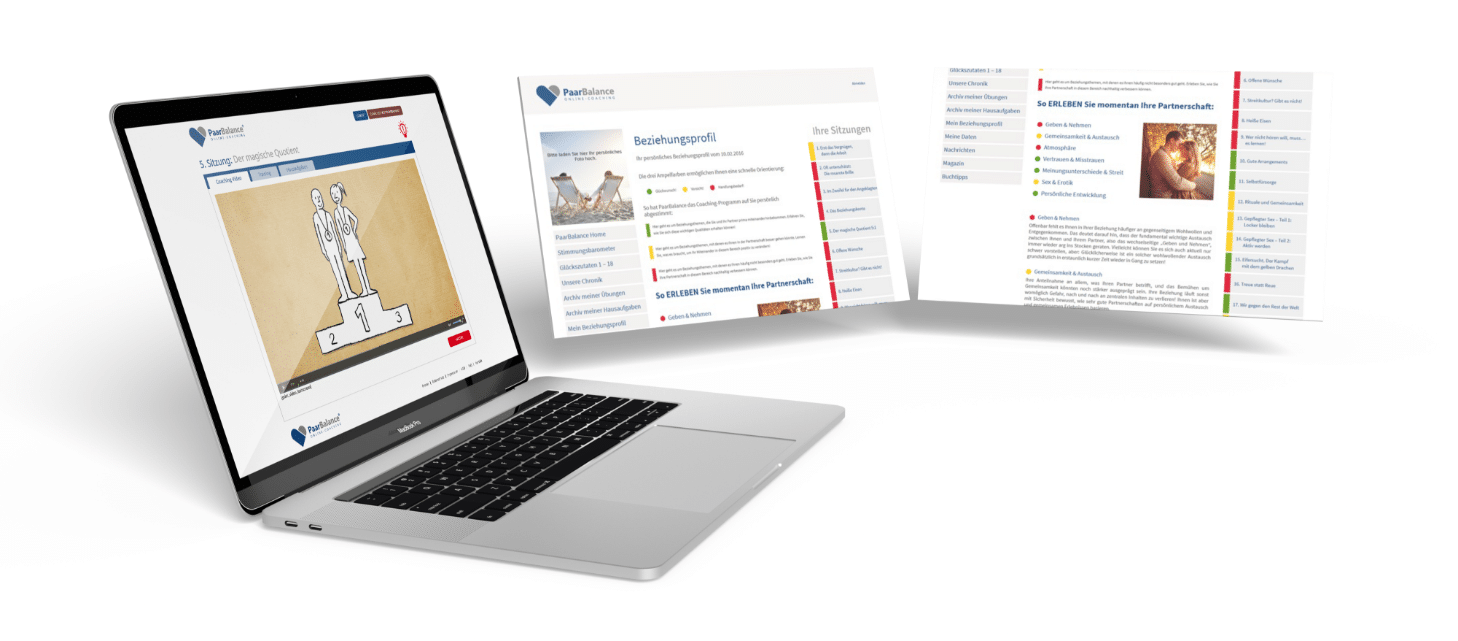
Gain the most comprehensive overview possible of your resources and challenges as a couple and take the scientifically based relationship test from PaarBalance (duration approx. 10 minutes).
Immediately afterwards you will receive your personal relationship profile with an individual strengths and weaknesses overview ( free of charge & without obligation) .
Perhaps the test will reveal that your partnership or marriage has significantly more positive aspects than you were aware of at times, and that you still love your partner – even if this feeling may currently be somewhat buried.
However, weaknesses and challenges may also become apparent that you hadn't considered and should no longer take lightly in the future.
Take the opportunity to find out what specific things or overarching qualities you are currently lacking and how your satisfaction could be improved.
Have you come to the conclusion that you and your partner do not want to go your separate ways?
Then you need to make a very conscious decision for your partnership.
Even if a breakup should ultimately occur, it is incredibly important to be able to say to yourself later: "I didn't throw our love away lightly. I fought for us."
Take the following recommendations to heart.
(4) Don't add fuel to the fire
Even though you probably don't like this question: Is it possible to stop contact with the person who has emotionally consumed you in the near future, or – if it is someone from your work environment or neighborhood – at least to significantly reduce it?
If you want to use the emotional turmoil as an opportunity to first take a close look at your existing relationship and adjust individual aspects to put it on a new footing, it would be counterproductive to simultaneously further inflame feelings for the other person.
Imagine your existing partnership as a plant that hasn't had the best conditions for optimal growth lately. Consciously and diligently nurture this little plant, which may perish if you don't water and fertilize it regularly from now on and take good care to ensure it isn't trampled or overgrown.
(5) Talk to your partner
Take some time to talk to your partner about how things are going in your relationship. Let them see what's going on behind the scenes and describe as precisely as possible what you value and want to keep, and what you're currently not, or no longer, completely satisfied with.
Avoid accusations and attacks; instead, express wishes and suggestions.
Should you bring up your feelings for someone else in this conversation? If you want to give your relationship or marriage the best possible chance for a fresh start, it might be wise to keep your feelings for the other person to yourself and instead focus on the things you have in common and plans with your partner. Revealing your feelings could leave your partner feeling deeply insecure.
It is your 'job' to find out the reasons for your emotional turmoil, to master your emotions and gradually assign these feelings the appropriate place on your life shelf, which 'for the time being' does not block your present and future with your current partner.
(6) Make a conscious effort to nurture your relationship
Thanks to the relationship test, you've likely gained a clear understanding of your strengths and areas for improvement. Use this clarity to improve the quality of your relationship as much as possible.
Let us support you on this journey. Our CoupleBalance program was developed precisely for this purpose. The 18 sessions (each session structured as: 1 video on an important relationship topic; 2 exercises; 3 homework assignments to choose from) provide the most proven tips and recommendations on how you and your partner can quickly and positively rekindle your love and deep feelings for each other.
The online sessions can be conveniently conducted from home, regardless of time and place.
Should you also wish for face-to-face support, personal consultations with a couples counselor or couples therapist in your area can be the next step (see article “ Couples therapy: When is it useful? Process, methods & costs ”).
Having a crush on someone else doesn't necessarily mean the end of the relationship. However, it's often a clear warning sign.
In this situation, investigate the causes and actively and consciously strengthen your relationship, because:
It's better to experience something new (one more time) with your old partner than to experience the same old things (possibly soon) with a new partner !
Start your self-test now
All the best & warmest regards
Your Prof. Dr. Ludwig Schindler & the PaarBalance team
☝🏻 Related articles on the topic "In love with someone else! Now what?"
Frequently Asked Questions
What does it mean to be in love with someone else?
Being in love with someone else means having developed strong romantic feelings for another person – despite being in a committed relationship. For most people affected, it's exciting to be newly in love. On the other hand, these feelings of infatuation are often accompanied by guilt towards their partner. This usually leads to inner conflict.
What to do if you're in love with someone else despite being in a relationship?
Don't try to suppress your feelings; this often has the opposite effect. Question exactly what you're feeling: "Is it really being in love, or am I just enjoying the attention?" "Am I missing something in my relationship? If so, what?" Avoid anything you might later regret. Don't make any hasty decisions.
Is it normal to fall in love despite being in a committed relationship?
Even in committed relationships, it's part of human nature to occasionally feel a stronger attraction to another person, for example, because we find someone exceptionally attractive and approachable, or because we feel connected due to a particular situation. The crucial thing is to keep the agreements with our partner in mind.
Should I tell my partner about my crush on someone else?
Open communication in a relationship is generally important. However, you should first gain as much inner clarity as possible before unnecessarily unsettling or hurting your partner. Perhaps, upon closer examination, you'll find that you're not actually in love with someone else, but simply that the increased attention is good for you?
Is it possible to be in love with multiple people at the same time?
Yes, it's possible to develop strong feelings for several people at the same time. However, that doesn't automatically mean you have to get yourself into trouble. Loyalty is an active process. Meeting people who resonate with you is wonderful – but it doesn't automatically mean you have to be seeing multiple people at once.