


☝🏻 Quick start guide to overcoming jealousy
Do you suffer from jealousy yourself? Or do you have a partner who is very jealous?
Getting jealousy under control permanently is a major challenge for many. But: It's worth it! Whether you're dealing with the topic of "combating jealousy" because you yourself are tormented by jealousy, or whether you feel unjustly accused by your jealous partner:
Intense jealousy puts a strain on every relationship! Even if the partners have different challenges to overcome, both are usually severely affected in an acute jealousy situation.
If thoughts constantly revolve around the topic "I could be cheated on", "He/She probably finds others more interesting/sporty/exciting/funniest/... than me", if harmless situations repeatedly escalate, if gnawing feelings of jealousy simply refuse to go away and overshadow the entire partnership - then urgent action should be taken.
What are the causes of jealousy? Why do we feel jealousy at all – from an evolutionary biological perspective?
Are there different forms of jealousy?
Does jealousy always play a role in intimate relationships? How much jealousy is 'normal'?
Should one openly show jealousy and talk about one's thoughts and feelings, or is it better to no longer share one's jealous feelings with the other person?
Answers to these questions and more on the topics of "How do we permanently defeat the jealousy monster?", "How can I prevent a delicate situation from escalating?", etc., can be found in the following article.
Jealousy: A first test
Find out how jealous you really are in our first self-test. Which of the following statements apply to you? - Answer as honestly and spontaneously as possible (Yes/No).
🚀 1,961 people have found a way out of jealousy this way.
What to do about jealousy? - First of all: Look your opponent firmly in the eyes!
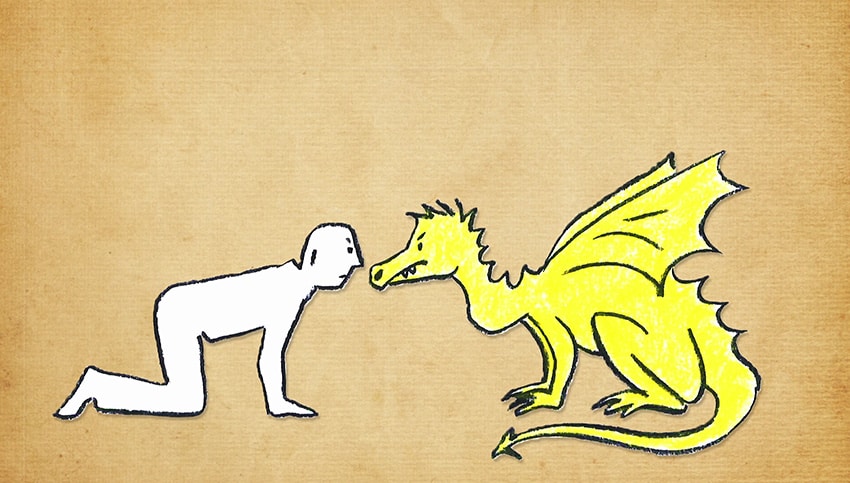
Do you want to fight your own jealousy and finally get rid of the gnawing feeling of constant mistrust and fear of loss?
Do you suffer from uncontrollable thoughts and fantasies about your partner cheating?
Do you make check-in calls?
Do you secretly scour your partner's phone for signs of infidelity - perhaps even without ever having had a real reason to do so?
Or is it exactly the opposite: Do you feel controlled and monitored by your partner?
Are you suffering from being overheard while on the phone?
Do you see a pinched face when you tell your partner you've arranged to meet an old acquaintance for coffee or that you'd like to help a colleague move?
Relationships overshadowed by jealousy usually don't improve on their own. We can only reshape what we actively address.
Therefore, the first important step towards positive change is not to "bury your head in the sand," but to actively seek a way that can help you and lead you out of the vicious cycle of jealousy.
In that spirit: Congratulations on tackling this issue! Now it's time to stick with it... 🙂
Overcoming jealousy: Equip yourself with important background information for the fight!

Strong (or even pathological) jealousy puts a strain on every relationship (regardless of whether it is a 'man-woman', 'man-man' or 'woman-woman' couple).
Anyone who has ever suffered from jealousy attacks knows how agonizing they can be.
Jealousy almost never disappears on its own; we are almost always challenged to decisively address the emotional turmoil of fear, passion, and low self-esteem.
How to get rid of jealousy
To overcome jealousy permanently, it's often necessary to first focus on yourself and your own feelings surrounding jealousy. Contrary to popular belief, it is indeed possible to overcome jealousy. You want to get rid of your jealousy. Let's take a closer look: What exactly is jealousy?
What is jealousy?
Jealousy - a definition
Jealousy is an emotional reaction that occurs when a person feels they are losing an important relationship or something of value to another person. It can range from mild to intense feelings and often involves emotions such as insecurity, fear, anger, and sadness.
Jealousy can occur in romantic relationships as well as in friendships, business relationships, and even between siblings.
While a certain degree of jealousy can be normal in relationships, excessive or chronic jealousy can be harmful and lead to conflict, mistrust, and dissatisfaction. It is important to recognize jealousy and find effective strategies to manage it, which can be achieved through individual counseling or couples therapy.
In short: Jealousy is fear of loss.
Whether we like it or not, love wants to possess . The more important someone is to us, the stronger the desire to 'keep' that loved one, and the greater the worry that we might lose them again. We hope the other person feels the same way—and wish we wouldn't have to share them.
Jealousy is a natural feeling – comparable to other feelings that are also unpleasant but can be very strong, such as anger or disgust.
Just because these feelings are 'normal' and 'natural' doesn't mean we should act out all emotions uncontrollably. Rather, we must constantly strive to bring these natural, universal impulses below a kind of 'critical level' – otherwise, it could become dangerous for our relationships.
Why is jealousy so overwhelming?

Why does a fit of jealousy turn sophisticated women into uncontrolled furies? Why do jealous gentlemen become roaring rage-mongers? Why does jealousy rob us of sleep and ruin our nerves? Or, to put it another way: What gives the feeling of jealousy such power?
Where does jealousy come from? Is jealousy necessary? - Answers from psychology
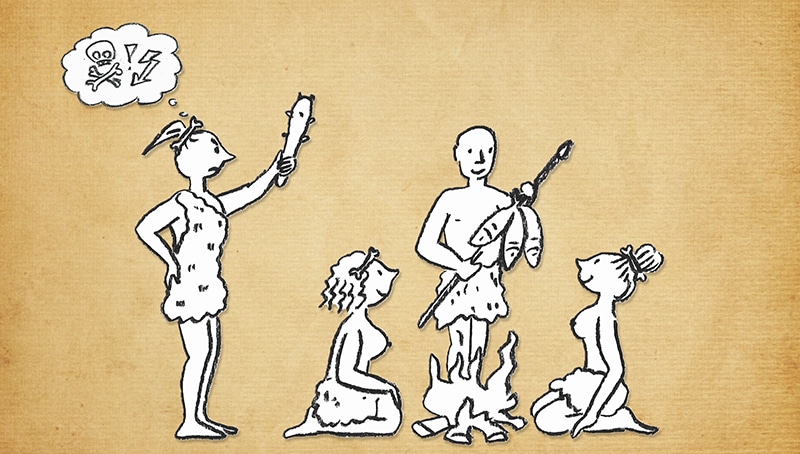
Jealousy is considered an evolutionarily acquired protective mechanism, i.e., a natural feeling that arises whenever we are afraid of losing someone important to us.
Without a reliable companion of their own kind, the fight against hungry saber-toothed tigers would never have been won. Belonging and the certainty of being able to rely on one's partner and pack were vital for survival.
Even though saber-toothed tigers have long since disappeared, the vague fear of not being able to survive if the relationship with that important person by our side falls apart, and the feeling of being defenseless and vulnerable without our partner, can still pull the rug out from under us today.
The mere thought of losing our partner to someone else feels existentially threatening. Therefore, we immediately go on high alert if we get the impression that our partner is attracted to someone else and our relationship is in danger. We then prefer to react too quickly rather than too slowly , since losing our partner would be so devastating.
Love and jealousy: Two sides of the same coin?
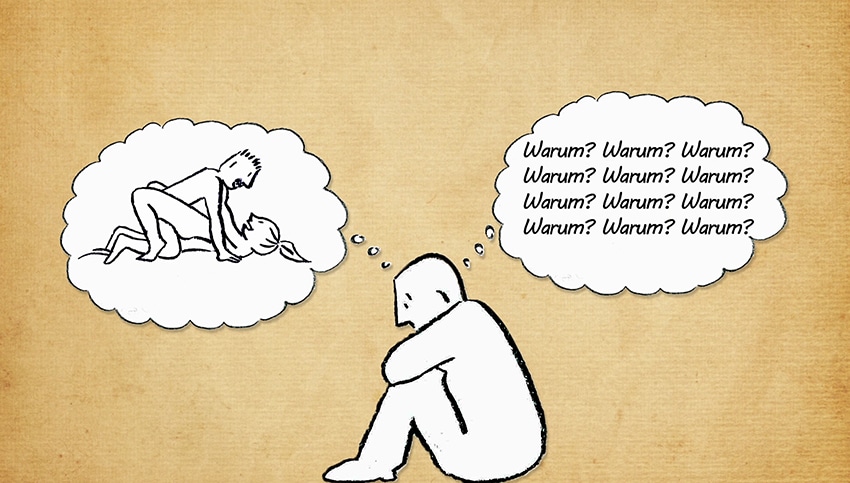
Fear of loss inevitably arises when another person touches us emotionally and grows dear to our hearts, when we allow ourselves to feel feelings, belonging, love and connection.
The mere thought of losing a loved one to someone else is a terrifying prospect. It's no wonder, then, that fear surges up suddenly when we're flooded with fantasies of our partner turning away from us and towards another person.
The step from diffuse fear of loss to a concrete fit of jealousy is often a short one.
This mistake prevents many people from fighting their own jealousy.
However, it would be a misconception to understand jealousy as a kind of proof of love, along the lines of: "Be glad that I'm so jealous! That just shows you how important you are to me..."
Above all, the supposed proof of love, "jealousy," must not be used to justify controlling or even abusive behavior (see also our article on "Toxic Relationships" ). Even though it's perfectly understandable that we don't want to lose the most important person in our lives, excessive fear of loss should never be used as justification for monitoring another person and curtailing their autonomy.
In exceptional cases, a seemingly harmless form of jealousy can develop into a pathological delusion of jealousy.
If you or your partner notice symptoms such as constantly worrying about alleged infidelity, making accusations and allegations without a valid reason, checking phone calls, emails, text messages, etc., you should seek professional help (psychotherapy or counseling) as soon as possible (see also: " Couple therapy: When is it useful? Process, methods & costs" ).
What is pathological jealousy?
Pathological jealousy , also known as morbid jealousy or delusional jealousy , is an intense, excessive, and unhealthy state of mistrust and anxiety in a relationship. It goes beyond normal insecurities and fears and can lead a person to obsessively monitor, control, and question their partner's behavior.
This extreme mistrust can strain relationships and lead to conflict, stress, and even emotional or physical violence. It is important to recognize pathological jealousy and seek professional help to manage it. Therapy and counseling can help identify the causes of pathological jealousy and develop strategies to cope with it. This contributes to building and maintaining healthy relationships.
The most common reasons for jealousy
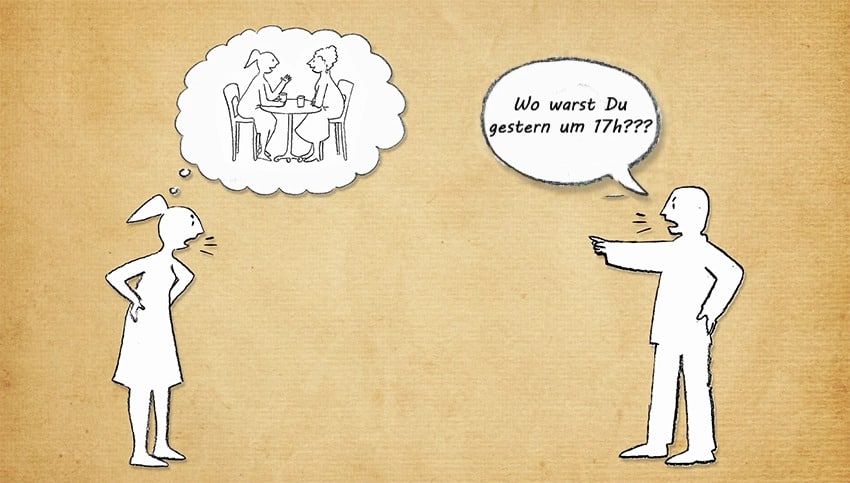
"You have someone else!!" "That's nonsense! You can drive someone crazy with your damn jealousy!"
Jealousy can have a wide variety of triggers. For example, low self-esteem , low self-worth, and a lack of confidence are often accompanied by the worry of not being lovable and attractive enough for others in the long run.
Insecure individuals in committed relationships are often convinced – some consciously, some unconsciously – that their lives are only worth living alongside this one person. With such a mix of feelings, it's no wonder they react quickly with jealousy in their relationship.
Experiences of loss in our own childhood can also have a lasting impact on our emotional state. Whether we find it easy to trust other people or whether we become jealous adults who generally react quickly with fear and mistrust when others get emotionally close to them, often has to do with what we experienced in the past and which feelings were predominant in our childhood.
The gnawing fear that our partner might be dissatisfied with sex and passion in the relationship – especially if she or he is currently experiencing a lack of sexual desire – and our resulting suspicions that the other person is looking for an extramarital flirtation, are often the reason for bouts of jealousy.
Jealousy after an actual affair
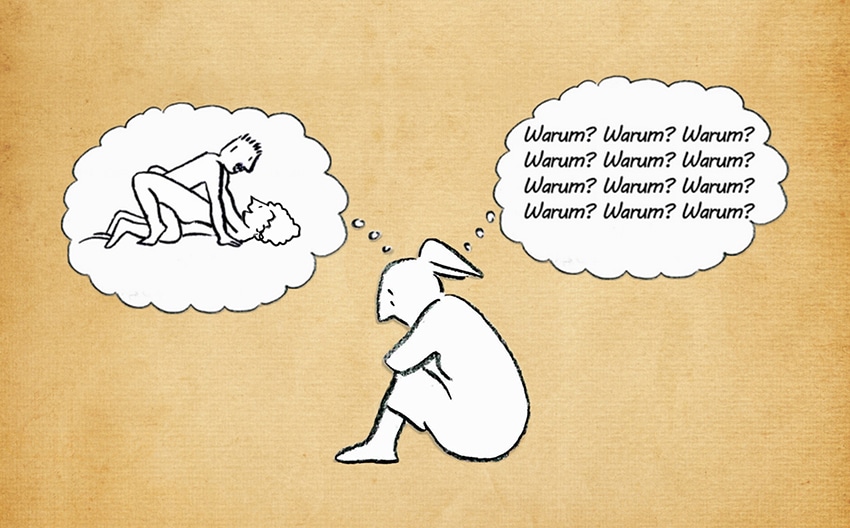
Sometimes jealousy has a very real basis: experienced infidelity in a previous relationship or an actual affair by the partner (see also "Forgiving an affair: Our couples experts help you out of the crisis" ).
Especially if a partner's affair remains undetected for a longer period, it can be accompanied by a painful loss of self-respect and self-worth : "Why didn't I notice that he/she was cheating?", "How could I have been so naive?", "Why was I lied to so shamelessly?"
Jealousy then serves as a form of self-protection for the betrayed partner. It's perfectly understandable that someone who has realized they've been deceived by their supposedly honest partner would become extremely distrustful.
And even if it may sound paradoxical at first: Having an affair and the associated feelings of guilt can be the reason why the person who cheated also becomes jealous and insecure – because they now live with the fear that their partner might one day take revenge for the suffering they have experienced .
Jealousy and mistrust drive away self-esteem and self-respect.
When we struggle with acute jealousy, we can hardly believe what's happening to us: all traces of self-confidence, self-esteem, and self-worth have vanished. Mistrust, jealousy, and panic have taken over.
We feel at the mercy of our own emotions ; suffer from sleep disturbances; have difficulty concentrating; struggle to control ourselves; become insecure, restless, aggressive – or all of the above. The range of psychological symptoms that put us in a state of emergency is vast.
It's as if we've been given blinders.
Job, friends, hobbies – nothing can distract us. Instead, our tunnel vision causes us to scrutinize every behavior of our partner:
"Didn't he behave strangely when those two women walked by?"
"Why that brief hesitation when I asked if her love for me was still as great as in the beginning?"
"Did he say that deliberately to distract from my question?"
"Can you really trust her if she's meeting up with that childhood friend again?"
"I used to get a little token of his love almost every day , now it's only for my birthday at most." etc.
While we confront our partner – jealous and agitated – with baseless accusations, our self-confidence suffers. In such situations, we perceive ourselves as less than lovable and feel even more miserable.
And the man/woman by our side? They're constantly taken aback! Because they feel wrongly accused of flirting outside the relationship and don't feel at all that their behavior is jeopardizing the relationship. Because they're annoyed that we don't trust them... Because they can't grasp that we doubt their love.
Those who cannot shake off jealousy will one day stifle love.

We just need to make the enclosure nice and small and easy to navigate, and secure the exit well – then we will have lifelong control over our beloved creature and it will never be lost to us!
Is that really a good tactic? It might work with a guinea pig. But will it help with our partner? Never!
The tighter we draw the fence around the person we love, the more likely it is that they will one day break out.
Completely. And then forever. Because she was deprived of the space to run and the air to breathe.
Holding onto what we love at all costs doesn't work in a relationship. After all, we all want our partner to be with us of their own free will, not because we force them to stay. And forced displays of affection aren't really what makes us happy either... are they?
Even if the desire to always have the other person with you is perfectly understandable, if we fail to give our loved one enough space, the relationship will be severely strained. Intense jealousy leads to profound suffering. Often, a single fit of jealousy destroys much painstakingly rebuilt trust.
Positive feelings for one another diminish more and more; almost all areas of the relationship are affected by jealousy: the tone of communication between both partners becomes harsher. Intimacy and sex life suffer. Shared activities become less frequent. In short: we lose sight of what it's really all about, namely enjoying a loving relationship with our partner.
That is why it is so essential that we defeat jealousy before it can cause irreparable damage.
You can find further fatal misunderstandings, persistent misconceptions and relationship myths refuted by numerous studies in our article "How Relationships Work" .
Our tip: Combat jealousy with online coaching from PaarBalance
Don't let jealousy become a relationship killer! Fight for your happiness in love! Decide to overcome your fear of loss! Conquer jealousy in your partnership!
In the interactive Couple Balance Coaching ↗ you will find, among other things, well-founded answers to the questions :
- How can I overcome unfounded panic that my partner might be cheating?
- Can trust, love, and self-respect grow again if infidelity has actually occurred in the partnership?
- How can jealousy and fear of loss be permanently reduced to a tolerable level?
You will receive very specific tips for more togetherness and trust in your relationship.
Ultimately, both partners in the relationship need to make adjustments:
- The jealous person usually needs to learn to reduce their possessiveness, improve their self-confidence and self-esteem, develop personal interests, and cultivate friendships independent of their partner. They need to become adept at calmly discussing their jealousy with their partner; about how they struggle with feelings of jealousy, but accept it as a personal challenge and seek help.
- Derjenige, der die Gefühle von Angst und Eifersucht bei seinem Partner auslöst, muss einerseits lernen, Geduld und Verständnis zu zeigen, dem anderen immer wieder aufs Neue Vertrauen zu vermitteln, Aufmerksamkeit zu schenken und dessen Gefühl zu stärken, liebenswert zu sein. Zugleich muss er verinnerlichen, sich von seinem eifersüchtigen Partner unter keinen Umständen in seinem persönlichen Radius einschränken oder 'ver-formen' zu lassen. Solche Zugeständnisse ,um des lieben Frieden Willens' geben dem eifersüchtigen Partner nämlich nicht das erhoffte Gefühl von dauerhafter Sicherheit, sondern erweisen sich als Eimer mit Löchern: Mit hoher Wahrscheinlichkeit werden solche Zugeständnisse zu weiteren Forderungen nach noch mehr Einschränkungen führen – und egal, wie eng der Radius des kontrollierten Partners auch wird - davon wird sich das erwartete Gefühl von Beruhigung beim Eifersüchtigen dennoch nicht einstellen.
Werden Sie Ihr eigener Experte, wenn es darum geht, Eifersucht dauerhaft in Schach zu halten!
Leisten Sie Ihren Beitrag für mehr Beziehungsqualität! Lassen Sie sich konkret helfen. Profitieren Sie vom großen Schatz an wertvollen Erfahrungen und konkreten Tipps.
- Damit sich (wieder) eine vertrauensvolle Basis in ihrer Beziehung bilden kann.
- Damit Sie alle kontrollierenden Maßnahmen über Bord werfen können.
- Damit Sie (wieder) das Leben zu zweit genießen können und Ihre Liebe stark und 'frei' wird.
Starten Sie jetzt mit dem Selbsttest
Wir wünschen Ihnen alles Liebe!
Judith Gastner & das PaarBalance-Team
☝🏻 Passend zum Thema Eifersucht
Häufige Fragen
Woher kommt Eifersucht?
Jealousy is an evolutionarily rooted phenomenon. It arises whenever there is a fear of losing a loved one to someone else. A certain degree of jealousy is therefore perfectly natural. Extreme and persistent jealousy is usually caused by low self-esteem and a lack of trust.
What are typical signs of jealousy?
Common signs of excessive jealousy include persistent mistrust, chronic insecurity, and a strong urge to question, monitor, and control the partner (or people in their environment).
Is jealousy positive or negative?
Jealousy is, first and foremost, a perfectly natural emotion. We don't want to lose a loved one and become vigilant as soon as we sense danger. However, if jealousy and fear of loss become excessive, this has a negative impact on the relationship. The partner feels restricted and controlled and reacts with frustration at not being trusted.
How can you fight jealousy?
To successfully combat jealousy, one should work on their self-esteem and trust. Realistic expectations and open communication with their partner about their respective desires, needs, and fears are crucial. If the jealousy is particularly persistent or destructive, professional help may be necessary.
Does jealousy ruin a relationship?
Intense jealousy can severely strain a relationship, as it almost always involves mistrust, arguments, surveillance, and accusations. The other person feels stifled and hurt by the lack of trust. If the jealous partner fails to control their emotions, the likelihood of a breakup increases.