






You've met someone who makes your heart flutter. Everything is going wonderfully until the thought of a committed relationship arises and you suddenly feel the urgent need to book a flight to Bali – alone.
Or perhaps it's exactly the opposite? You're in love with someone who gets sweaty palms at the word "relationship" and develops an escape plan when openly considering whether a shared Netflix account might make sense.
Then welcome to the world of commitment phobia!

☝🏻 The 3 most important insights about attachment anxiety
🚀 Already 65,511 people have gained clarity through the test.
Why closeness becomes an emotional challenge for some
Most people experience connection and intimacy as something beautiful, because the desire for stable, loving relationships is a fundamental human need. However, not everyone finds it easy to allow true closeness. This is especially true when it involves more than friendship, which can be difficult for some people – and the resulting emotional rollercoaster is almost unbearable for the two protagonists (plus their friends who are in on it and have to go through it all with them) in the long run.
Why do some people find it so difficult to commit – especially when it comes to potential partnerships? Even though the time they've spent together so far has started so promisingly?
The answer is: attachment anxiety (or "relationship phobia" or "relationship avoidance" or "fear of emotional closeness"...).
Fear of commitment is a complex phenomenon. Often, people with fear of commitment don't understand why they find it so difficult to allow closeness to another person whom they initially found lovable and attractive, and to take further steps together as a couple.
However, the human brain works quickly and cleverly. At breakneck speed, it offers every person with commitment issues a dozen reasons why...
- why "the one who" is not actually "the right one",
- why a committed relationship doesn't fit into one's life plan right now,
- why so many other things currently have a much higher priority than a partnership... - and everything else!
But: Fear of commitment doesn't have to be a lifelong companion.
With a little courage, a dose of self-reflection, patience, open communication and plenty of self-care, people with attachment anxiety can learn to overcome their fear of intimacy and embark on the adventure of love.
Essential before any positive change: Determining the current situation.
Before embarking on a journey with a specific destination, we should know where we're starting from – because without a clear location, even the most beautiful trip can quickly end in a roundabout. We shouldn't lose track of how far we've come and whether we're even on the desired route.
Is there currently a partnership in your life worth fighting for? Or an "attempt at a partnership"?
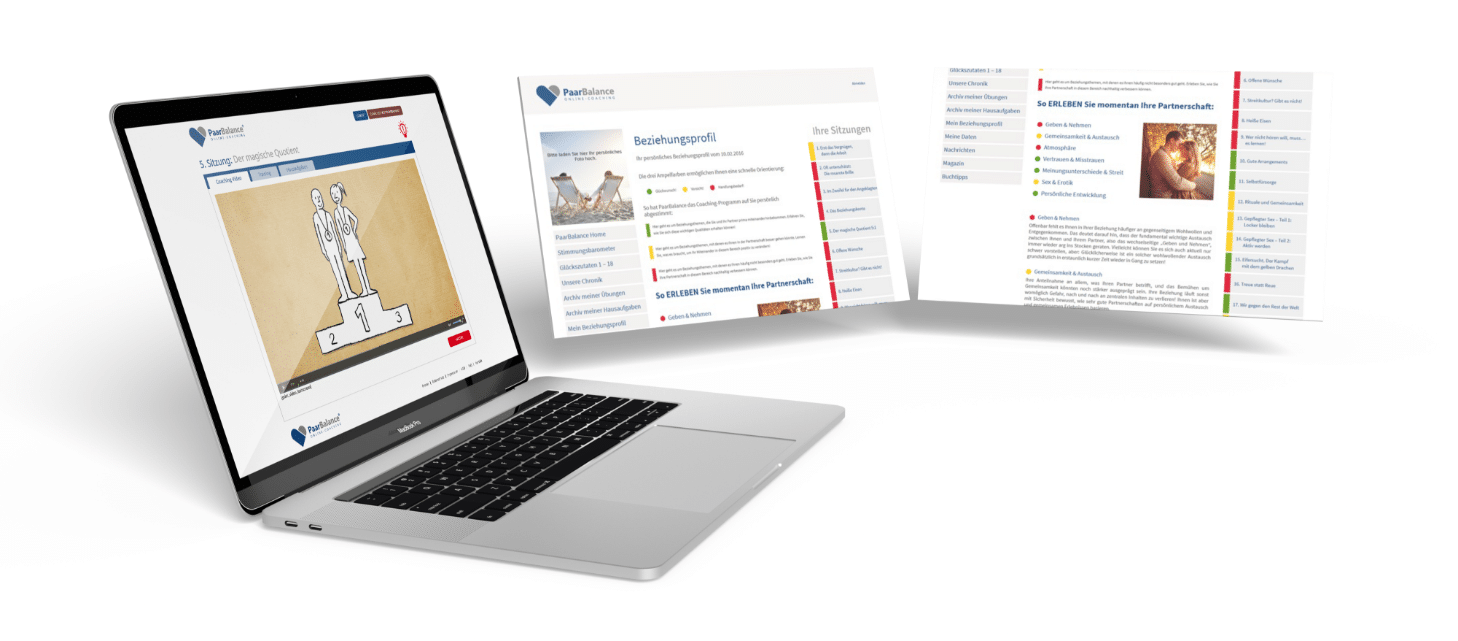
Now is the perfect opportunity to examine the current state of your relationship. The CoupleBalance relationship test, developed by renowned couples therapist and relationship expert Prof. Dr. Ludwig Schindler and colleagues, provides you with a scientifically sound analysis of the strengths and weaknesses of your journey together so far.
Take your relationship test now! (free)
How is your relationship?
What are your strengths and weaknesses?
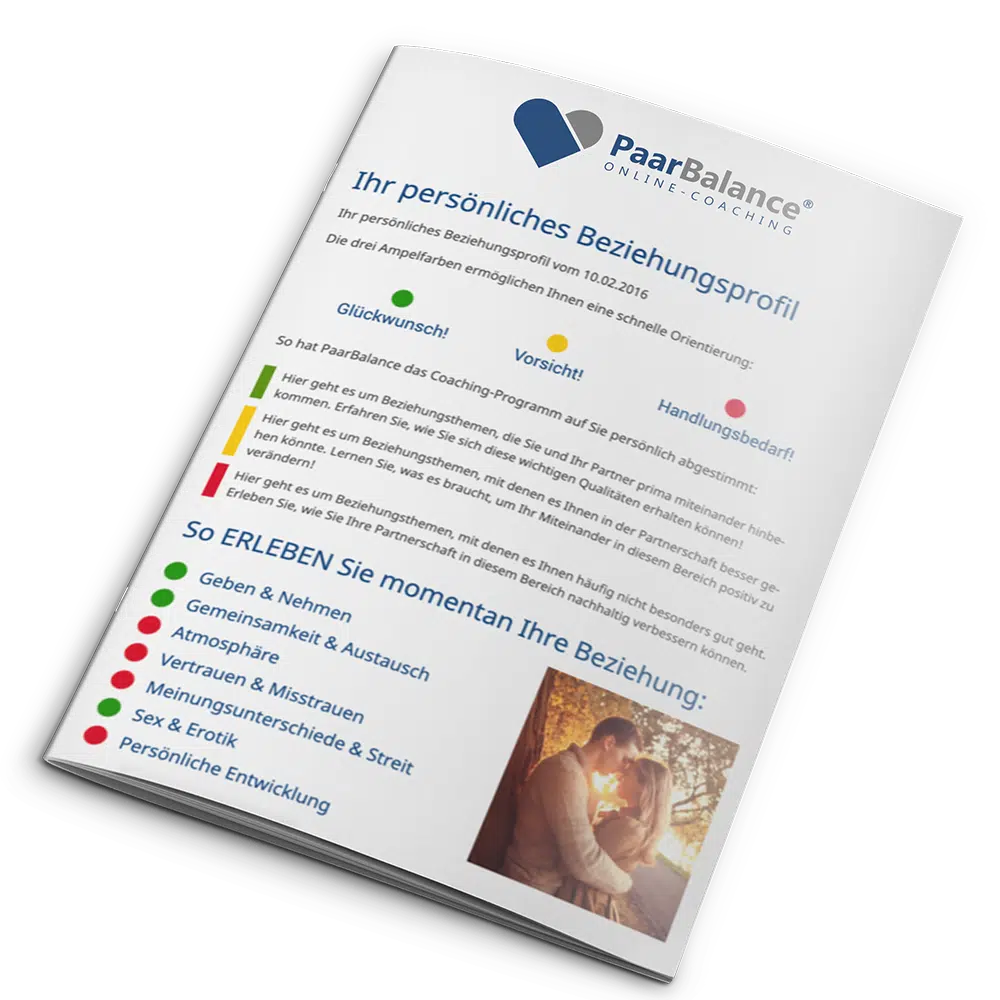
You will find out immediately afterwards in your personal PaarBalance relationship profile (free).
Start your relationship test now!
✓ Scientifically sound
✓ Includes detailed analysis
✓ Your data will not be shared
✓ 100% free & non-binding
100% secure. We comply with data protection regulations. Registration for the relationship test is free .
Please read this important information beforehand:
Data Protection ᐧ Terms and Conditions ᐧ General Information Agreement Terms and Conditions . Transparency Statement
Immediately after the evaluation, you will receive your personal relationship profile – a kind of X-ray of your relationship. You will see, on the one hand, where you have already set the right course and, on the other hand, where and how you are chipping away at the veneer of love.
Only those who understand the sources of friction in relationships can ensure that there will be less friction in the future and that the relationship runs smoothly in the medium and long term...
"Relationship license" instead of "relationship anxiety" - because love can be learned.

Let's be honest: Navigating a relationship smoothly over years or even decades is significantly trickier than driving a car – and yet there's no relationship license. Considering the countless hours we spend taking tests and collecting certificates, that's pretty astonishing, isn't it? Especially when you think about how important a stable relationship is for our well-being and health.
It's no wonder, then, that one feels insecure when navigating unfamiliar relationship territory – without knowing exactly what awaits around the next bend. After all, a dangerous pothole could appear at any moment.
Fortunately, relationship research has thoroughly investigated what it takes to remain calm and confident in the driver's seat, even in difficult relationship situations.
We want to share this knowledge with you now. It will not only help you feel more confident in your relationship, but also help you understand what a partner with commitment issues needs to overcome their fear of intimacy. Therefore, in this blog post, we will address the following questions:
Why is "bonding" so important for us humans?
What is meant by "fear of commitment"?
What symptoms indicate attachment anxiety?
How can fear of commitment develop?
What can you do if you have a partner with commitment issues?
And – if you yourself suffer from commitment issues – how can you overcome your own fear of intimacy?
“Attachment” – Why it is so important for us humans

"Attachment" is like the glue that holds us all together – a central concept in psychology and developmental research that describes how we form and maintain emotional and social connections. Why is all of this so important?
Let's take a closer look at the most significant bio-psycho-social aspects below:
Survival advantage
Imagine you're a small child in the Stone Age. The world around you is full of dangers – from fearsome saber-toothed tigers to oversized coconuts. But luckily, you have a close bond with your parents, who act like your personal bodyguard and gourmet chef rolled into one. This strong connection not only protects you but also ensures you regularly enjoy a guaranteed meal. Your chances of survival skyrocket!
Emotional safety and well-being
Most people experience a secure attachment like a cozy blanket on a cold winter day. It offers emotional security and comfort. Those who know they are loved and valued can face the stresses of everyday life with a charming shrug. Children with a secure attachment often develop healthy self-esteem and a positive self-image – they essentially carry their secure blanket with them at all times.
Social and emotional development
The quality of attachment in early childhood is like the quality of a house's foundation: if the foundation is secure, the walls can be built straight and stable. Securely attached children grow into social butterflies who can build positive relationships with peers and later partners. Insecure attachments, on the other hand, are like a crooked foundation – making it considerably more challenging and unstable later on when it comes to social and emotional skills.
Mental health
A secure attachment acts like an invisible shield against mental health problems. People with stable and supportive relationships carry this shield throughout their lives and are less likely to be affected by depression, anxiety, and other mental health issues. A stable childhood with strong, reliable relationships is therefore like an immune booster for the soul.
Stress management
We all know that life sometimes has its unpleasant sides – stress, difficult life events, and the proverbial obstacles that get in our way. But with strong social connections, these obstacles can often be gathered up and quickly transformed into a staircase. Knowing you can rely on others is like a superpower that strengthens your own resilience.
Biological foundations
Bonds also influence what happens in our bodies. Take, for example, the bonding hormone oxytocin. This hormone plays a major role in building trust and social bonds. Whether breastfeeding, cuddling, or simply having pleasant conversations – oxytocin is always present and ensures that people feel connected to one another.
Attachment therefore plays a crucial role in all stages of life – from childhood to old age. A strong attachment ensures that people feel emotionally well, can build healthy social relationships, and maintain mental balance.
What is meant by "fear of commitment"?

Fear of commitment is the fear of precisely this emotional closeness and commitment.
For people with commitment issues, the thought of losing themselves in a relationship, potentially being "controlled" by someone else, having their freedom restricted, and ultimately being hurt, is so frightening that they prefer to keep their distance. This means that these fears are in constant conflict with the aforementioned "advantages" of stable relationships.
The tactic of those with commitment issues? To carefully manage closeness so they don't get swept away by the emotional ocean. You can imagine it like a dance where you want to hold your partner's hand, but constantly take a step back.
In short: Fear of commitment is the constant struggle between the desire for closeness and the fear of being trapped in that closeness.
What symptoms indicate attachment anxiety?
People with commitment issues use various strategies to keep their own feelings from becoming too intense and the relationship from becoming too close, thus supposedly protecting themselves from getting hurt.
Keep your distance – no closeness at all!
For people with commitment issues, maintaining a certain "safe distance" is extremely important. This can mean avoiding close physical contact or emotional conversations. Imagine you're at the movies and the lead actor is about to make a love confession in close-up. For someone with commitment issues, this moment triggers an urgent need to buy more popcorn—right now! They want to avoid intimacy and prefer to stay on the surface of the relationship. As a result, their partner often feels as if they can't penetrate an invisible wall surrounding their loved one.
The "cuddly cat" panic – First closeness, then withdrawal
Or this: Everything is going great, there's even cuddling and laughter, and suddenly – bam! – the partner with commitment issues withdraws completely. This can happen when people with commitment issues feel they've revealed too much of themselves after an intense period of closeness. Their internal alarm system then goes off, and they flee – sometimes literally, sometimes emotionally.
The other person feels painfully rejected and completely confused: "It was so wonderful just a moment ago, and now I'm being pushed away - what on earth has happened?! What did I do wrong?"
Love put to the test – Constant testing
This also happens frequently: People with commitment issues set up a veritable "test lab" for love. They constantly check whether their partner is "really" committed to them. This isn't about simple little "love questions," but about fundamentally questioning the relationship. The partner then experiences this as if they've booked a season ticket for a roller coaster: exciting on the one hand, but extremely exhausting on the other.
The paradoxical result of this strategy: People with attachment anxiety also drive their (previously attachment-secure) partner into distance.
How can fear of commitment develop?

Fear of commitment is not a simple phenomenon, but a complex interplay of past experiences, childhood imprints, fear of freedom, and self-doubt. To overcome fear of commitment, it is important to recognize its roots and confront them. Only then can you gradually dismantle the protective barrier and clear the way for a fulfilling relationship.
Past relationship experiences: A suitcase full of the past
Perhaps you (or your partner) have gone through a painful breakup in the past that has robbed you (or them) of your trust in love. And it's a bit like visiting a haunted house: once you're inside, you're constantly on guard because a new horror could be lurking behind every door. The past experiences have left deep scars that keep resurfacing as a fear of emotional intimacy.
Childhood: The script for future relationships
If your parents had a relationship that was full of drama, these early impressions may be deeply ingrained in your emotional DNA. You may have learned that relationships are a risky endeavor where it's best to keep your distance. If your parents staged their own relationship like a Hollywood blockbuster, you may have gotten the impression that genuine intimacy inevitably leads to disappointment.
Fear of loss of freedom
For some people, the word "relationship" sounds like a synonym for "loss of freedom." They are afraid of commitment because they value their independence above all else. If their basic premise is: "Life is a wild party!"—then the prospect of restricting the freedom necessary for that in favor of a committed relationship understandably stirs up great anxiety, even if the freedom-loving person suspects that close relationships could also be a source of joy.
Self-esteem: The invisible troublemaker
Perhaps you secretly wonder whether you could even withstand the trials of love. Low self-esteem is like a hidden saboteur, constantly sabotaging attempts to form deep bonds. For someone who doesn't consider themselves "truly" lovable, the idea of letting someone get close can be frightening. The fear of ultimately not being good enough or being disappointed can be so strong that they prefer to keep their distance.
The four best tips for dealing with a partner who has commitment issues

1. Patience is your new best friend
Imagine you are a Zen master of relationships. Your mantra is: "Slow and steady." If your partner behaves like a timid cat that flees under the sofa at every loud noise, then it is up to you to radiate calm.
What does that mean in concrete terms?
Don't push for rapid progress. A clear recommendation: Instead of directly addressing "big" topics like "moving in together," give a partner with commitment issues plenty of time to gradually get used to such a significant idea. Celebrate "smaller" shared experiences like a day trip or a weekend getaway – and discover for yourself that even relatively "short" adventures can create lasting memories.
Encourage your partner gently. Signs of commitment, such as offering to clear out a drawer in your bathroom for them or lending them your spare house key for the weekend, can send an important signal that you, in turn, trust them. But please don't do everything at once! Remember that every step is a small victory.
2. Communication is worth its weight in gold.
If your partner disappears like a mole in a tunnel when it comes to relationship issues, there's only one thing that helps: very, very careful communication.
What does that mean in concrete terms?
Have open-ended conversations. Ask about your partner's fears and concerns without immediately expecting or offering solutions. A sentence like, "I can understand that you're worried about this. Tell me a little more..." can be a good starting point.
Avoid an interrogation style. Questions like, "Why don't you want to move in together? Are you still unsure if you really love me?" will scare off a partner with commitment issues in no time. Be empathetic and understanding, and allow space for open and honest answers.
3. Self-care – don't forget yourself!
While you're looking after your shy feline partner, don't forget to take care of yourself. Your well-being is just as important as your partner's. Imagine you're a gardener who tends not only to the flowers but also to your own hands.
What does that mean in concrete terms?
Take time for yourself. Regularly dedicate time to your own interests. A happy partner is a balanced partner. The same applies to you. Go to the gym, meet up with friends, or simply enjoy a quiet evening with a good book.
Set healthy boundaries. It's important to give your partner time and space, but also communicate your own needs. A relationship isn't a one-way street. Say, kindly but clearly, what you need to feel comfortable and valued.
4. Build trust – but please not in turbo mode
Trust is the foundation of every relationship, and with a partner who has commitment issues, it takes a great deal of sensitivity to build that foundation firmly. Imagine it like building a sandcastle: too much pressure, and it all collapses; too little, and it remains loose and unstable. It's about building trust step by step, without pressuring or controlling.
What does that mean in concrete terms?
Be reliable. Keep your promises – no matter how small. Reliability is an important signal for people with commitment issues.
Give them space . Trust also means giving your partner the space they need. Trust grows when your partner realizes they are loved without needing to be constantly near you.
Show understanding . If your partner withdraws, don't take it personally. Show understanding for their fears and make it clear that you are ready to walk this path together – at their pace.
Mit Geduld, Humor und Selbstfürsorge kann selbst die schüchternste Beziehung wachsen und gedeihen. Bleiben Sie entspannt – und vergessen Sie nicht, dass Rom auch nicht an einem Tag gebaut wurde.
So können Sie Ihre eigene Bindungsangst überwinden

Der erste Schritt: Bindungsangst erkennen und akzeptieren.
Akzeptanz ist der Schlüssel zu jeder Veränderung. Stellen Sie sich vor, Sie stehen vor dem Spiegel und sagen: "Hallo, Bindungsangst. Interessant, dich mal etwas näher kennenzulernen!" Nehmen Sie sich Zeit, um über Ihre Ängste nachzudenken. Wann treten sie auf? Welche Situationen triggern sie? Am besten notieren Sie Ihre Gedanken mal für eine Weile in einem Tagebuch (ein bisschen wie eine Naturdokumentation über Ihr eigenes Gefühlsleben).
Kleine Schritte und Geduld
Machen Sie kleine Schritte in Richtung Bindung. Beginnen Sie damit, sich bei Verabredungen mehr zu öffnen, ohne gleich ans Zusammenziehen zu denken. Ähnlich wie beim Schwimmen lernen: Zuerst plantschen Sie im flachen Wasser, bevor Sie sich ins tiefe Becken wagen. Auch wichtig: Feiern Sie Ihre Erfolge. Jede (!) noch so vermeintlich kleine positive Erfahrung zählt. Haben Sie jemanden umarmt, ohne sofort loszulassen? Super! Hat ein romantischer Abend Sie nicht unmittelbar in die Flucht geschlagen? Großartig! Diese kleinen Siege sind der Weg zum großen Erfolg.
Kommunikation
Reden Sie mit Ihrem Partner möglichst offen über Gedanken, Gefühle und Ängste. Ehrlichkeit ist hier das Mittel der Wahl. Sie werden überrascht sein, wie verständnisvoll Menschen sein können, wenn Sie ihnen Ihre inneren Kämpfe anvertrauen. Es hilft enorm, wenn Sie zumindest immer wieder ein paar Ihrer Gedanken laut aussprechen, anstatt alles mit sich selbst auszumachen und den anderen dadurch vor den Kopf zu stoßen - bzw. vor "vollendete Tatsachen" zu stellen.
Selbstliebe
Arbeiten Sie an Ihrem Selbstwertgefühl. Nehmen Sie sich Zeit für Selbstpflege und Aktivitäten, die Ihnen Freude bereiten. Ein starkes Selbstwertgefühl ist wie ein robustes Fundament, auf dem sich Beziehungen erst stabil aufbauen lassen. Machen Sie Dinge, die Ihnen gut tun und Ihr Selbstbewusstsein stärken. Ob es nun Yoga ist, Malen, Lesen oder ein Spaziergang in der Natur – Hauptsache, Sie fühlen sich wohl dabei.
Seien Sie nett zu sich selbst. Erlauben Sie sich, Fehler zu machen und daraus zu lernen. Auch ein positiver innerer Dialog kann Wunder wirken.
Denken Sie über professionelle Unterstützung nach
Auf dem Weg zu einem gesunden Umgang mit Nähe und Distanz können
eine Therapie bei einem Psychotherapeuten oder einer Psychotherapeutin,
eine Paartherapie gemeinsam mit dem (potentiellen) Partner,
eine inspirierende Lektüre oder
ein strukturiertes Online-Selbsthilfeprogramm
eine wertvolle Unterstützung sein.
Those who prefer to deal with their fear of commitment "in the privacy of their own room" can use tried and tested self-help literature (e.g. by Stefanie Stahl or Wieland Stolzenburg) or the PaarBalance self-help program (scientifically based online coaching that teaches the most important "ingredients of happy long-term relationships" in a short time).
Conclusion: Master the emotional balancing act! It's worth it...

Fear of commitment is like an emotional labyrinth that almost always consists of experiences, childhood influences, the fear of loss of freedom, and self-esteem issues.
The first step to overcoming these fears is recognizing and becoming aware of them. When you or your partner understand the roots of the fear of commitment, you can work together to overcome the emotional barriers and build a fulfilling relationship.
Stay calm and humorous – the path to emotional closeness may be challenging, but it often leads to the most beautiful discoveries in the relationship universe.
Fear of commitment is a complex but surmountable phenomenon. Almost everyone can learn to overcome their fears and embark on the adventure of love.
The next time thoughts of escape arise, remember this: the most beautiful stories often begin where your comfort zone ends. Stay courageous and open to love – after all, relationships are always about growing together – and sometimes that means growing beyond your own limits.
In this sense: Stop with the fear, not with the partner!

☝🏻 Related to the topic of fear of commitment