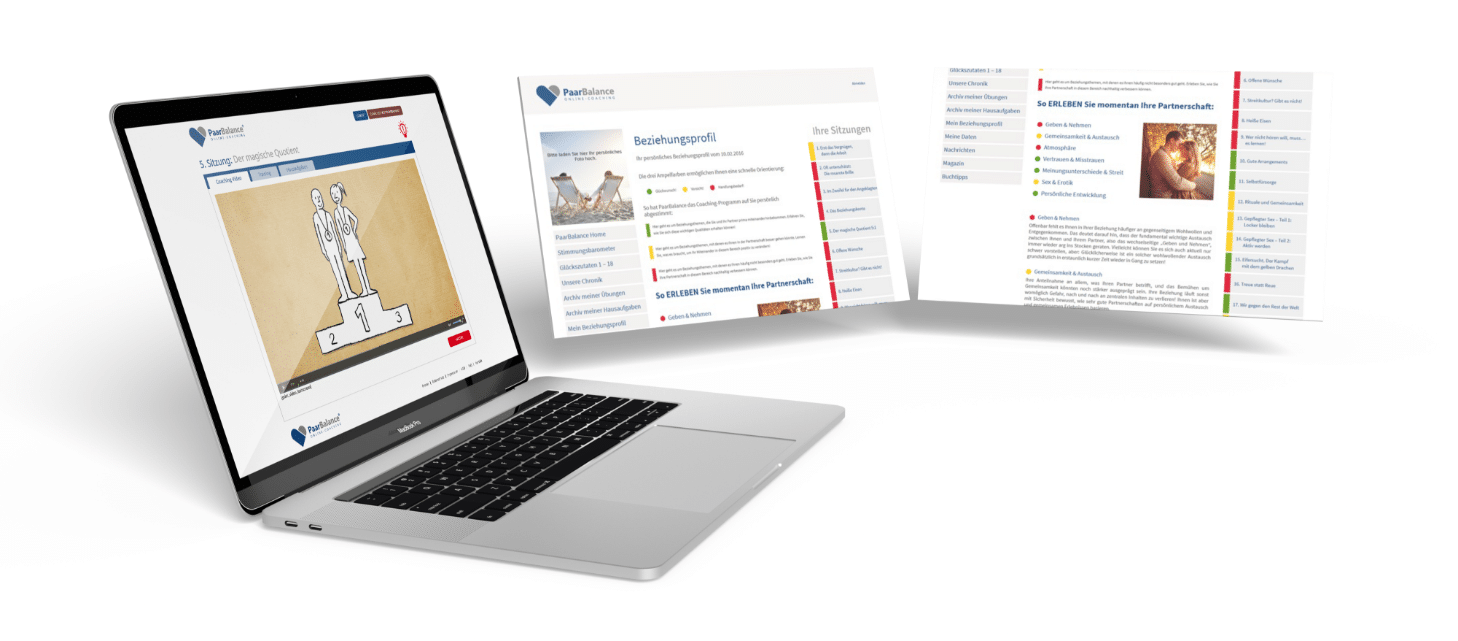






☝🏻 Quick start: Relationship test - how is my relationship doing?
Would you like to learn more about the strengths and weaknesses in your relationship?
Then a thorough relationship test is probably just the thing to quickly and specifically get initial answers to the 'big' questions such as:
- What topics are particularly 'sensitive' for us?
- Which areas and content within our partnership are currently running smoothly?
- Was I perhaps not even aware of a major problem between the two of us?
- Perhaps we have resources in our relationship that I haven't been able to see so far?
Take your relationship test now! (free)
How is your relationship?
What are your strengths and weaknesses?
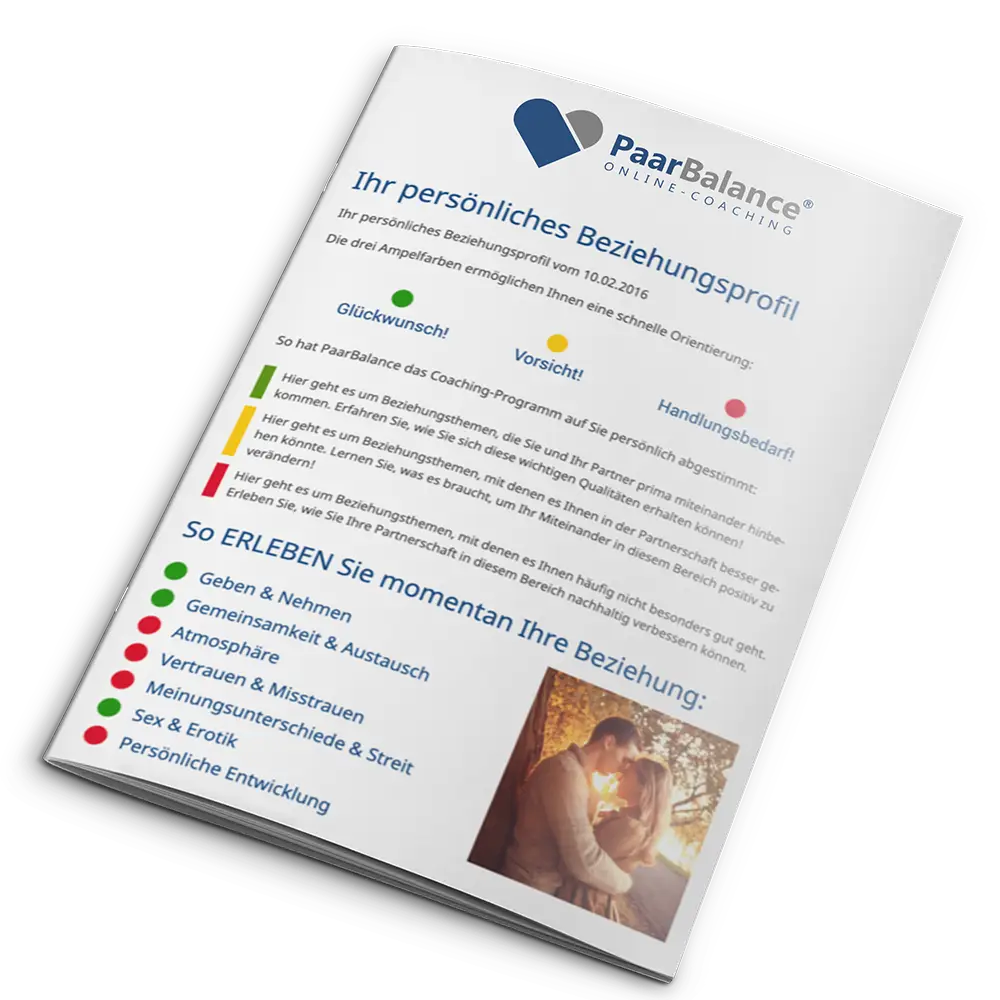
You will find out immediately afterwards in your personal PaarBalance relationship profile (free).
Start your relationship test now!
✓ Scientifically sound
✓ Includes detailed analysis
✓ Your data will not be shared
✓ 100% free & non-binding
100% secure. We comply with data protection regulations. Registration for the relationship test is free .
Please read this important information beforehand:
Data Protection ᐧ Terms and Conditions ᐧ General Information Agreement Terms and Conditions . Transparency Statement
With so many relationship tests available, how can I find one that will truly help me?
Both online (on dating websites) and offline (in magazines and advice columns) you can find countless relationship tests – for singles who don't want to stay single, for people in long-term relationships, for those newly in love, for people with small but persistent problems, for couples who have big and existential issues to solve, for separated people who want to win back their ex, etc., etc. – the range of topics is enormous.
But what helps you recognize whether a test is reputable?
Which relationship tests are truly meaningful?
This article aims to support you with background information and tips.
- to be able to distinguish a psychologically sound relationship test from a superficial fun quiz
- to find out for yourself which questions you would like to ask and answer as part of a relationship test and which topics particularly interest you.
Why take a relationship test?
For a variety of reasons, the following question may arise at some point in a partnership:
- "How is our relationship actually doing overall?"
- “Do we know all of the other person’s ‘big issues’ right now?”
- "Perhaps we're not talking to each other enough anymore?"
- "Do I still ask my husband how he is doing with genuine interest?"
- "Am I still really listening to her - or am I increasingly giving quick tips (even when she doesn't ask any questions, but just needs a listening ear)?"
- "What am I doing right – all things considered – and what am I possibly doing wrong?"
Vielleicht fühlen wir uns aber auch nach einem Abend mit anderen Pärchen verunsichert und beginnen zu grübeln und alte (oder neue) Vergleiche zu diesen Paaren zu ziehen - und plötzlich nagt in uns die eine oder andere Frage:
- "Könnte denn auch ich so richtig 'aus vollem Herzen heraus' sagen: "Er ist meine ganz große Liebe!"?
- „Haben wir genau so viel (bzw. genau so wenig) Sex wie die anderen?“
- „Ist das, was wir für einander fühlen, noch immer Liebe?"
- "Warum sagt meine Frau eigentlich nie vor anderen Paaren, dass sie mich liebt?"
- "Ist es vielleicht doch nicht so 'natürlich' und 'normal', wie wir es immer darstellen, sondern ziemlich riskant: Unser häufiges Streiten, einander Verletzungen zufügen, wieder versöhnen?“ (siehe auch unseren Artikel "Trennung auf Zeit?)
Vielleicht machen wir uns dann aufgrund solcher aufwühlender Gedanken auf die Suche nach konkreten Antworten - und beginnen, konkret zu recherchieren, wo wir hilfreiche Tipps, neue Anregungen oder auch professionelle Unterstützung bekommen können.
Wann machen Menschen einen Partnertest?
Sogenannte Partnertests kommen, wie gesagt, oft schon zum Einsatz, bevor Menschen überhaupt in einer Beziehung leben, d.h. wenn sie Singles (also noch auf Partnersuche) sind - insbesondere im Zusammenhang mit Partnervermittlungsbörsen.
Ein großer Teil der Testverfahren zum Thema Beziehungszufriedenheit wendet sich allerdings an Menschen, die nicht auf Partnersuche oder gerade frisch verliebt sind, sondern an Paare bzw. die einzelnen Parter (d.h. die jeweiligen Männer und Frauen in festen Partnerschaften), die das Gefühl haben:
- dass es in ihrer Beziehung einfach schon länger nicht rund läuft,
- dass inzwischen zu viele 'schwierige' Themen im Raum stehen,
- dass sie schon lange keine guten Gespräche mehr führen konnten,
- dass sie immer weniger entspannte Zeit miteinander verbringen.
Viele Betroffene erschrecken, wenn Sie plötzlich feststellen, dass sie sich insgeheim immer häufiger quälende Fragen stellen wie:
- Kannst Du Dir - Hand aufs Herz! - überhaupt noch vorstellen, nach all den Streitereien wieder das Positive zu sehen?
- Glaubst Du - ganz ehrlich! - selbst noch daran, dass es nach all dem, was wir uns gegenseitig angetan haben, gelingen kann, wieder respektvoller miteinander umzugehen?
- Hast Du Dir nicht - in letzter Zeit sogar täglich! - die Frage gestellt, ob eine Trennung nicht vielleicht doch das Beste wäre?
- Wie stehen - generell - die Chancen, dass eine Liebe, die im Laufe der Zeit Patina angesetzt hat, wieder als kostbarer Schatz empfunden wird?
Wie kann man einen fundierten Partnertest von einem 'netten Beziehungs-Quiz zwischendurch' unterscheiden?
In Zeitschriften und im Internet ist eine unglaubliche Fülle an Tests zu den Themen Beziehung, Liebe und Sex zu finden: Für den Partner. Für die Partnerin. Für heterosexuelle Paare. Für homosexuelle Männer und Frauen. Mit den verschiedensten Inhalten.
Fast jeder hat schon einmal – mehr oder weniger verstohlen – im Wartebereich des Friseurs oder der Hausärztin irgendeinen Liebestest in einer Zeitschrift ausgefüllt und vor der Behandlung noch schnell die Test-Auswertung verschlungen, um endlich in Erfahrung zu bringen, welcher 'Beziehungstyp' man denn nun ist… 😉
Surft man ein bisschen im Internet, findet man unzählige solcher Psychotests mit Überschriften wie:
- "Kamasutra Quiz - wie fit bist Du in Sachen Sex und Liebe?"
- "Ist Deine Partnerin wirklich glücklich? Unser Beziehungstest verrät es Dir."
- "Wie viel Leidenschaft gibt es in Eurer Beziehung? Hier kannst Du es herausfinden."
- "Der große Liebestest – passen wir zusammen? In 5 Minuten hast Du die Antwort."
- "Bist Du wirklich verliebt? 10 Fragen, die es Dir verraten."
- "Liebestest: Hast Du eine Chance bei ihm? - Finde heraus, ob Dein Schwarm auch in Dich verliebt ist."
- "Teste Deine Beziehung – teste Dich!"
- "Gehört Ihr zusammen? Macht den Test!"
- "Meine Partnerin flirtet mit anderen. Diese 5 Punkte verraten Dir, ob Du Eure Liebe noch retten kannst."
- "Neue Quiz-Fragen: Bist Du ein guter Liebhaber?"
- "Das passende Sternzeichen, die gleichen Hobbys, dieselben Bedürfnisse? Unser Partnertest verrät Dir, worauf es zwischen Mann und Frau wirklich ankommt."
- "Liebt ER Dich noch? Hier kannst Du erfahren, wie gut Deine Beziehung wirklich ist"
- "Liebe auf dem Prüfstand – Für Paare, die es wissen wollen."
- "Fit als Partner? Unser Quiz verrät Dir in nur 5 Minuten, ob Du Nachholbedarf hast."
- "Liebt sie Dich? Unser Liebestest weiß die Antwort." usw. usf.
Most of these love tests have entertainment value , and it can certainly be exciting and stimulating to think concretely again about one's own communication and conflict behavior, about sexuality, dealing with jealousy or an affair - and in this context to think about important couple topics such as fear of commitment, self-confidence, forgiveness, etc.
Almost all such psychological tests lack any scientific basis . For non-psychologists, it is often difficult to assess the reliability of a relationship test.
Without scientific rigor, however, no sound evaluation is possible. While the initial questions may stimulate thought, they generally cannot be answered in a well-founded manner – in the worst case, harmful and misleading statements are even made.
What makes a relationship test reliable?
Does one need to have studied psychology and test theory to be able to distinguish a good love test from a harmless quiz?
Of course not. Most readers are well aware that the quick "How fit are you in love?" quiz in the weekly women's magazine hardly meets scientific standards. And answering questions about love and sex can still be fun. However, the subsequent results shouldn't be taken too seriously.
So what characterizes a sound relationship test? Even if it might sound a bit dry in theory, it's definitely worthwhile to be clear about the following points before answering test questions on the topic of relationships:
A scientific instrument is characterized by the fact that it is designed based on relevant research findings and methodologically developed, thus exhibiting very specific test quality criteria . Such diagnostic instruments are developed for use in couples counseling and psychotherapy. They are rarely freely accessible and usually require payment – this is also true of the most widely used instrument in German-speaking countries, the "Partnership Questionnaire" (PFB) by Kurt Hahlweg (2016). The precise criteria for category formation and test evaluation are explained in detail for scientific instruments.
Developing such a questionnaire instrument is complex and must be tested on a larger group of people (in our case: people in a committed relationship ) before it can be used "publicly".
What should a good relationship test include?
Essentially, these are the 3 criteria for a good relationship test:
- The test should have been methodically developed on a solid scientific basis by relationship experts (otherwise, tests usually only have a superficial quiz character).
- The test should ask well-thought-out questions in order to accurately identify the personal strengths and weaknesses of your relationship and to reflect a truly meaningful picture back to you.
- Ideally, you will not be left alone with the evaluation and results , but will receive concrete starting points to take action: to get appropriate support or to strengthen your relationship independently.
Take your relationship test now! (free)
How is your relationship?
What are your strengths and weaknesses?
You will find out immediately afterwards in your personal PaarBalance relationship profile (free).
Start your relationship test now!
✓ Scientifically sound
✓ Includes detailed analysis
✓ Your data will not be shared
✓ 100% free & non-binding
100% secure. We comply with data protection regulations. Registration for the relationship test is free .
Please read this important information beforehand:
Data Protection ᐧ Terms and Conditions ᐧ General Information Agreement Terms and Conditions . Transparency Statement
Since there were hardly any sound relationship tests for the individual partner, the two couple therapists Prof. Dr. Ludwig Schindler and Dr. Judith Gastner, together with a research team, developed a scientifically sound relationship test and evaluated it on a large sample.
The relationship test was developed according to all current methodological requirements at a scientific level.
It is used as an important component (anamnesis, recording of the current state) at the beginning of the PaarBalance tool, the first interactive couples therapy for one person that works online .
You can find all the information at www.paarbalance.de/online-coaching .
What does the PaarBalance relationship test reveal about my partnership?
The PaarBalance relationship test aims to:
- to sum up how you experience your relationship in different aspects ,
- To make them aware of their personal contribution to the current relationship situation and
- to prepare them for active change steps .
These questions will help you get a good overview of the current state of your partnership:
- What is the atmosphere like between me and my partner?
- What customs and habits prevail in our society?
- What are my core beliefs about love and relationships?
How many questions does the test contain and how long does it take?
The PaarBalance relationship test includes a total of 64 questions about how you (a) experience and (b) shape your relationship.
For each individual question, answer options are offered in 6 levels .
It is advisable to set aside about 10 minutes to answer each question as undisturbed and calmly as possible.
Will I receive my evaluation immediately?
What information will I find in my personal relationship profile?
Immediately after completing the questionnaire, your personal relationship profile will be created - both as a text version and using the traffic light colors red, yellow and green, so that you get a good overview immediately afterwards :
- RED = Action required!
- YELLOW = Caution!
- GREEN = Congratulations!
You will learn how you are currently EXPERIENCED in your relationship in the following areas:
- Giving & Taking
- Common ground & exchange
- atmosphere
- Trust & Distrust
- Differences of opinion & conflict
- Sex & Erotica
- Personal development
And you will learn how to currently shape your relationship in the following aspects:
- Self-opening
- Closeness in everyday life
- Support & Care
- Dealing with controversies
- Sensitivity & susceptibility to offense
- Appreciation & Respect
The PaarBalance relationship test allows for individual customization of online partnership coaching.
By answering the questions in the partnership test, not only is your personal relationship profile created, but a differentiated allocation of the 18 individual sessions is also carried out - if you want to strengthen your love and start the couples therapy online from PaarBalance after the test .
This way, before processing each session, you will know what significance the topic covered has for you personally :
- RED : This section addresses relationship issues that you often find difficult. Discover how you can sustainably improve your relationship in this area!
- YELLOW : This section focuses on relationship issues that could improve your partnership. Learn what it takes to positively change your interactions in this area!
- GREEN : This section focuses on relationship topics that you and your partner are already handling well. Learn how to maintain these important qualities!
The key ingredients for a happy relationship are presented in a concise and humorous way in the PaarBalance self-help program and conveyed in a practical manner.
Why is the PaarBalance relationship test offered free of charge?
The partnership analysis in the PaarBalance relationship profile has already enabled countless people to become (finally) more aware of the strengths and challenges of their partnership.
We are very happy about that! 🙂 It is always wonderful for us to receive feedback from users that simply taking the relationship test was the decisive impetus to actively engage in their romantic relationship again.
For this reason, we continue to offer our scientifically based test free of charge - regardless of whether (or when) you subsequently wish to use the PaarBalance program for yourself or not.
Click here to take the free PaarBalance relationship test:
Strengthening the relationship! What does it take for a happy partnership?
Research over the last few decades has identified a number of universal experiential qualities that most people desire for a fulfilling partnership.
This includes, among other things , appreciation and respect, understanding and support, togetherness and security .
In clinical psychology and psychotherapy, there is now a wealth of empirical findings about which thought and behavior patterns are important for the success of a relationship perceived as happy, and what can be detrimental or harmful.
Key areas include, among others...
- Communication skills
- Joint conflict resolution
- Loving interaction in everyday life
- Activities as a couple
- Traditions, rituals, celebrations
- Good stress management
The satisfaction experienced in the partnership is the product of how both partners interact with each other .
This interaction, in turn, is comprised of personal attitudes, daily contributions to shared life, and the conflict management of each partner. The analysis and resolution of relationship problems must begin at this level.
Here's how you can do something good for your relationship: The CoupleBalance program
What is Couple Balance?
PaarBalance is a scientifically based, highly effective online program for greater satisfaction in relationships, combining all the aforementioned aspects. You can use the tool independently, regardless of time and place, immediately – i.e., without any waiting time – (as a self-help program or to complement counseling).
Structure & Content
The core of the program consists of 18 consecutive units on relevant relationship topics, each containing:
• a coaching video
• two interactive exercises
• three homework assignments to choose from
Time required?
A complete online session lasts approximately 20 minutes (but can easily be divided into shorter segments). You should aim for a maximum of two sessions per week. To allow ample time to fully absorb all the content, a total of about three months is recommended.
More information about the online coaching program can be found at www.paarbalance.de/registrieren .
Couple coaching for one person: Why does it work?
The PaarBalance relationship test already focuses on the experiences and behavior of the individual partner – not on the couple as a whole, because:
Each partner has their own personal perceptions , specific concerns, memories, wishes, motives, etc. They should be able to freely name and question these – without the other person looking over their shoulder.
It is therefore advisable that both partners complete the relationship test as well as all exercises and homework in peace and quiet on their own (i.e., without any "censorship" or "softening" due to curious readers).
Everyone can then decide for themselves – both in the relationship profile and from session to session – whether and to what extent they want to share their important thoughts, aha moments and wishes with their partner .
There is the option to easily send emails with key summaries to your partner. But – and this is important! – only if he or she specifically requests them.
And finally, to reassure all those who want to actively do something to improve the quality of their relationship - but whose partners are not currently on board:
It has been proven that if one partner starts to positively change their personal contribution to shaping the relationship, the other partner will follow suit. 🙂
Take the first step now and have your (free) CoupleBalance relationship profile created:
I sincerely wish you all the best for your relationship!
☝🏻 Related articles on the topic of "relationship test"
Frequently Asked Questions
Why should you take a relationship test?
A relationship test is particularly useful when there are uncertainties about the quality of your relationship. Are goodwill and love still present? How do you interact in different areas? What contribution does each partner make to the success of the partnership? What are the strengths and challenges?
How can you recognize a reputable relationship test for relationship quality?
A reputable relationship test can be identified by the following criteria: 1. It was methodically developed based on scientific research findings. 2. The test's objective is clearly explained. 3. It identifies not only the weaknesses but also the individual strengths of the partnership. 4. It presents the results in an understandable way. 5. It provides guidance on how a couple can proceed.
What can you learn about a partnership through a relationship test?
The example of the PaarBalance relationship test shows what a partnership test can reveal: It succinctly summarizes how each partner experiences the relationship in its various facets, what role they themselves play in the current relationship situation, and what active steps can be taken to improve the partnership.
How does the PaarBalance relationship test work?
The CoupleBalance relationship test takes approximately 10 minutes to complete. It consists of 64 questions that explore how you experience and shape your partnership. For each question, you can choose from six graded answer options. Immediately after completing the test, a personal relationship profile (presented in text blocks and using traffic light colors for quick reference) is generated based on your answers.
What information can be found in the PaarBalance relationship profile?
The personal relationship profile summarizes how the relationship is experienced in individual aspects, such as giving and receiving, trust and mistrust, and sex and eroticism. It also describes how one shapes the partnership, including aspects such as support and care, dealing with controversies, and appreciation and respect.