








☝🏻 Quick Start: The Four Horsemen of the Apocalypse in a Relationship
What memories surface when you think back to the first weeks and months with your partner?
Everything seemed perfect, and your relationship was characterized by love, closeness, security, mutual support, exciting eroticism, goodwill, respect, patience... And then?
Unfortunately, many couples experience their relationship changing over time. The tone becomes harsher. The atmosphere cooler. Intimacy and security diminish. Arguments increase. Sexuality fades. Neither partner feels truly seen, valued, or loved by the other anymore.
This article will tell you the most important things about four behavioral patterns that are particularly damaging to romantic relationships and make a later breakup likely. They were identified by the couples therapist, psychologist, and scientist John Gottman, who extensively studied the interaction dynamics between partners. He referred to these toxic patterns as " the four horsemen of the apocalypse of romantic relationships ."
You can find out what these are and how you can counteract them here.
🚀 Already 65,511 people have gained clarity through the test.
How is your relationship going right now?
How do you treat each other?
Take the test! (scientifically sound & free)
Perhaps you are currently experiencing such a change and, after many arguments and conflicts, are asking yourself:
- "Do we still love each other?"
- "Do we want to continue like this for much longer?"
- "Do we have a real chance that things will be carefree and beautiful between us again?"
Feel free to use the scientifically based CoupleBalance relationship test (duration approx. 10 minutes) to gain a comprehensive overview of how you interact with each other as a couple.
Immediately afterwards you will receive your individual strengths and weaknesses profile (free of charge and without obligation) as well as concrete recommendations on how to successfully resolve personal problem areas and significantly expand existing resources.
Take your relationship test now! (free)
How is your relationship?
What are your strengths and weaknesses?
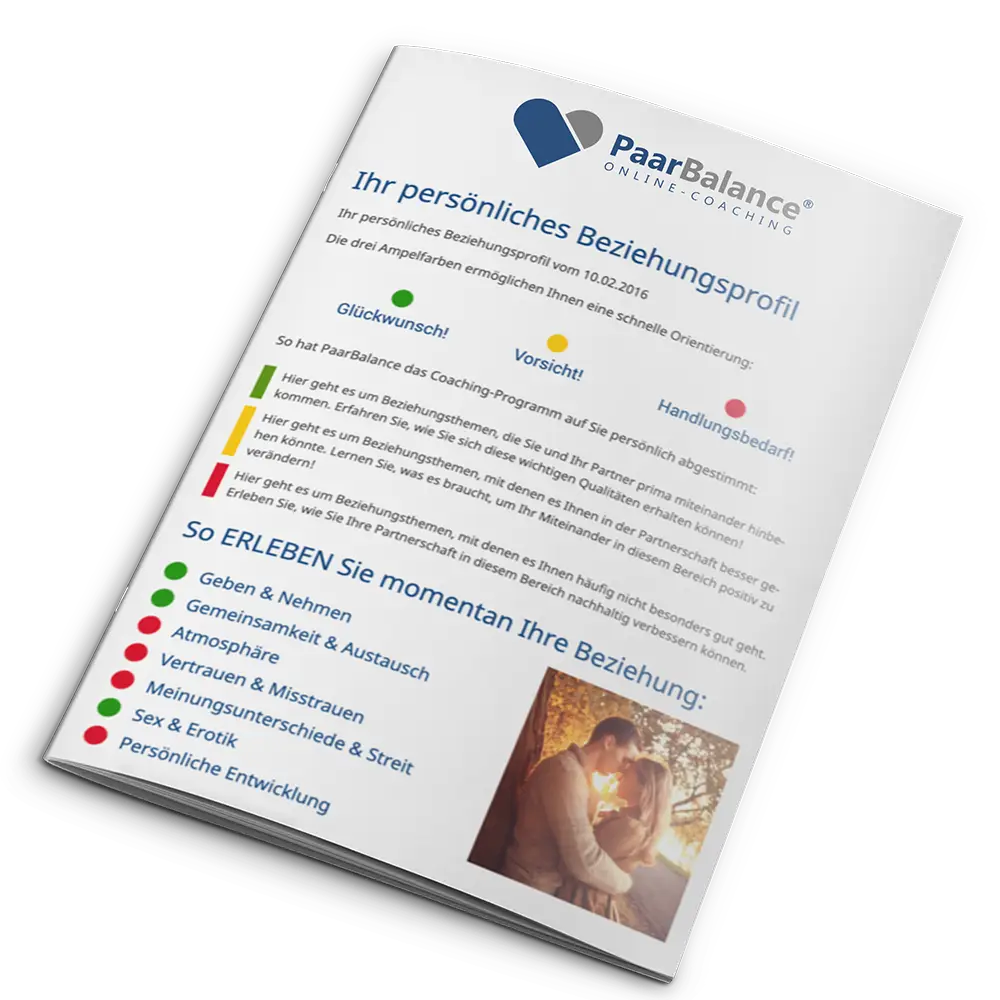
You will find out immediately afterwards in your personal PaarBalance relationship profile (free).
Start your relationship test now!
✓ Scientifically sound
✓ Includes detailed analysis
✓ Your data will not be shared
✓ 100% free & non-binding
100% secure. We comply with data protection regulations. Registration for the relationship test is free .
Please read this important information beforehand:
Data Protection ᐧ Terms and Conditions ᐧ General Information Agreement Terms and Conditions . Transparency Statement
Why do relationships so often "go downhill"? - Here's the answer from relationship research.
Almost every couple desires a loving and relaxed relationship. Nobody wants to live permanently in a tense or frosty atmosphere.
Why then do so many couples eventually reach a point where they are no longer friendly to each other and are increasingly unhappy?
John Gottman, an American psychologist, scientist, and author born in 1942, wanted to better understand the emotional world of couples. To this end, he conducted numerous studies, including investigations into the relationship between...
- the interaction dynamics between the partners,
- the relationship satisfaction experienced by the couple and
- the subsequent separation rate .
He was able to identify four behavioral patterns that cause particularly lasting damage to couples and make a later breakup likely. Gottman calls them " the four horsemen of the apocalypse of relationships ".
Harbingers of impending doom
Gottman chose the name "Apocalyptic Horsemen" in reference to the Book of Revelation , the last book of the New Testament. There, the apocalyptic horsemen are messengers who announce the end of the world. Similar to the biblical prophecy, the apocalyptic horsemen of the couple's relationship are aptly named: their name says it all.
When they become commonplace in relationships - while at the same time the affected couples lose their sense of "good manners" - they can mean the end and downfall of love.
They creep in over time, become a habit, and reveal their destructive potential, especially in conflict situations.
On the one hand, the Four Horsemen of the Apocalypse ensure that a small conflict quickly escalates, while on the other hand they prevent the partners from resolving an unpleasant situation quickly and constructively.
Is the relationship doomed to fail once the Four Horsemen of the Apocalypse have appeared?
No! The behaviors described do not automatically lead to the end of a relationship. However, studies show that they can significantly increase the likelihood of a later breakup .
However, you are not powerless against all of this: If you consciously confront the malevolent horsemen, you can take targeted countermeasures and gradually banish them from your couple life.
The first step is to identify the individual horsemen of the apocalypse in one's own everyday relationship life - because you need as clear a picture as possible in your mind of what to pay attention to:
In what form and in what situations do these harmful behavioral patterns gallop through one's everyday life as a couple and damage the atmosphere?
This varies from couple to couple and is never directly comparable. However, even if – unlike Gottman and his research team – you won't be using video cameras, measuring devices, or computers for a detailed analysis and evaluation of negative interactions with your partner:
You will certainly still be able to determine whether and, if so, which of Gottman's four horsemen have already visited your relationship - provided you dare to look honestly and self-critically .
It's best to resolve to set aside all spontaneous impulses of defense or justification (in the sense of: "I had to be that way because you were that way...") if you yourself repeatedly trigger conflict in your daily relationship. Realizing this doesn't feel particularly good at first. But there's no need to worry:
Immediately following the description of each individual rider, you will receive proven tips on how to limit existing damage and avoid further damaging the relationship in the future.
The First Horseman of the Apocalypse: A Review

The first horseman of the apocalypse identified by John Gottman is criticism.
Now you might be asking yourself: "If criticizing is a behavior that harms my marriage, how am I supposed to address problems at all?" or: "Does that mean I have to just say yes to everything and completely suppress my needs and spontaneous reactions?"
These questions are absolutely valid. After all, it's essential to talk openly about conflicts and disagreements in relationships. Those who always swallow them down and never address them will become increasingly unhappy over time – and will eventually "explode" from all the suppressed anger and frustration.
So how can you tell your wife or husband in the future if something bothers you and you would like things to be different?
In this context, John Gottman made an important distinction: the distinction between criticism and complaint .
A complaint is not criticism
Although both terms sound interchangeable at first glance, they differ in some key aspects. This is best illustrated with a concrete example.
A (destructive) critique might sound – somewhat exaggerated – something like this:
"You used to cook for me so often - but you don't do that at all anymore. You've become quite selfish in general. You haven't supported me for ages. You always think of yourself first. Be honest: you haven't really loved me for quite some time now."
A characteristic feature is that criticism often contains "you" messages, blame, and insinuations. It is frequently peppered with generalizing words such as "always," "never," "everything," "only," or "nothing," and also includes the partner's overall character, personality, or attitude .
A (constructive) complaint, on the other hand, might sound something like this:
"You used to cook for me so often – I always really enjoyed it. Unfortunately, that hasn't been happening as often lately. I'd love it if you could cook something for us again next weekend. That would be really nice. What do you think of (...)? I'd really love some of that right now..."
Complaints contain "I" statements that reflect one's own wishes and needs. The wording is rather descriptive and refers to specific situations.
The two statements begin exactly the same and essentially contain the same message:
It was wonderful for me (and I also perceived it as a sign of your care, support, and love) to have you cook for me. I regret that this hasn't happened for a while and would love to do it again sometime.
The other formulations, however, are completely different. Therefore, they evoke very different reactions in the recipient. They represent a very contrasting approach to one's own needs and desires.
Poorly worded criticism often contains an attack on the other person, inviting a defensive counterattack. Because those who feel attacked will strike back.
Criticism, justification, and counter-criticism quickly escalate until the situation spirals out of control.
Furthermore, the criticism formulated above, for example, conveys that the critic is generally dissatisfied with the entire relationship and the partner's character. That is, of course, hurtful.
In contrast, a complaint ideally includes a suggestion that is as concrete and actionable as possible, describing what would benefit the person who formulated it.
Refrain from criticism and counter-criticism.
We can therefore give a clear recommendation on how to deal with the first horseman of the apocalypse:
- Describe your own feelings .
- Avoid generalizations when addressing a problem or a wish. You don't have to weigh every word, but certain words and phrases (like "so") have proven to be unfavorable and should be avoided whenever possible.
- Do not respond with justification, defense, or counter-criticism when your partner expresses criticism.
- Instead, counter with a complaint (about his criticism), for example by saying: "The way you just phrased that hurt me. It makes me feel like you're completely unhappy in our relationship, and that I've been doing something fundamentally wrong for a long time." This will likely lead your partner to tone down his general criticism.
- Phrase what would be good for you as a suggestion or request - and not as a demand or subsequent accusation .
Couples often think that things have to get loud from time to time, in the sense of: "Arguments are like a cleansing thunderstorm" or: "That's just part of the culture of arguing".
In our experience, however, this isn't true: By the time a conflict arises, the culture has almost always already broken down. Avoid escalation whenever possible. Express your wishes and needs before you completely lose your temper.
The second horseman: Contempt

The second horseman of the apocalypse is contempt.
You are probably familiar with this phenomenon: In an argument, things happen that you later regret.
People roll their eyes, make sarcastic and disparaging remarks, and sometimes even say something hurtful quite deliberately and intentionally.
But even if one didn't 'actually' mean it that way: Such behaviors can be interpreted as various forms of contempt .
The reason: When someone makes contemptuous remarks or signals, it's usually no longer just about the point of contention itself, but about spitefully hurting their partner. They come across as a deliberate attack. For example, seemingly insignificant details can escalate into fundamental criticism of the person, such as: "You always leave your dirty socks lying around. If you're this messy and chaotic at work, I can easily understand why your boss didn't promote you!"
Such a statement can be deeply hurtful.
Contempt is a breach of trust.
It becomes particularly painful when the intimacy between two partners is used as a weapon and sore spots of the other person, which were discussed in confidence, are exploited.
Even if such a statement is only made during a heated argument and the other person sincerely regrets it shortly afterwards, such an incident can permanently damage the partner's trust.
Mimicking someone else or sighing loudly can also express contempt, as can mocking laughter or head-shaking. All of these things say at that moment: "I don't take you seriously and I think what you say or do is stupid."
Similar to criticism, such behavior invites a defensive response. However, this response is usually even more severe than after criticism, as contempt is even more hurtful. Ultimately, it violates the fundamental principle of good relationships: treating each other with respect and as equals.
Avoid contempt or make amends immediately.
Of course, for the sake of love, it's best to avoid behaviors that express contempt. However, this isn't always possible. What can you do if a conflict has involved contemptuous behavior?
In this case, apologize immediately, not after the argument has ended – because no matter how angry you are or how serious the conflict may be:
A derogatory remark should not go unchallenged. It causes lasting damage to the loved one. And that is certainly not what you want for yourself or your relationship.
When something is perceived as contemptuous, it's usually not forgotten even after the argument. Make it clear that the contemptuous behavior doesn't reflect your true feelings towards your loved one.
Signs of appreciation and sincere compliments can help to make up for the moment of contempt.
The third horseman: Walls

In a violent collision, you may sometimes reach a point where you no longer want to or can deal with the situation because emotions are running high.
Many couples experience this, especially after derogatory remarks have been made. Often, one partner withdraws and avoids further conflict altogether. Usually, the other reacts similarly and also withdraws. This behavior can be beneficial if both use the lull in the argument to regulate their emotions. Afterwards, a calmer, more objective discussion about the conflict issues can take place, increasing the likelihood of resolving the dispute together.
However, partners don't always get back together after a period of separation. If this happens, the separation becomes a problem.
Often, one partner avoids discussing sensitive topics altogether, for example by leaving the room when certain subjects are brought up. This can serve as self-protection and a desire to avoid appearing vulnerable. However, this creates veritable "areas of silence" that the couple no longer discusses.
Sometimes, one partner in a relationship withdraws more and more often. This can be triggered by stress with colleagues at work or in everyday life. By remaining silent and avoiding potential conflicts, the already stressed partner wants to prevent additional relationship stress. This usually happens unconsciously, without any explicit decision on their part.
Rückzug baut eine Mauer zwischen den Partnern auf
Auf den ersten Blick wirkt Rückzug wie eine sinnvolle Verhaltensweise, die einen hitzigen Streit beenden und dadurch verhindern kann, dass ein Konflikt eskaliert. Sie hat aber eine große Signalwirkung:
Ein Partner „mauert“ sich regelrecht vor dem anderen ein. Er signalisiert: „Ich lasse dich nicht an mich heran, du bist unerwünscht.“ Gleichzeitig macht das Mauern die Aufarbeitung und Lösung von Konflikten unmöglich. Und das ist Gift für jede Paarbeziehung!
Im schlimmsten Fall löst all das beim anderen das Gefühl aus, das Gegenüber habe kein Interesse mehr an der Beziehung. Es scheint schließlich so, als würde er sich nicht mehr mit dem anderen austauschen und nicht mehr in die Beziehung oder Ehe investieren wollen. Mauern in diesem Sinne verhindert emotionale Nähe zwischen den Beziehungspartnern und führt auf Dauer zu einer emotionalen Entfremdung - eine der häufigsten Trennungsursachen!
Schaffen Sie Intimität und Offenheit
Die wichtigste Maßnahme gegen das Mauern ist Vorbeugen: Verbringen Sie regelmäßig Zeit mit Ihrem Liebsten, in der Sie es möglichst entspannt und schön miteinander haben. Das stärkt die emotionale Nähe und bildet die Basis, um sich vertrauensvoll miteinander austauschen zu können.
Falls es bei Ihnen bereits „Schweige-Themen“ geben sollte, ist nun der Zeitpunkt gekommen, um sie anzusprechen. Schaffen Sie dazu eine angenehme Atmosphäre und tasten Sie sich behutsam heran, indem Sie erst einmal über andere Dinge sprechen, mit denen Sie sich beide wohl fühlen, und das „Schweige-Thema“ nur ganz vorsichtig antippen. Teilen Sie offen mit, dass es für Sie ebenfalls nicht einfach ist, darüber zu sprechen - Sie aber der Meinung sind, dass es wichtig wäre, weil es Sie beschäftigt. Bemühen Sie sich um eine wohlwollende und respektvolle Ausgangssituation.
Trotz der bisherigen Empfehlungen wird sich nicht jeder Streit vermeiden lassen. In der akuten Situation selbst kann Ihnen wieder danach sein, sich sofort zurückzuziehen. Was können Sie also tun, wenn der Konflikt bereits in vollem Gange ist und Sie in der Hitze des Moments bereits wortlos den Raum verlassen haben?
Versuchen Sie, weiteres Mauern abzukürzen. Das bedeutet: Atmen Sie tief durch und suchen Sie danach wieder das Gespräch. Signalisieren Sie, dass es Ihnen am Herzen liegt, den Konflikt beizulegen.
Der vierte Reiter: Machtdemonstration

Den Begriff „Machtdemonstration“ verbinden viele Menschen oft eher mit ihrer Positionierung am Arbeitsplatz und nicht so sehr mit ihrer Partnerschaft. Machtdemonstrationen kommen jedoch auch in vielen Paarbeziehungen vor.
Stellen Sie sich folgendes Beispiel vor:
Lena and Linus are a couple and share a car. Lately, Linus has often taken it without asking, even though Lena would have liked to use it too. Now Linus has tickets for a concert in a remote arena and desperately needs the car to drive there with a friend. Because Lena is angry about the lack of communication over the past few weeks, she retaliates by working late that very day and returning the car late, causing Linus and his friend to miss the concert.
Power displays damage the foundation of the relationship.
Linus can now interpret this behavior in two ways:
- Outwardly directed: "Lena wants to show that I am dependent on her and that she can determine what I can and cannot do."
- Looking inward: "Lena doesn't care about my wishes and needs. She doesn't help to fulfill them and even actively gets in their way."
In both cases, Linus feels powerless. Lena, on the other hand, has demonstrated her power.
Besides such blatant behaviors, many partnerships also exhibit more subtle forms of power displays. A particularly common tactic is the repeated rehashing of long-past misconduct, for example, when one partner repeatedly dredges up the other's past mistakes in discussions. This triggers feelings of guilt in the other partner each time and thus "manipulates" the discussion.
Power displays from a partner often cause deep hurt, as they challenge the fundamental principle of an equal relationship. This creates a spiral of mutual power struggles that not infrequently culminates in the ultimate demonstration: an affair. The message to the partner is: "I don't need you. Your needs for fidelity and honesty are irrelevant to me." Ultimately, this often means the end of the relationship.
If you have already experienced infidelity in your relationship, our blog article " Forgiving an Affair " offers concrete help on how to deal with this exceptional situation.
Work together to address displays of power.
If you notice power struggles arising in your relationship, the golden rule is: address them directly. Explore the reasons for them together.
Perhaps there's a serious worry or a genuine need behind it that your partner doesn't know how else to express. It's also possible that there's lingering resentment about a (past or present) situation in your relationship that hurt (or has hurt) him.
Work through these reasons together. This will help you prevent power struggles and return to an equal partnership.
How to prevent a love apocalypse!
From now on, pay close attention to the four horsemen of the apocalypse in your everyday relationships, because they can be the ultimate "relationship killers".
Remember: If you encounter some of the horsemen of the apocalypse in your daily life as a couple, your relationship isn't automatically doomed. Becoming more aware and identifying them is already an important step. Together, you can effectively confront each of the apocalyptic horsemen and banish them forever.
If such behaviors continue to occur more frequently despite your serious efforts, this may indicate that there are deeper conflicts in your relationship that you apparently cannot resolve without external support.
Strengthen your relationship by examining the underlying causes more closely. If necessary, seek professional help to prevent further damage.
In-person couples counseling or couples therapy (e.g. at die-partnerschaftsberater.de ) or an online program that you can use regardless of time and place may be the next sensible step.
Our recommendation: Get to know the CoupleBalance program for lasting relationship happiness.
To the Couple Balance Program →
PaarBalance is the only scientifically verified, interactive online coaching program for improving couple relationships in German-speaking countries, which can also be used by the individual partner .
This means you can take immediate action and start – regardless of where your life partner (currently) stands.
Through 18 sessions, you will receive proven, scientifically validated tips on how to consistently bid farewell to the Four Horsemen of the Apocalypse and (re)discover more ease, joy of life and sense of togetherness.
All the best on your journey and warmest regards
Yours sincerely, Dr. Judith Gastner & the PaarBalance team
☝🏻 Related articles on the topic of "The Four Horsemen of the Apocalypse"