






Can an algorithm help when two people no longer understand each other?
What sounds like science fiction is already reality: Artificial intelligence is now also involved in couples therapy – as a chatbot, relationship coach or digital advisor.
This article explains how AI-powered tools work, what opportunities and limitations they offer in couples counseling – and when human support remains irreplaceable.

☝🏻 Quick start: Couples therapy with AI
Why use AI in couples therapy for love now?
Artificial intelligence is no longer just a science fiction film topic – it writes texts, recognizes patterns in data, answers questions. And now? It's even talking about love. About intimacy, trust, conflicts. Even about separation and reconciliation. What used to only happen in confidential conversations with a therapist is now supposedly possible via AI – anytime, anonymously, and without waiting times, while traditional therapy services often involve long waiting lists.
For many couples, this sounds like a promising shortcut: "Maybe it would help to talk to a neutral machine before we get an appointment with a therapist." No wonder ChatGPT and other AI-powered coaches have been discussed in the field of couples counseling for months – not just in tech blogs, but also in magazines like GQ and on the Swiss public broadcaster SRF's health program . Many couples – especially those with young children – are increasingly looking for quick and easy solutions because traditional services often involve long waiting lists before finding a suitable couples therapist with available appointment slots and convenient times.
But can a chatbot really help resolve relationship crises? Or is it more of a short-lived digital band-aid?
Before we address this question, it is worth taking a look at what “AI in couples therapy” actually means – and where it is already in use today.
Artificial Intelligence: A brief explanation
What does an AI actually do?
Essentially, it's about machines and programs taking over tasks that were previously reserved for human intelligence: They analyze data, recognize patterns, and provide answers to complex questions. This opens up new possibilities, especially in the field of couples therapy and relationship counseling.
Systems like ChatGPT are capable of simulating human conversations, responding to individual questions, and drawing on a vast knowledge base. In this way, artificial intelligence can help couples better understand their relationship dynamics, reflect on conflicts, and gain new perspectives.
In digital conversations with AI, couples and individuals receive insights they might otherwise only gain in a session with a therapist. The combination of technical intelligence and psychological expertise makes AI an exciting tool for anyone who wants to actively shape and better understand their relationship.
The clear advantages of AI in relationships
The use of AI in couples therapy and relationship counseling offers numerous advantages. One of the biggest benefits: couples can seek support without having to immediately schedule an appointment with a therapist. Especially when there are inhibitions about discussing persistent relationship problems, unpleasant arguments, or deep insecurities, an AI-supported system like ChatGPT provides an anonymous, judgment-free space. Here, people can openly ask their questions, organize their thoughts, and find initial approaches to solving their relationship problems – all without fear of evaluation.
Furthermore, AI helps to identify and specifically improve communication patterns. By analyzing conversations and evaluating typical behaviors, artificial intelligence can provide valuable insights into how to avoid misunderstandings and strengthen communication within a relationship. It also delivers sound information and practical suggestions for specific issues such as jealousy, recurring misunderstandings, or a lack of intimacy. This gives couples access to a wide range of knowledge and tools to reflect on their relationship and grow together – regardless of time or place.
How AI is used in couples therapy
Artificial intelligence in relationship counseling – that might sound strange at first. In reality, however, it usually refers to something much more commonplace: a computer-based system that learns to respond to human questions based on extensive data – and uses various applications and methods in couples therapy to cover different counseling and coaching scenarios. Sometimes objective, sometimes empathetic – depending on how it has been trained.
For example, those who ask ChatGPT for relationship advice often receive surprisingly nuanced answers. The text generator recognizes typical dynamics, identifies communication patterns, and provides concrete suggestions – from "Remember to use 'I' messages" to the question of whether shared values still exist. ChatGPT can be used specifically in couples therapy scenarios to develop realistic solutions for various challenges and situations, thereby improving the quality of counseling. For many users, this already provides a valuable impetus for self-reflection.
Other tools go a step further:
AI-CoupleCoach
Developed by renowned couples therapist Dr. David Wilchfort. Includes Dr. Wilchfort's wealth of experience from over 50 years of intensive couples therapy work with an estimated 25,000 (!) couples.
Cost: free
Analyzes couple dynamics using an interactive question-and-answer dialogue. It suggests targeted exercises to encourage perspective shifts and new behaviors. Additionally, the tool offers concrete suggestions for resolving arguments and other conflicts to support couples in managing difficult situations.
👉🏻 Test it now: www.paarbalance.de/ki-beratung
Eric A.I.
Developed by couples therapist Eric Hegmann
Cost: between €6-12 per session, as of July 2025
Offers coaching sessions via chat – no appointment necessary, no waiting time. The answers are based on psychologically sound models, but are entirely AI-generated.
Link: www.eric-hegmann.de/blog/paarberatung/eric-ai-online-coaching-ohne-termin-und-wartezeit
These services promise: First aid for relationships – digital, immediately available, and individually tailored. This is (still) not "real" therapy in the classical sense, but rather modern self-help tools with a therapeutic feel.
Whether and how well this works depends heavily on the goal. Those seeking initial food for thought or fresh perspectives on entrenched situations can certainly benefit. Those looking to resolve deep-seated conflicts or experiencing acute relationship crises usually need more than that. However, initial user experiences with these AI-based applications indicate that they are perceived as particularly helpful for everyday challenges and for supporting conflict resolution and dispute management.
An important indicator of the quality of AI systems
A key aspect that is often overlooked in public discourse concerns the qualifications of the AI used . Not every artificial intelligence that offers "relationship advice" has actually been developed to professionally support couples.
Couple therapist Dr. David Wilchfort sums it up perfectly:
I believe it is very important to distinguish between a general AI and an AI with targeted fine-tuning for the skills of a relationship coach.
Many people will have experience with non-specialized AI tools in the future – and may be disappointed. Because if an AI hasn't been specifically trained for this sensitive area, it doesn't really deserve the title 'couples therapist AI'.
Couple therapist Dr. David Wilchfort
This assessment is also confirmed by a recent analysis in the renowned medical journal NEJM AI ( link to the study ): This shows that specialized, psychologically trained AI systems achieve significantly better results than generally trained tools.
At the same time, a new study from the US shows that AI "relationship assistants" are particularly widespread among younger users – 72% of US teens have already communicated with AI companions, according to TechCrunch ( link to the study ). The danger: Those who have bad experiences with questionable systems early on are more likely to be skeptical of high-quality offerings later on.
That's why it's so important to know the quality criteria for AI-based services – and not to dismiss every digital tool as a serious form of couples counseling. Especially in strained relationships, people need reliability, expertise, and a service that truly provides support.
Research says: AI can provide impulses – but cannot establish a real relationship.
Numerous studies show that digital tools can be helpful in relationship management – especially when it comes to better understanding oneself. Tools like ChatGPT or specialized AI coaches help to organize thoughts, identify conflicts, and adopt new perspectives.
An overview of the most important scientific studies, including those published in PLOS Mental Health , shows that the quality of responses from AI systems like ChatGPT is often rated as comparable to that of human psychotherapists by participants – especially with regard to key factors such as empathy, therapeutic alliance and rapport.
The University of Freiburg plays a leading role in this research, with expert Prof. Dr. Johanna Löchner, a specialist in clinical psychology and psychotherapy, playing a key role in the studies. The results and findings of these investigations show that expectations regarding the effectiveness of AI in psychotherapy and couples therapy are partially met: AI can be helpful in certain areas, such as relationship advice, conflict resolution, or questions about one's partner, but in other areas it cannot replace the depth of human support.
The studies also emphasize the role of medical psychology and medical sociology in the evaluation of AI-supported therapies. The importance of female therapists and psychotherapists in assessing the study results is particularly highlighted. Furthermore, the relationship between the couple, the therapist-client relationship, and the partner's role in the scenarios studied are considered central to the success of the therapy.
The SRF report ( link to the article ) summarizes: Many people find it relieving to confide their relationship worries to a neutral entity like an AI – without fear of judgment or misunderstanding. Often, this is enough to gain initial clarity.
But this is also where the limit lies: AI provides suggestions, but not genuine guidance . Anyone wanting to address deeper issues – such as breaches of trust, long-simmering conflicts, or dealing with emotional distance – needs a framework that offers more than quick chat responses.
A good starting point for profound and lasting change is the free relationship test from PaarBalance . It provides a sound analysis of your current relationship situation – scientifically based and immediately understandable. The result shows you where you stand as a couple and in which areas action is needed .
That this structured approach works is demonstrated by a controlled study on the effectiveness of the PaarBalance program : Participants not only significantly improved their relationship satisfaction – depressive symptoms also decreased noticeably.
Take your relationship test now! (free)
How is your relationship?
What are your strengths and weaknesses?
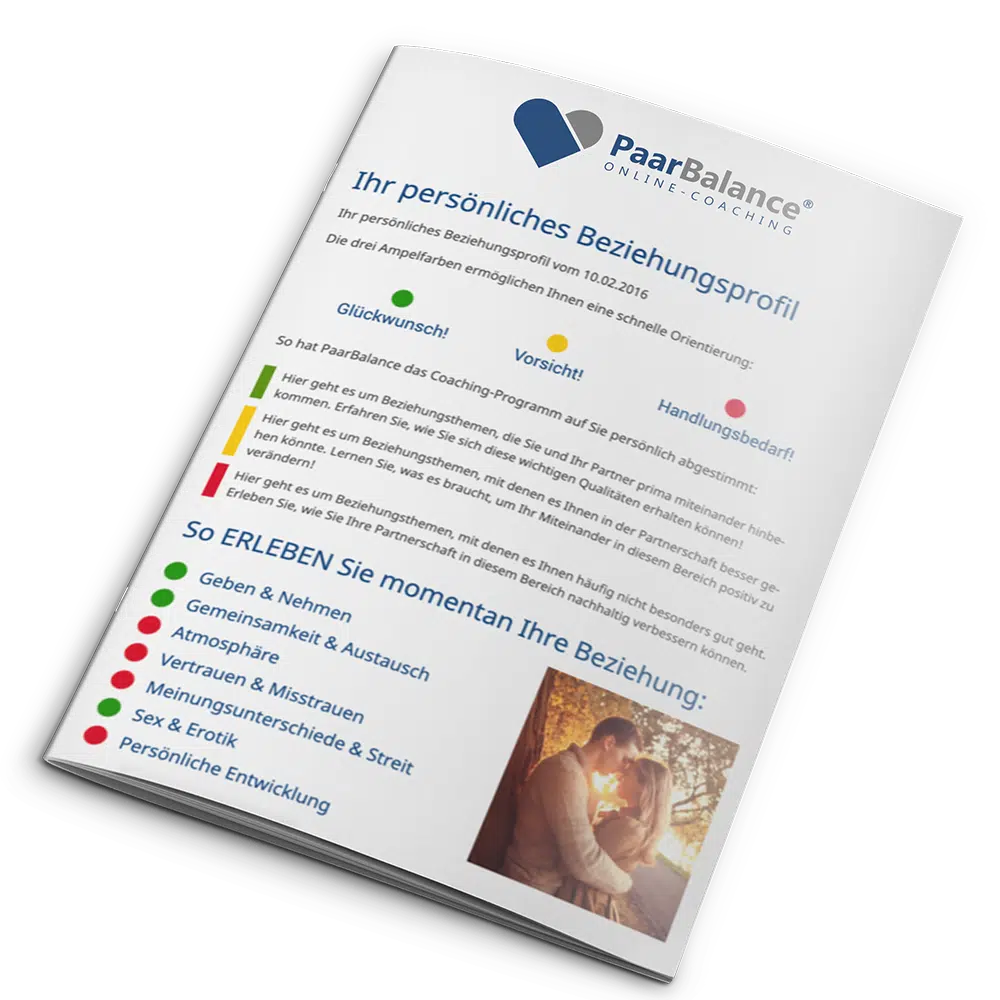
You will find out immediately afterwards in your personal PaarBalance relationship profile (free).
Start your relationship test now!
✓ Scientifically sound
✓ Includes detailed analysis
✓ Your data will not be shared
✓ 100% free & non-binding
100% secure. We comply with data protection regulations. Registration for the relationship test is free .
Please read this important information beforehand:
Data Protection ᐧ Terms and Conditions ᐧ General Information Agreement Terms and Conditions . Transparency Statement
Opportunities and limitations of AI in couples counseling
Artificial intelligence can be a valuable first step – especially for people who haven't dared to talk about their relationship problems before. Access is low-threshold, anonymous, and available at any time. And in many cases, a well-programmed AI coach actually provides helpful suggestions.
But this is precisely where the limitations lie: AI cannot replace relational experience. It can listen – but not feel. It can articulate – but not resonate. And it can advise – but not truly accompany. AI-supported services cannot replace traditional therapy because they lack the depth of the therapeutic relationship and the empathetic support of a human being.
Another critical point concerns data security : Anyone sharing personal conflicts with an AI should know where this information goes. Not every platform offers the transparency that such a sensitive area as a romantic relationship deserves.
In short: AI can help get started with relationship work – but when it comes to really developing as a couple, more than a chat interface is needed.
Conclusion: AI as a good starting point – real change requires depth
Artificial intelligence in couples therapy is more than a trend – it reflects the need many people have for immediate help, guidance, and structure. In acute situations, an AI coach can provide calm, offer suggestions, and encourage self-reflection.
But: Real change happens where people look deeper . Where they recognize patterns, try new paths, and develop genuine relationship skills.
So, if you feel that your relationship "can't continue like this," then an AI tool can be an important first step. But to experience real, lasting change, you need systematic, step-by-step support – with depth, structure, and psychological expertise.
Couple Balance as an alternative to couple therapy with AI
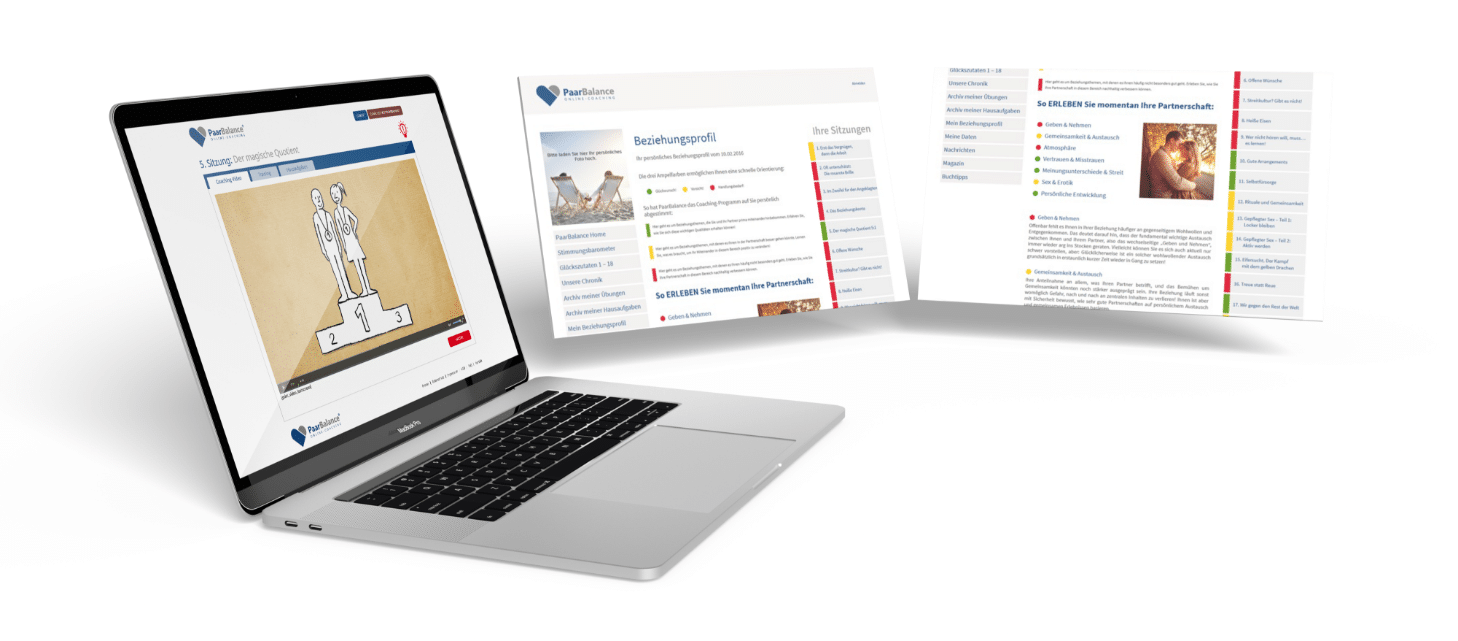
PaarBalance is not an AI chat – and that's quite deliberate. Because our goal from the beginning was:
To guide people step by step, using the findings from couple therapy research, to better understand their own thought and behavior patterns and to change them so that they feel more satisfied and secure in their relationship.
At PaarBalance, the transformation begins with a comprehensive relationship test that gives you a clear picture of your current relationship dynamics – individual and scientifically based.
Building on this, you will be guided through a clearly structured process in 18 compact online sessions:
🧩 You recognize your patterns.
🛠️ You will learn specific tools.
🤝 You can initiate change directly – even if your partner is not (yet) participating.
An AI component is also planned for PaarBalance – to offer you even more comprehensive support in the future. But even today, PaarBalance is more than just a chat – it's a real, always-available "relationship coach on the go" for your everyday relationship.
Related articles on the topic of "Couple therapy with AI"
Frequently Asked Questions
Can artificial intelligence help with relationship problems?
Yes – AI-powered tools like ChatGPT or specialized relationship chatbots can help organize your thoughts and gain new perspectives. However, they don't replace in-depth therapeutic support, but rather offer initial impulses and guidance.
What is the difference between an AI and an online coaching program?
AI typically works purely text-based, reacting to input and providing situational answers. A well-founded online relationship coaching program like PaarBalance offers structured content and guides you step-by-step through a process of change. It begins with a comprehensive analysis of your current situation using the scientifically validated PaarBalance relationship test and the creation of an individual relationship profile.
Is couples therapy with AI safe?
It depends on the provider. Good tools provide transparent information about data protection. Nevertheless, you should always carefully check how your data is handled, especially when dealing with sensitive topics. Programs like PaarBalance prioritize the highest level of data security.
Are there any free relationship analysis services available?
Yes. At PaarBalance, you can take a scientifically based relationship test free of charge . It reveals the state of your partnership – anonymously and discreetly. This gives you a valuable assessment before you decide on the right coaching or therapy for you.
For whom is AI suitable in couples counseling?
AI tools are particularly suitable for:
- People who are hesitant to speak directly to a therapist
- Couples with minor communication problems
- Individuals who wish to reflect on their relationship
Those who want to resolve deeper conflicts in the long term or prevent an impending separation are better advised to use a professional coaching program or genuine couples counseling .